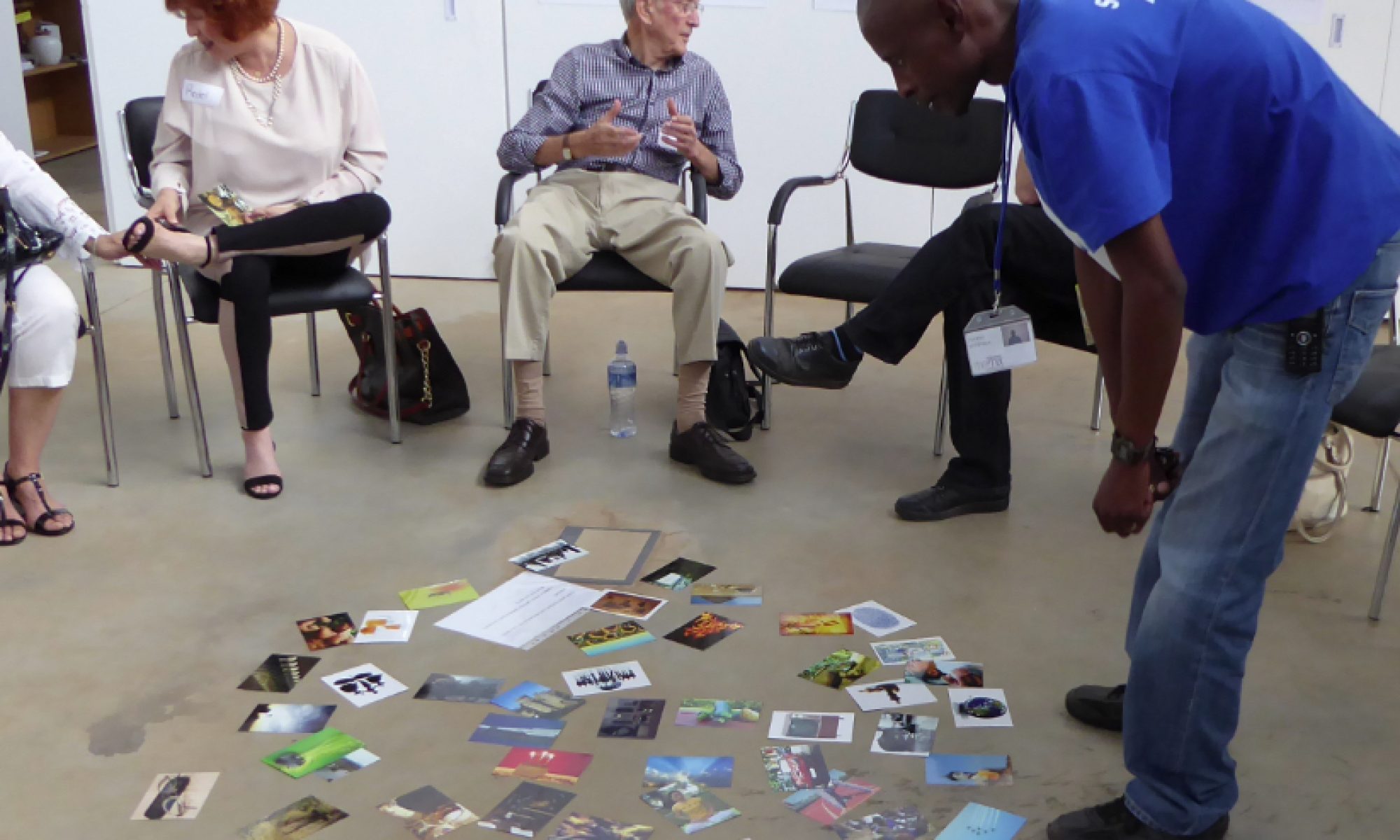
Story Class 2.1: Stories for transformation

The Princess of the African Savannah

Retold from the original by Emily Bornoff. LAPA Publishers, 2010.

Once upon a time in the African Savannah there was a princess who was as beautiful as the landscape. Her eyes shone like the night stars, her hair was curly as the thorn trees and her skin as dark as the soil. She was beautiful, happy and friendly. Her father was a good king.

One day a prince came from a faraway country. He was handsome, young and courageous. The king invited him into his home. Soon the prince and the princess grew very fond of each other. The people who like to sing and dance and tell stories around the fires at night nudged each other saying: One day those two will reign over us together…

Then winter came and with winter came the dry season. The prince became restless and frustrated: I cant stand the dust and the dry grass. Out there are many lands waiting for me to discover them, I must leave.

Oh, how I would love to come with you,said the princess, but my place is with my people. We know that the dry season will pass and the rain will come again in summer.

I must leave, said the prince, but I will return with the summer rain.

And I will wait for you….

She waited all winter and the next summer, but he did not return. She waited another winter and a summer and yet another. Still he did not come back.

One day an eagle came and sat on her shoulder.

Why are you sad, princess?

My prince has not returned. Please go search for him and when you find him, remind him that I am still waiting.

The eagle searched far and wide and when he was about to give up, he found the prince in a mountainous country by the sea. The prince was still young, courageous and handsome, but also had an embarrassed look about him.

When the eagle told him who he was, he dropped his head and said:

I made promises that I did not know I would not be able to keep. I was foolish and did not know I would find this beautiful land where my heart wants to stay forever. Please tell the princess I am sorry.’

The eagle returned to find the princess just like he left her, waiting.

When he told her what the prince had said, she grew very angry: You are a lying and deceitful bird. You were too lazy to do as I asked, and now you are making up stories! Go away and never return!

The princess waited three more turns of the season and then she realised that the eagle had spoken the truth. And then she began to weep.

She wept without restraint. Her father tried to cheer her up with beads and new clothes. The people tried by singing songs and telling stories. Still the princess wept.

Soon the tears formed a puddle by her feet. The puddle became a stream, the stream turned into a river and the river transformed the landscape into a wet land.

With the water came the fish and then the water birds. Soon large game came like the hippo and the crocodile.

Still the princess wept.

The people built canoes and began to fish in the water. They cut the reads and started to make baskets. They hunted the large game that came to drink. Mothers washed clothes and children played in the water.

One day the eagle returned and sat down near the princess. When she saw him, she asked: Why did you come back after I was so rude to you?

Shhhhhe replied, just look up and see what your tears have created!

The princess looked up and saw the people working and playing. She saw the landscape that had changed and said: I want to go out in a canoe with my father.

When she saw all there was to see, she realised that, although the land was very different from what she remembered, it was just as beautiful.

While the princess was always beautiful and friendly, over time her happiness too returned. But she was now also wise. When her father passed away some time thereafter she could be a worthy leader for her people. It was well with them and their land.

I chose this story for this story course because of its long twilight zones. A twilight zone is an in between place where it is neither day or night, where a hero wavers on a threshold betwixt and between.

Every story has two such twilight zones: one between the beginning and the middle of the story and one between the middle and the ending. The first shows the hero wavering before she accepts the Call to Adventure. The second sees her wavering between her old way of doing and accepting the new truth that the journey is teaching her.

Our princess’s first twilight zone starts when the winter first came, but it continues for the whole time that she waits for the prince, not accepting his departure. Her second twilight zone begins as her father and her people give up on her and continue with their lives in the new landscape her tears created. It ends as she finally looks up as prompted by the eagle, and decides to go out in a canoe with her father.

The transformational power of stories are locked up in how we handle our own twilight zones and how we support others through theirs.

Join the rest of the story class to learn how to harness the transformational power of story.

Tuesdays 19:30 to 21:00, from 8 Feb for 8 weeks at 6 Neetling str in Stellenbosch. Next week is the last of 2 free sessions for you to check out if you like it or not. If you missed the first one, please come 15 minutes earlier on the 15th.

I can’t wait to take you further on this adventure!

Petro

Improvisation class 1 Gifts, Acceptance and Gratitude


Last night another group of brave souls embarked on their journey into the “spur of the moment” …the magical world of Improvisation – a world filled with mystery, secure uncertainty and spontaneity. The class got under way with a game called “the story of my name”. In this exercise everyone is afforded a chance to tell the story behind their name. This game introduced some fundamental principles of improvisation , namely 1. ) listening and 2.) Creating a story without planning.

This was followed by a name game in which you have to say someone else’s name in the circle and walk towards them, the named person must then say someone else’s name and walk towards them before the first person reaches them. When people play this game for the first time they are often anxious about making a mistake. This anxiety usually results in a perceived failure. Our fear for failure is often what causes us to fail. In improvisation we do away with failures and mistakes. They simply seize to exist in our world. Everything that happens is seen as an offer that can be used. This is encapsulated in the phrase “make your partner look good”.

To elaborate on this improvisation fundamental we played a game called “Circus Bow”. In the game every participant gets a chance to make a large bow and say anything in the line of “I failed” or “I made a mistake”. The rest of the group then gives a big round of applause…as though this failure was a beautifully constructed success.

For the next exercise everyone paired up with another participant and counted to 3, each time alternating who counts next. After a while the number one is replaced with a sound. Then 2 is replaced with a move and 3 is replaced with a word. After the game Mayah commented that what made it difficult was that you have to listen and remember to speak at the same time. That is very true about improvisation. In improvisation you always need to balance opposites – listening and speaking, being aware of yourself and being aware of others, taking control and giving up control. The only way to do this is by being present and doing whatever is required in the particular moment.

The next exercise called “mirror mirror” built on this idea. Participants paired up again. One participant moved while the other participant mirrored every movement. Then they switch. Whoever was leading now follows and vice versa and in the third round both lead and follow at the same time. The aim of the game is to move exactly at the same time – in sync. The only way to do this is if you are really focused on the other person and aware of yourself at the same time. Pierre also mentioned that you need to be very playful about it. The best part of this exercise is when you don’t know who is leading. It’s as if you are both thinking exactly the same thing. In improvisation we call this a group mind.

The next improvisation fundamental was accepting offers and building on them. In improvisation this is described by the phrase “yes and”. It means that any offer that is presented is accepted and built on. The opposite of this is called “blocking”. The phrase we often use in life to block other peoples’ offers is “yes but”. To practice “yes and” everyone paired up with someone else and planned a vacation. In the first round all had to respond to their partner’s idea with a sentence that started with “yes but” and a reason why the suggestion wasn’t a good idea and then give another idea. After that everyone had the same task but instead of starting the sentence with “yes but”, the participants had to start their sentences with “yes and” – accepting the other player’s idea and building on it. When you accept you bond with your partner, you create wonderful new ideas and you build positive energy. When you block, you get frustrated, nothing creative results and you build negative energy. Why is it that we more often block than except in life? Some reasons that came out of the group are: ego, fear and laziness.

The last game for the evening was “Yes lets!” In this game any one can make a suggestion like “Lets read a book” or “Let’s sit on a pyramid and howl at the moon”. The others then respond very excitedly with the words “Yes lets!” and mime doing what was suggested with enthusiasm. It’s amazing how much fun this game is if you really commit to it. It is not very often that people accept our ideas with so much enthusiasm and not just say they support it but also do it right away. Antoinette made a comment about what a huge gift it is to have your ideas accepted like that. So this game was like a big Christmas party, everyone just showering each other with gifts. This is absolutely the spirit of improvisation – giving, accepting and gratitude. What a great way to end our first class. Thank you for everyone’s participation and I’m really looking forward to next week.

The Last Straw – Setting Goals that change your life

What do you want in 2011?

At the start of a new year many people feel that call to go on an adventure to change something that had been waiting for a long time. This is the year I will start studying part time, lose that wait, write that book or even find Mr Right, make more money, get my own house…

This article will help you clarify that dream so that you can turn it into reality starting right now. Many people are content with just dreaming knowing it will never happen, but some of us are so tired of being where we are that we are willing to do something out of our comfort zones.

A Great Goal  is a visionary goal, one that is very specific, but may seem unrealistic and even impossible. Yet it creates a sense of urgency and pull like finding a treasure map in a bottle. It makes you want to start working on the change immediately and from the moment you discovered the promise of treasure something in the way you see your life has shifted. In other words it impacts the present moment.

Step one of your Present Success Story is to Get a Great Goal

Great Goals vs. Smart Goals

Most coaches will tell you that no success is possible without a smart goal. A SMART goal is Specific, Measurable, Actionable, Realistic and Time-oriented.

In 2008 when my second son was reaching his one year milestone, I got sick of being overweight. I set a SMART goal to get my own familiar body back. I would lose 8 kg’s by the 30th of April, my baby boy’s birthday, also the month we would be moving from Pietermaritzburg to Stellenbosch and start a new chapter in our lives.

Did I lose the weight with this goal? Well, yes and no. It is always more complicated in real life, isn’t it? I lost 6 kg’s by the deadline, but once we moved I gained most of it back due to a bitterly cold winter and the stress of the new life. It was not so realistic after all. It took me another 2 and a half years to get where I wanted to be, but I had to change my Smart Goal into a Great goal to do it.

Un like smart goals great goals take story and context into account.

Great  goals differ from Smart goals in 4 aspects: They are not actionable, not realistic and not time-oriented and they take story into account. They do not have the ART of SMART, but they are much more arty – much more creative..

Great Goals are not SMART.

When Shrek set off to get his swamp back, he did not know how or when he would get it done. When Cinderella started to dream about going to the ball her case seemed hopeless.. Even worse, when Little Red set off through the woods, she thought it was going to be easy…

A great goal for the beginning of your present success story needs to be

  1. Specific and measurable: so you can know what the focus of your action should be right now, but
  2. Not Actionable: you do not have to know how to do it and may very well need luck and a little magic to get it done
  3. Not Realistic: you need to think out the box and get out of your comfort zone so you must challenge what you think is possible
  4. Not Time oriented in the future: You cannot always know how long something will take, but your goal must impact your present moment and your actions right now.

Because Great Goals are context bound it also needs to be

5. Set off by a last straw experience. A story always starts with someone in a situation that has become intolerable

A Great Goal is inspired by the last straw

A Goal only becomes Great when it is infused by the energy of someone having reached a point of no return. You can toy with the idea of losing weight for years before something happens and you are ready to say: that’s it, no more.  The goal summarises a dream that you no longer want to put off.

Sometimes this is caused by a tragedy or life changing event, but you can also elect to make the change before tragedy strikes. Why wait to get lung cancer before you stop smoking? A good excuse for choosing to do something you have wanted for a long time is the start of a new year. What unfulfilled dream can you tackle this year without having to wait for the next crisis?

Start your new year by setting a Great Goal.

By following the 6 steps of a Present Success Story, you can set the ball rolling to make the change you know is needed. To help you remember all 6 steps I use the sentence: Get More Personal Success Authentically Today. The first letter of every word corresponds with the step relating to that letter. We start with the letter G: Get a Great Goal.

Note: Smart goals also have a very important role to play, but only around stage 5 as you get to know yourself and your adversaries.

If you want to get an overview of each stage over the next 10 weeks email me at petro@playingmantis.net

My own present success story for 2011: A Million a month to share

The personal success story I am working on presently is to change my finances around. My goal: To make a million a month to share. This is a shared goal between my husband Gerhi and myself.

I have no idea how or when to make this happen, but that is because I do not understand money well enough to make the sums and plan my strategy. But I am setting the goal precisely to inspire me to find out how money works, how business works and how to think about both. IT is a journey I am only just embarking on because I have reach my point of no return regarding two things: 1. Never having enough to be free of worry and running a business blindly with too little financial understanding. If you want to follow my story go to www.PetroJansevanVuuren.com.

If you want to get an overview of each stage over the next 10 weeks email me at petro@playingmantis.net

Come to one of our Present Success Story workshops

Improvisation and Learning: A neuropsychological viewpoint

by Manuela Glasbrenner

Brain
I recently attended one of the Playing Mantis workshops held by Burgert. The concept of improvisation being applied as a tool for learning was totally new to me and I was very curious to see what it was all about.
The workshop was a great success in my opinion. A fresh approach to the practice of personal and team development: Joyful and exciting, but at the same time instructive. The exercises were simple in their execution, yet led directly to reflections and revealed some rather surprising insights. As a psychologist I believed that I already knew quite a bit about some of the topics and ideas touched upon by the workshop. Amazingly, afterwards I found myself continuously reflecting on these exercises and the new thoughts they brought up, even to this day.
This led me to ponder some questions with regards to the underlying neuropsychological processes of learning. What happens in our brain that makes us learn so easily in an improvisational setting and why does it bring about such an outstanding effect? To understand this, I would like to shortly outline some facts about learning as well as some of the findings of current research.


What is learning?

If we talk about learning, we usually refer to the act, process or experience of gaining knowledge or skill. Psychologists often define it as acquiring of modifying patterns of behaviour or cognition, usually after practicing or experiencing something.


How do we learn?

Firstly, we need to know that our brains will experience lifelong physical diversification and development as a result of learning.
A human brain contains about 120 billion neurons (nerve cells) that are interconnected three-dimensionally. One neuron can have a few thousand connections, which means that we command a dense network with a fibre length of about 400 000 kilometers. Every piece of information reaching our brain will be transformed and decoded into electronic patterns. Neurons pass this information to other neurons, to muscles or to gland cells. This information transfer can be optimized through an expansion and modification of the existing network: Learning materializes through changes at the synaptic clefts between neurons or through the creation of new neural conjunctions. At the same time, every process of learning provides a basis for the continuation of learning in the future. In other words, every new connection becomes a stepping stone for further development beyond what has just been learned. The opposite effect takes place as well: Connections which are not being used anymore become degraded. This is for example what happens when we “forget”, which means, we lose access to the knowledge that was saved in the brain. Learning therefore shapes the individual micro-structures of our brains, neuro-scientists call this “plasticity”.

Improvisation and learning

These above mentioned learning processes take place throughout our whole lives, and the brain changes according to its usage. The question then to raise here is: How can we optimize these processes? What can neuroscience tell us about optimal learning and where do improvisational learning techniques fit into these findings?

1. Improvisation exercises are fun

One of the most significant memories of the improvisation workshop for me, is that it was a lot of fun. Even if Burgert’s description of the upcoming tasks may have sounded weird at first, I got the impression that everybody enjoyed them once they began, leading to many smiles and laughter in the group. What does this tell us about their effects?
Emotions play an essential role in learning and neuroscience helps us to understand why this is the case: There are some areas in the brain which are particularly involved in learning and memory. This is the so called “Limbic System”, which consists of the Hippocampus and the Amygdala in the medial temporal lobes, the basal fore brain as well as the prefrontal cortex and areas of the brain stem.
These structures serve as a kind of operational centre: The Limbic System executes the emotional evaluation and selection of incoming information. It can be seen as a filter, which any information has to pass before it can be further processed and encoded. Emotionally coloured contents, which are perceived as relevant and important to ourselves, pass this filter more easily and will receive preferential treatment during further processing in the brain. This means that they will be encoded more quickly, firmly and deeply. The ability to remember is in the same way strongly dependent on the emotional content of the learning material, as well as on the personal concern, mood and involvement during the learning process.
Emotions are of great importance for learning processes because they allow the personal identification with everything that has to be learned. If we therefore manage to combine a learning experience with positive emotions by means of making it enjoyable, we can be sure that its content will be memorized for a long time. This means that the playfulness that Playing Mantis incorporate into their improvisation techniques, strongly increases their effectiveness.

2. Improvisation exercises induce creativity

The exercises we did in the workshop contained guidelines, but often demanded from the participants to develop ideas, movements and stories for themselves. There was never a sheet of paper or model we were supposed to comprehend and memorize, and the outcome was open to our personal explanation and interpretation. This kind of framework leads to creative learning.
Human creativity is a specific kind of thinking or cognitive process, because it involves making new mental connections rather than analyzing or commenting on existing ones. On the neural level, this commensurates with the build up of novel neural pathways or the reconnection of previously disconnected ones. An FMRI-study, conducted at a university in Bristol in 2005 by Paul Howard-Jones and colleagues, aimed to identify those areas of the brain associated with making up a story creatively. Tasks involving story telling will usually result in increased activity in the left side of the brain, which is associated with language processing. This study however, found that those participants who solved the task creatively, showed an increase in activity in certain prefrontal areas of both hemispheres of the brain.
These results suggest that parts of the right hemisphere are required for creative thinking. An explanation for this, is that creative thinking demands higher cognitive effort: We have to access different areas in the brain and combine the relevant information into a new, creative solution. The additional effort required might have been needed to access contextual memory that was necessary to learn a new insight. This memory might have become inaccessible and eventually even forgotten otherwise.
Self-derived, creative solutions therefore generate a type of learning which manifests across the brain and is thus more successful, while being told what to do merely generates temporary, superficial knowledge.
Additionally, it has been shown that the kind of “Aha! experiences” we get through our own efforts, also activate the brain’s reward system and thus improve learning as explained in the last chapter about emotions.

3. Improvisation exercises encompass comprehensive demands and information

If we talk about the attainment of “knowledge”, we do not only think about cognitive structures, but also include behavioral patterns, which contain diverse impressions. The concepts and behaviours that participants of these workshops are supposed to gain, should also be applicable in complex and dynamic real-life situations.
Playful, spontaneous and practical exercises like improvisation techniques fulfill these requirements and challenge a person in real-time, involving all his senses. Again, this fact promotes successful learning based on neurological principles:
Our brain doesn’t have direct access to the world in order to gain knowledge. Sensory cells will transform every incoming piece of information into signal patterns which will then be distributed to different brain centers, according to their qualities. For example, impressions concerning movement will be processed in other areas than input about the properties of materials or sounds and language. These signals turn into information and obtain meaning only through their concurrent processing in these different brain regions. In the same way, knowledge is not being stored and retained as a whole. When we memorize something, our brain uses particularly notable pieces of information, which are then recombined into one impression.
Therefore, the most successful learning methods are those that cultivate the ability of the brain to link and build networks. Ideally they should stimulate all the senses and activate multimodal skills to thus challenge the brain in different aspects and vice versa enable it to activate the attained knowledge through various triggers. Multi-faceted activities advance the development of the brain throughout a person’s lifetime. Therefore it is playful activities, not passive, uninvolved parroting of knowledge that leads to physical changes of the brain and hence to enduring, applicable learning.

What do we learn from this?

In a nutshell, improvisation can be seen as a distinct type of dynamic, experiential learning, which promotes creative problem solving and innovation through processes that correspond with the operating principles of our brain.
But without trying it out, this knowledge might be of little use 🙂

__________________________

Howard-Jones, P.A., Blakemore, S.-J., Samuel, E. A., Summers, I. R., Claxton, G. (2005). Semantic divergence and creative story generation: An fMRI investigation. Cognitive Brain Research, 25, 240 – 250.

Creative Play for Growing Parents and kids – Part 1

Three games and three good reasons to play

How important is it to play with your kids? What sort of games should you play? How much and when do you play?

I presented a 1 hour workshop around these questions   in December last year at Uitkyk Wine estate for about 40 parents and kids. For 30 minutes we all played together, and then the kids went to play freely at the newly installed jungle gym while I chatted to parents on the importance and difficulties of playing with your kids.

This article will review 3 active games you can play with your kids from age 1 to 11. Each game is used to illustrate a different reason for playing. In a next article I will share with you 3 main obstacles that block our efforts to play with our kids.

1. Ring a rosies – surviving twilight

Ring a rosies
This game was invented during the time of the black plague. Game playing in times of twilight helps us deal with the pain and uncertainty. Illness is a typical twilight zone where you do not know if you will die or live, whether your loved ones will make it or not. A game helps us to gain distance from the discomfort and reflect on it in a way that helps us gain a certain measure of control.

The best time for playing games like this with your kids is the first 10 minutes when you are home from work just before you start cooking or doing other stuff. Or maybe while you are waiting for someone to arrive or something to happen and you have 10 minutes to kill. A small amount of time in the right place will distress a whole evening or afternoon.

I know it is really hard to switch off your to do lists and your chores in order to play a little – really hard. I struggle myself sometimes. Allow your kids to drag you from your head space into the present moment and you will also distress a little. I keep having to learn this lesson myself over and and over again.

Another big twilight zone for your child is bedtime. The looming darkness of the night can be terrifying. Playing a game or reading a story in this time will be of great comfort for your child.

2. Pigs and wolves – knowing who to be and who not to be

Pigs and wolvesThis game is an invention of my own that helps kids and adults deal with conflicting roles. One person out of 4 or 5 is wolf, the other are pigs. The wolf tries to catch a pig and when he does, he turns into a pig and the pig takes on the wolf role.

Working from home not knowing if you are a house husband or a business man, needing to be a lover and a life partner not knowing when to be the lover and when to be the wife, or home schooling not knowing when to be a teacher and when to be a parent are all examples of the kinds of role related twilight zones we find ourselves in. I know these twilight zones myself so well and had to come up with a game to help me and my family through the stresses of balancing opposites within us.

Not to mention our kids. They want to do it themselves and get help at the same time, they want to be a big boy and still be the baby, they want to be the only child and have a sister.

Playing a game where you can experiment with opposing roles like being the victim or the perpetrator, the weak one or the strong one helps you to know who to be and who not to be so that you can keep the best aspects of both roles alive in yourself. This skill helps older kids make peace with new siblings, or teenagers be themselves in the midst of peer pressure and helps employees stand up to their superiors when their values are offended.

For you it will help to reconcile that feeling of wanting to eat your children and wanting to run away and hide from them at once. It will help you find new avenues for protecting them and letting them take risks at the same time.  All thanks to a simple game of pigs and wolf.

3. Hide and seek – Believing in the good

Hide and SeekPeek-a-boo is the simplest form of hide and seek and can be played with infants from as early as 6 months. Later as kid’s turn 9 and 10 they start adding intricate rules to complicate the game. Yet, the principle stays the same: if I get myself into a dark lonely place, someone will look for me and find me.

If you play hide and seek with your kids, you build the trust in them that they will be found even if they got themselves into a lost state. This is also true of reading stories at bed time: the princess that goes to sleep for 100 years, or chokes and ends up in a glass casket and is woken by a prince. The warrior that goes into the dark forest to sleigh the giant or the dragon and comes out victorious. All these stories build your child’s belief that he will wake up on the other side of the dark night. Later in life she will still hold on that core belief that there is light at the other end of darkness.

Now remember this when next you feel lost in a dark place and go easy on yourself. Be kind to the kid in you that just wants to be found and take heart: Daddy’s coming.

Active dramatic games and stories are essential for helping both you and your child:

  1. Deal with uncertainty and twilight
  2. Discover who they want to be and who they do not want to be
  3. Retain a sense of hope and confidence in life.

Look out for the next article on this subject dealing with the things that interfere with our playing.

If you want to take part in our next Family Fun Workshop, simply email me at petro@playingmantis.net.

If you want to receive a news letter with this and other information, please click here to add your name to the mailing list, and we can let you know.

Story Class 1.8 – And they lived happily ever after?

I have a deep sense of gratitude for all of you who took part in the story course. Your commitment and generosity of spirit is overwhelming. You were able to grasp the ethic of collaborative creative work and really make the process your own. Thank you for trusting me as facilitator and the process.

Last night I talked for almost 2 hours on Skype with a Spanish PhD student who interviewed me for her thesis on using the ‘symbolic frame’ for creating lasting transformation in people. I told her about our process and some of the shifts we had noticed. She asked me how I know that these shifts are lasting and did not just occur on a superficial cognitive level.

How lasting is the happy ever after?

I had my own ideas about this, but I thought I would give it back to you and allow you yourselves to comment on the short term benefits you experienced during the course as well as the lasting value it has for you. Feel free to comment on how lasting you think the shifts are. What does ‘happy ever after’ mean to you in this sense?

Your comments will be invaluable for everyone interested in trying out one of our story workshops as well as for me to somehow capture the impact of the work.

Thank you for taking the time to reflect and share your thoughts, I am looking forward to your comments.

Story Class 1.7 – The gentle breezes of dawn and dusk

The gentle breezes of dawn and dusk…
have secrets to tell
Don’t go back to sleep…

You must ask for what you truly want…
Don’t go back to sleep…

People are passing …back and forth
Across the threshold,
where the two worlds meet…
Don’t go back to sleep…

The door is big and round…
Don’t go back to sleep!

–          Rumi

Thank you Margaret for this lovely quote! I will use it more often. It is so apt.

Thank you to the rest of you for a most memorable story evening. The kind of un structured improvisation I used last night is one of the most difficult things to master and all of you did extremely well. Although some of you were out of your depth at times, you allowed the story and the other characters to carry you until you were able to contribute again. I was most amazed.

Who knew Friar Charles would sacrifice himself for the triplets?

Who knew old Bluh could be a baby minder?

Who knew Lady Ishtar could let her betrothed be with the women he truly loved?

Or that Ereshkigar was so ravenous as to lose herself in the face of nourishment – she who seemed to have it all?

As promised, here are the template points for the last stage of the journey: The Return with the elixir:

The last stage of the journey starts with the hero’s resolve to cross the threshold back to her own world, although sometimes she is chased across it. Often she experiences setbacks on her return which threaten to rekindle the flaw, addiction or desire that she had supposedly overcome in the ordeal.

V. The Return: Transforming Your World  
The Road Back.   Hero rededicates to change. Harmony can only be achieved by working through the underlying reason for the crisis Finally…(hero returns)
Resurrection Hero makes a final attempt at difficult change. Old behaviour is released and new behaviour is internalized. Now every day/from that day on…(a new state of normality is reached)
Return with the Elixir. At last the hero masters the problem. Communitas (sense of togetherness and unity) and new meaning is attained. At last…(hero is healed and with her the community)

The lesson learned in the ordeal will be put to the final test as the hero faces death and Resurrection.  The hero must provide external proof of the change in her character by her behaviour or appearance.  It is one thing to learn something of oneself in the Special World; it is another to apply that knowledge back home in the ordinary world.  This is like Ishtar allowing Tamuz and Evelyn to raise their children together and giving up her betrothal.

Having provided proof of growth, the hero may now Return with the Elixir, the item or the wisdom that can heal her wound and perhaps that of her world.  The story may end neatly with all loose ends tied or it may have an open ending.  Either way the hero gives her world and/or the audience a new perspective. Clearly the triplets are the Elixir of our story.

The above is an excerpt from an article I wrote on story structure and you can use it for the completion of your story for next week.

Just remember the golden rule: the template is just a way into the story, but once the story flows it leads the way, not the template. Always trust the spontaneous flow over the analytical temptation of the template.

Also, as you complete your story, remember that different characters may have experienced certain moments of their journeys in different places in relation to the others. This is art, not science – let the gentle breezes of dawn and dusk lead you.

Next week I would like to spend some time looking at your personal story.  How will your story end? Will your story carry beyond the boundaries of your life to the lives of others?

Story class 1.6 – Why Acting creates the shift that thinking can’t

There comes a point in everyone’s story, fictional or real, where a shift in perspective is crucial for successful transformation. In real life people look for this shift by reading, attending seminars, talking to their friends and mentors, going to church and googling for info on the net. Yet all the info and talk and thinking in the world do not bring them to the point of making that internal behavioural shift – that moment that causes them never to be the same again.

Then that same person goes on holiday, or has to deal with the death of a loved one, or a wedding, or they play a game of soccer with friends or they go for a hike in nature, or they create a piece of art, or join a dance class or just have a great meal with friends and suddenly old things have a new colour.

All these are examples of experiences that bring change: experiential learning. Typically they have the following 4 aspects in common:

1. A change of scenery/setting
2. Involvement of the body i.e. movement
3. Emotional connection i.e. a heart response and
4. The presence of others – including the presence of nature or the creative muse

I went to my kinesiologist 2 months ago with a most debilitating pain in my back. She says to me: you think and struggle too much in your head and do not move enough in your body. She prescribed a half hour of walking twice a week so that my mental struggles can come into perspective and move from my head into my body.

This advice was one of the reasons that prompted me to start the story class because I knew I did not have enough work that allowed me to move – too many ideas in my head and not enough physical outlet for them. Of course acting out stories adds people, a change of scenery and the emotional connection, creating the ideal opportunity for gut level shifts to occur.

Although these shifts can happen to anyone at any time, there is a particular moment in a story designed for it. A place in the story where it is most likely to occur because of all the story stages that preceded it. This moment is typically two thirds into the story just before act three. Some writers refer to it as the pause before the climax, that calm before the storm. It is the moment when the hero seems to have lost and the journey seems to be a failure, then something happens that allows him/her to see the bigger picture and the greater good.

This is the moment where Shrek in the first movie realises it is no longer about getting his swamp back, but it is now about getting his love back. It is where Brave Heart realises it is no longer just about his family, but about is entire tribe. It is the moment where the facilitator realises it is not about the plan and the timeline, but about commitment to a group and including all the voices of the participant. It is also the moment when the travellers in the Underworld enter into the court of Ereshkigal, Queen of the Underworld.

Last week’s class was all about Stage 4 of the journey: The Ordeal. The conversation we had about how to deal with absence in the group evoked the distinctive kind of energy that is characteristic of the Ordeal. When we therefore stood up from the table and began to:

1. Change the scenery from this world into story world, then from the upper world of Bellashréne to the Underworld
2. Move our bodies to create images of protagonist, antagonist, contagonist and guide
3. Engage our emotions in response to the story and
4. Work collaboratively with one another,

I could see each character making the shift we are talking about and transforming to a higher level of consciousness.

I saw Fai Lilly stretched to breaking point trying to see into the Underworld and then letting it go, finding her peace in the Upper World.

I saw Friar Charles full of fear trying to protect and fend off threats finally surrendering to the powers of the Underworld ending on the floor squealing with glee.

I saw Bluh, the lonesome outcast connecting with others and making friends.

I saw Lollie the dancer abandon her need to understand allowing the dance to penetrate not just her own body but radiate into the entire Underworld.

I saw Ishtar the Betrothed and Evelyn the Loved find friendship in each other and peace in themselves.

I also saw myself as Queen of the Underworld first lose control and then regain her dignity.

Such is the power of acting and such is the power of doing it in a story with others.

Thank you all for your undivided commitment to the journey!

What lies ahead are mere formalities: events that directly flow from these shifts:
1. Finding the Duke Tamuz
2. Paying the price for his release
3. The birth of the triplets
4. The preservation of friendships
5. The return to Bellashréne.

Looking forward!

Petro Janse van Vuuren

Personal Success Story Workshop – What’s your definition of success?

I just completed a blog post on why acting is more effective than thinking when it comes to achieving success. I realised that the very same information is as relevant to the Personal Success Workshop of the past week end as to the story class about which I was writing. So I am posting it again from the perspective of the definition of success. Or perhaps you rather just want to go straight to the notes for the Personal Success Story workshop.

When I asked participants in the Personal Success Story to form a continuum showing to what degree they are ready for transformation, most of them placed themselves close to the side that indicates they are sick of being where they are and in dire need of change.

Transformation becomes our definition of success as we embark on the success story together. Success very rarely have anything to do with external changes, but always refer to an internal shift or transformation that then has a direct effect on the outer world of the hero. The lonely Shrek in the first movie makes friends and finds true love not because someone outside of him started to care for him, but because he started to care for them. He chose to go after Fiona while still believing that she thinks he is an unlovable ogre.

There comes a point in everyone’s story, fictional or real, where a shift in perspective is crucial for successful transformation. In real life people look for this shift by reading books, attending seminars, talking to their friends and mentors, going to church and googling for info on the net. Yet all the info and talk and thinking in the world do not bring them to the point of making that internal behavioural shift – that moment that causes them never to be the same again – the moment that embodies their definition of success.

Then that same person goes on holiday, or has to deal with the death of a loved one, or a wedding, or they play a game of soccer with friends or they go for a hike in nature, or they create a piece of art, or join a dance class or just have a great meal with friends and suddenly old things have a new colour.

All these are examples of experiences that bring change: experiential learning. If transformation is your definition of success, these are the kinds of experiences you seek. Typically they have the following 4 aspects in common:

  1. A change of scenery/setting
  2. Involvement of the body i.e. movement
  3. Emotional connection i.e. a heart response and
  4. The presence of others – including the presence of nature or the creative muse

I went to my kinesiologist 2 months ago with a most debilitating pain in my back. She says to me: you think and struggle too much in your head and do not move enough in your body. She prescribed a half hour of walking twice a week so that my mental struggles can come into perspective and move from my head into my body.

Although these shifts can happen to anyone at any time, there is a particular moment in a story designed for it. A place in the story where it is most likely to occur because of all the story stages that preceded it. This moment is typically two thirds into the story just before act three. Some writers refer to it as the pause before the climax that calm before the storm. It is the moment when the hero seems to have lost and the journey seems to be a failure, then something happens that allows him/her to see the bigger picture and the greater good.

This is the moment where Shrek in the first movie realises it is no longer about getting his swamp back, but it is now about getting his love back. It is where Brave Heart realises it is no longer just about his family, but about is entire tribe.

I saw shifts occur in all the Personal Success Story workshop except for the one who was on the furthest end of the continuum regarding his need for change. This participant also happens to be Burgert, who is my business partner, and whose definition of success for this workshop would not have been personal success, but the successful completion of the workshop in creating transformation for our participants.

Congratulations to all of you who were brave enough to come to this very experiential workshop and allowed the processes to impact your lives. I trust that the experience will reveal its layers of truth for you ongoing over the next few months so that you can achieve the change that matches your definition of success.

Click her for the Personal Success Story Notes

Petro Janse van Vuuren


Power of Presence Notes

The following is an outline of my Power of Presence workshop.  It is followed with descriptions of all the exercises.

Workshop outline

Exercise descriptions:

What I need to say to be fully present….

Participants pair up. Each then has the opportunity to state what they need to say to be fully present. They express this sentiment to their partner.  They should start their sentence with “what I need to say to be fully present is….”The partner then mirrors the other persons words exactly by starting their sentence with “I hear that what you need to say to be fully present is…”  It is important that the person mirroring does not give an interpretation of what they have heard, but tries to use the exact same words as far as possible. After the person mirroring has given a satisfactory account of what was said, the roles are reversed.  The exercise is not so much about saying what you need to say to be present, more so it’s about being listened to fully without judgment.  When we listen to people like this we help them to become fully present and be in the moment.  In essence what we are doing is accepting them and showing them that they are welcome and worth being listened to.

Pattern circle

Everyone stands in a circle.  One person starts a category pattern by calling out anything, such as a color, vegetable variety, animal or car brand, and then points to another player.  That player then points to another calling out something else that falls in the same category.  This continues until the last person points back to the first person.  The same pattern is then repeated without pointing.  When the pattern is established a new pattern with a new category is created.  When the second category is also established both patterns are passed around the circle at the same time.  When the group has mastered two patterns a third is added.  Listening and being aware of the other participants  are essential to ensure that not one of the patterns are dropped.  For a fourth round tell the participants to move around and not stay in a circle.  Interestingly this exercise fails when energy is absorbed and not  passed on …ie the pattern is lost and therefore  focus is lost. Key elements to keep in mind are listening and awareness.

I failed

All participants are given a  opening to make a large curtsy(bow)  and say anything to the effect  of “I failed” or “I made a mistake”.  The other participants respond by giving them an enthusiastic round of applause.  This exercise is also called “Circus bow”, named after the bow that a trapeze artist makes after he/she missed his/her partners awaiting grasp resulting in a  fantastic improvised  summersault into the net. The performer leaps out of the net  and makes a beautiful bow, like it was exactly what was supposed to happen. A learning from this exercise  is  a feeling of release  for taking an authenticated risk and not feeling  punished for a mistake.

This is not a…

An every day object such as a rope or a frying pan is placed in the middle of the circle.  Each participant must enter the circle, pick up the object and say “this is not a rope.  This is a snake.” Or “this is a necklace” or anything else that the object could resemble.  Each participant should come up with at least 3 different things that the object could be.   People are always surprised with how many ideas they come up with.  Our minds are far more capable of creative thought than we ever imagined possible.

Mirror mirror

Everyone pairs up with another person and stand facing each other.  Each pair decide who will be A and who will be B.  A is a person looking into a mirror and B is the mirror.  B should therefore copy A’s exact movement.  The idea is not that A should try and outwit B by making sudden movements.  The idea is that they work together and move like they are one so that an observer wouldn’t be able to see who is leading and who is following.  After a few minutes they switch.  A  is therefore now the mirror and B the person looking into the mirror.  For the third round both lead and follow at the same time.  They are therefore both looking into the mirror and being the mirror simultaneously.  Now it gets really interesting.  For it to work both need to take the lead and give up the lead, give and taking control the whole time.  When you get to that point you go into a state of flow in which you no longer know who is leading and who is following.  It is in this state of flow that creativity and relationship can thrive. .

Monster talk

Participants pair up again.  This time instead of mirroring each others’ movement they mirror each other’s speech.  One starts with a question while the other is speaking with them in unison.  The other then answers the question while the one who asked the question follows his speech.  In order to help your partner keep up with your speech it helps to talk a little bit slower.   It doesn’t help to anticipate what the other is going to say.  All you can do is stay in the moment.

Yes lets!

For this exercise you need enough space for everyone to move around.  The game starts with anyone in the group making a suggestion for an action such as “Let’s climb a tree!” or “Lets bake a cake!”  Everyone then replies with the words,  “Yes lets!”, and mimes the action with enthusiasm.   At any point someone else can make a new suggestion and everyone replies again with “Yes lets!”
The best way to make your team members look good is by accepting their suggestions and doing the action with enthusiasm.   If someone said something like “Let’s roar like lions” and just did it by himself, he would look like a fool and most likely feel like one as well.  What I love about this game is that you don’t just say yes I like your idea; you actually have to accept the idea by doing something with commitment.

Make your partner look good story

Last night my wife told me a beautiful story about how a family made their mother look good by accepting an offer and doing something with it.  In this story the offer the mother made wasn’t  an idea; it was a reality that was imposed on her without her choice.  She was diagnosed with throat cancer.  In her final week her last wish was to have a meal with her family, since she loved cooking and sharing dinner with her loved ones.  She couldn’t swallow the food because of the cancer and therefore had to spit it out after chewing it.  Seeing this, her family also spat out their food after chewing.  They made her look good by accepting her reality and doing it with her.  Accepting each  other’s reality, whether it is their creativity, personality or hardship and doing something with it is how you show real acceptance and that is how you build trust in your relationships with others.

Yes and vs. Yes but

The “yes and” practice in improvisation is one of the most important.  It means you accept your partner’s idea and build on it.  This exercise illustrates the difference between when you accept an idea and when you block it.  Participants work in pairs and are instructed to plan a vacation together.  One must start by sharing an idea.  The other replies with the words “Yes but”, a reason why it is not a good idea, and then shares another contrasting idea.  The first then replies with “yes but” and so they go back and forth blocking each other’s ideas.   After a while stop them and ask them to plan the same vacation but this time instead of saying “ yes but”  they must start their sentences with “yes and”, accepting the other’s idea and building on it.

Personal Yes and

Write down on a piece of paper something that you really want to do and the reason why you can’t do it.  For example “I want to read more but I don’t have enough time, so I don’t read more.” The excuse of not having enough time is how you block yourself from not doing what you actually want to do.  So you never read more.  Take out the “but” and replace it with an “and”.  The sentence now reads as “I want to read more and I don’t have enough time so…”  Now you are unblocked.  Not having enough time is not an excuse anymore it’s just a reality that you have to accept and your mind opens up for new possibilities. So your sentence could read something like, “I want to read more and I don’t have enough time so I’ll get audio books to listen to in the car when I travel or exercise.”  By changing the “but” to an “and” you turn the reality of not having enough time from a block into opportunity for new possibilities.