Improv class 2.5 – What do you really want?

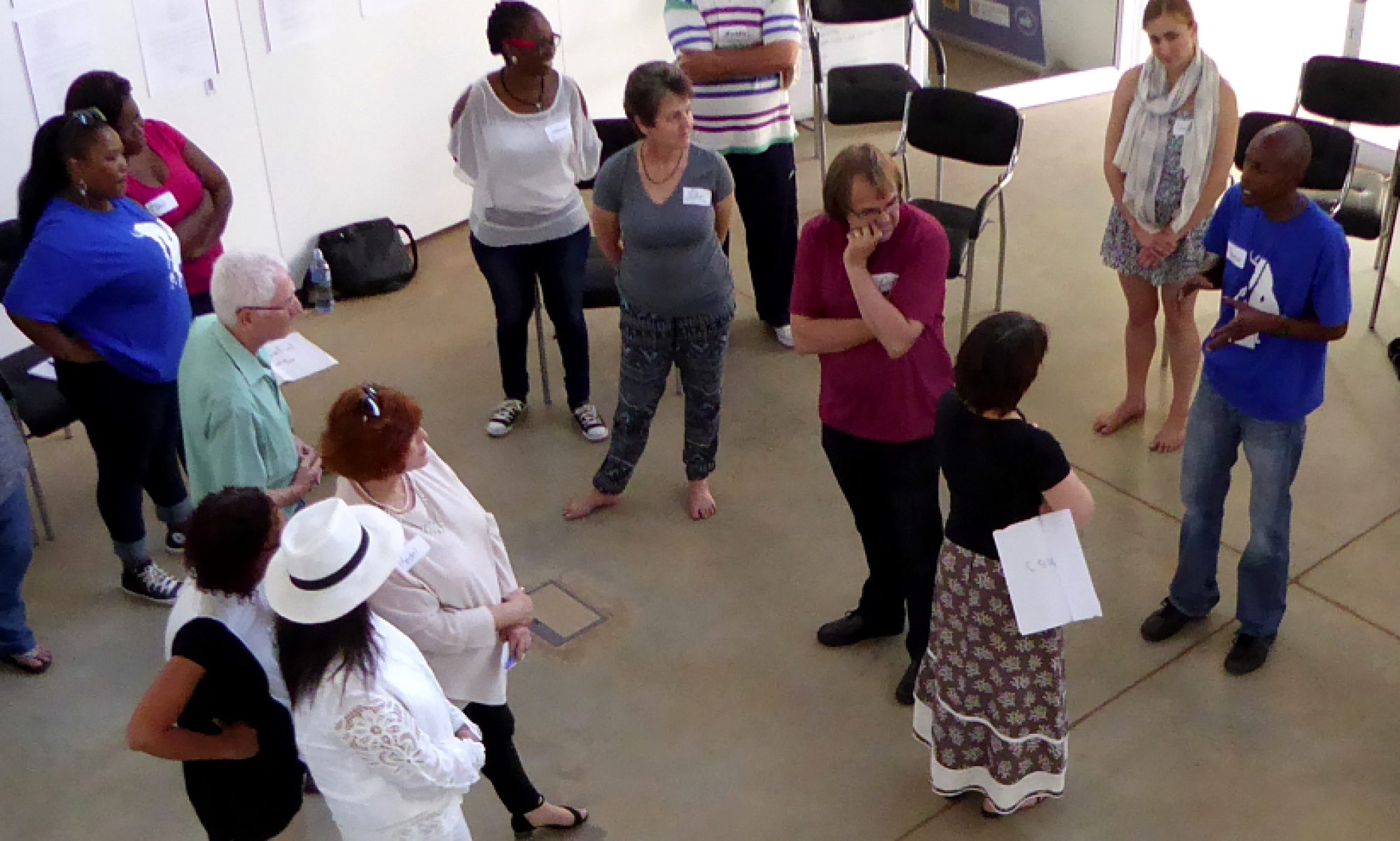
The theme of last week’s class was “what do you really want?” We started the class with a relaxation exercise followed by a warm up game called “Bunny bunny”. This game so excited me that I hurt my back. Luckily Mike had a few amateur chiropractor tricks up his sleeve. After getting all my vertebrae lined up again we did an Augusto Boal exercise called “Character walks”. In this exercise everyone walks around in the workshop space and becomes aware of their bodies. You identify the part of your body that you lead with and then accentuate it until you become a caricature of yourself. This makes you very aware of what stress and emotion you carry in your body. After that you shake off the character and go into a neutral walk. ( a walk without animation) Then for several rounds you focus on different parts of your body and do something different with that part of your body when you walk. As the teacher I would then ask different questions about the characters while everyone is walking. It is amazing how you will feel like a whole different person when you just walk differently. And answering questions like “what do you feel”, “where are you going?”, “what is your job?”, “what makes you angry?”, “what makes you happy?” and “what is the one thing that drives you?” are very easy. This is a great way to come up with a very strong character for a scene by just walking differently. After this exercise we played a game that I learned from Jet Eveleth at the IO Theatre called “Secret wants”. In this game two players do a scene. Before they start a secret want is given to each player. For example in the scene by Luci and Sonwabo, Luci wanted to be left alone and Sonwabo wanted Luci to be his friend. The secret wants made each character’s behaviour motivated, creating very strong characters. And because of the contrasting wants it resulted in a very interesting scene. Knowing what your character wants in an improv scene is very important because it makes the character well defined and motivates everything that he does. Sometimes when I tell players they should play strong characters they think it means a weird crazy character, but it is quite the opposite. A weird crazy character’s behaviour is often random and unmotivated. A strong character knows what he wants.

So what is the application of this improv wisdom in real life? If you want a strong personal character know what you want. And how do you know what you want? Look at your behaviour and write down the activities that take up most of your time and then ask yourself why you do this until you get to the core value behind these activities. If your time is filled with activities that you really don’t like such as a job that you hate, ask yourself how you can be true to your core value by doing something different that you do like. Or if the activity is something that you really can’t change, knowing why you do it will help you change the way you feel about it. Like my sister and business partner, Petro, says “Know your values, know your value.”
PS This week practise launching yourself into your core being…but mind your back.

Want to take an improv class? click here

Click here to read previous blog posts.

Improv Class 2.4 – Why do you do what you do?

The theme of the class before this one was “Be affected by what you hear.” We played a game in which one player started a scene with a random opening line. The other character then had to have a strong emotional reaction toward this line (see the previous blog). So I started this class with the question “what was it like to have a strong emotional reaction towards a random opening line?” Ruan said that it was hard for him to have a strong reaction towards a statement that he didn’t really care about. He felt that his response wasn’t authentic. Naomi told a story about her sister who received a birthday gift from a colleague. The colleague told her how she searched everywhere for this gift and how special it was. The gift was some weird ceramic chime. Not something that Naomi’s sister really liked and would normally have a strong feeling about. So how could she accept the gift in a way that would still validate the effort that her colleague went through and still be authentic? So she responded by saying “wow, thank you so much. How did you know I liked ceramics?” She accepted the gift and was affected by it in a way that validated her colleague while still being authentic because she really did like ceramics. This story is a perfect example of how you can be affected by what you hear and still be authentic.

Ruan and Naomi’s comments reminded me of two improv games so I combined them for the next exercise. The first is the Gifts game that I learned from Megan of Improvision. In this game a player hands an imaginary gift to the person next to them. The person receiving the gift, names the gift and over accepts it by saying how it is the one thing they’ve always wanted. In the other game an emotion is picked, such as anger. An imaginary box is then sent around the circle and every time the box is opened the player must react in the identified emotion but stronger than the previous person’s reaction. Until the reaction is so strong that the person dies or the box is completely destroyed. In my combined game we identified an emotion and then passed around gifts having a stronger and stronger reaction in the chosen emotion. The question that came up was, “how do I have a strong authentic reaction if what I receive really doesn’t matter to me?” The answer is simple; you play a character to who it would matter. For example, Mike received a gift that looked like a tray, so he made it a Wimbledon trophy and played a tennis player who won the tournament. In the example he also gave the object a specific characteristic that made it more valuable to his character. This is a great way to come up with strong characters in a scene – you pick any emotion and then react strongly in that emotion toward the opening line of your fellow player. Then you just play a character that justifies that reaction. Boom you have a strong character that has a strong motivation.

The application of this improv wisdom in real life is very valuable. Sometimes we have very strong reactions towards certain situations and offers from other people. These reactions may be positive or negative. A good way of becoming more self aware is to ask yourself, “why do I have such a strong reaction about this?” and “why does it matter to me?” These questions can lead you towards understanding what you value and really want in life – the theme for my next blog.


Want to take an improv class? click here


Click here to read previous blog posts.

Improv class 2.3 – The cure for our semi autism

The theme of last week’s improv class was “be affected by what you hear”. We started the class with a relaxing exercise, focusing on the sounds we heard around us. This was followed by a name game called “George” that I learned at the IO theatre in Chicago. After that we played the famous Keith Johnston game called “Its Tuesday”. In this game participants pair up. One player says a random line such as “It’s Tuesday” or “you are wearing a dress” or anything. The other player over accepts the statement and reacts very emotional. The reaction increases until it reaches absurdity. In some cases the player might even die a comical death. This exercise was followed by an exercise that I learned from Armondo Diaz at last year’s Applied Improv Conference. In the exercise one player says a random opening line. The other player must react in a way that shows that the other player’s statement is important to them. In other words they react with a strong emotion. The reason why they had a strong reaction becomes the focus of the scene.

The application of being affected by what you hear went through my thoughts the whole week. And then I decided to Google it and see what pops up. The article that drew my attention the most was about Autism. The one thing that struck me was that autistic children are not affected by what they hear. Often parents of autistic children will at first think that their child is deaf because they don’t react to their names or sounds such as a door closing. The child does hear but is just not affected by the sound. It is as if they hear but don’t register the sound because of some process in their brain that is not functioning properly. It sounds a lot like the statement that we’ve all heard so often from teachers, “you hear, but you don’t listen.” The article reports that, “Hearing without listening is useless to produce intelligent social interaction. The value of hearing is measured in the ability to listen and respond to auditory information. If an autistic child can not listen and respond intelligently their hearing is useless.” Isn’t it true that we all suffer from some form of autism? Hearing but not listening? Why is that? I believe it is because we are not present when we are listening to others. We are up in our heads, worrying, thinking about other things. This state of being up in our heads I believe is very similar to the autistic brain processes not functioning properly. The article about autism ends of with a form of treatment that can help autistic children to improve their malfunctioning brain process. It is called monaural speech development. The rest of us can also improve our semi autism by learning to be more present and less up in our heads. The treatment for this I call Improvisation.


Want to take an improv class? click here

Click here to read previous blog posts.

Improv class 2.1 – Present yourself

After the completion of my second 6 week “introduction to improv” class, participants expressed their interest in a level 2 class. This really excited me, and last Monday we all boarded a train on a new journey. The library where I usually taught the class flooded, so we had the class in Pane E Vino, a very cosy Italian restaurant across the street from where I live. The warm fireplace set the stage for everyone’s creativity to ignite.

The theme for the first class was presence and awareness. I started the class with a relaxing exercise to help everyone get rid of all the thoughts of the day that held them captive from the present moment. An easy way to help you become present is to listen attentively to all the sounds that you can hear around you. Another way is to focus on your body by becoming aware of your breathing and the life inside of your body. For the most of the class we played a game I call Pattern circle, a very simple game with a lot of learning. I think we could have played that one game for a whole day. We ended the class with a game called Monster talk. In this game 3 players play one character and have to talk in unison. It’s exactly like the lyrics in that song by The Supremes that Phil Collins made famous, You can’t hurry love… it’s a game of give and take. You have to talk slowly and give and take the control. And of course you have to be present, aware and really listen to each other. Hmmm… sounds a lot like love doesn’t it? So yes doing improv can even help you in your relationships.

Last night was the second workshop of my level 2 improv class. Again we started with a relaxing exercise to get everyone present and aware. Being present, aware and in that state of stillness free from thought is crucial for improvisation, since creative ideas don’t come from thought. Recently I listened to a talk by Eckhard Tolle called “The Journey within”. In his talk he says that creativity doesn’t come from thought but from a place of stillness. I tested this theory by asking my wife, who is the most creative person I know ,what happens just before she gets a creative idea. After a brief moment of silence she said in her metaphoric way of speaking, “There is stillness. It’s like the wind dies down and there is this moment of utter quiet and then the creative ideas come like a cloud burst. First just one large drop falls into the dry sand then it is followed by this shower of creativity.” “What is the wind?” I asked. “Its thoughts” she replies. I concluded that Eckhard is right. A creative idea isn’t a thought that you manufacture in your mind by trying really hard. In last night’s class Liezel also commented that you need to trust your own creativity. That is also very true. All people are creative; we just lose it over time. The good news is we can reclaim it. The first step is to be still, and trust. Improv helps one to do this.

We also played Freeze tag last night. In this game 2 people start a scene. At any moment anyone else can say freeze and tap out one of the players. He/she then takes that player’s position and starts a new scene in a completely new context justifying the position. For a second round I said freeze and told them who should go in and replace another player. This way they didn’t have time to think about what they wanted to do. They just had to trust themselves and see what arises. Everyone commented that it was easier to come up with something good if they didn’t have time to think about it. I really enjoyed Olaf and Minki’s scene that went from a hair dresser to a convict sitting in an electric chair.

The next step is to trust the other player that they will take your creativity and do something with it – accept it and build on it (“yes and” it). I believe that the reason why we are afraid to trust our own creativity is because we are so use to other people rejecting our creativity and not accepting it. We all know how much rejection hurts. For most people it is not worth taking that risk anymore, so they label themselves as uncreative to protect themselves from rejection.

We ended the class with a game of “Whose line is it anyway?” In this game 2 players each get 2 random sentences written on a piece of paper. At anytime during the scene they have to read one of the sentences and incorporate it into the scene. Everyone played this game extraordinary well, accepting the offers and incorporating it. Each scene was worthy to be performed in front of a paying audience. Thanks for everyone’s participation, I enjoyed it tremendously.

Now it’s your turn. Become still. Focus on the sounds around you. Become aware of your breathing. Write down in a comment below what arises.

Now it’s your turn. Become still. Focus on the sounds around you. Become aware of your breathing. Write down in a comment below what arises.

Click here to read more about our improv classes.
Click here to read other improv class blog posts.

Team Innovation through Improvisation – Part 6

Click here for more information about our Team Innovation workshops.
Click here to read the other parts

Ideas

Idea sharing is essential in an innovative team. The more ideas are shared in the group the more creative and novel ideas are triggered. And if these ideas build on one another the team will come up with a much more creative and meaningful idea than one team member could have come up with by themselves. But why is it that in some teams it feels like your creativity is diminished? Or the creative ideas are not much better than one individual’s idea. It is because in such teams the members don’t feel safe to participate in idea sharing. How can an atmosphere be created in which team members feel safe to share their ideas? Actors in an Improvisation theater group creates this atmosphere by applying the “yes and” principle. The “yes and” principle means that when your team members shares an idea you accept it (yes the idea) and then build on it. When an idea is not accepted it is called a “block”. The way we often block one another is by saying “yes but”. Most people are more used to saying “yes but” than “yes and”. Every time someone shares an idea and it is blocked by another team member the likelihood that the person will share another idea is diminished. Therefore to create an atmosphere that promotes idea sharing start applying the “yes and” principle.

Right now you might think “yes, but I can’t say yes to all ideas all the time.” Yes and you might be saying this because you are already in a mindset of “blocking” rather than “accepting”. It is true there are appropriate times to block, but they are far less than appropriate times to accept. Try the “yes and” principle for a day and see what happens. The “yes and “principle is more a mindset than anything else. It is a mindset of accepting reality and doing something useful with it.


Quick exercise:

Let everyone pair up with a partner. Tell them that together they have to plan a company Christmas party. One must start by sharing an idea. The other replies with the words “Yes but”, a reason why it is not a good idea, and then share another idea. The first then replies with “yes but” and so they go back and forth blocking each other’s ideas. After a while stop them and ask them to plan the same party but this time instead of saying yes but they must start their sentences with “yes and”, accepting the other’s idea and building on it. Reflect on the exercise and ask the following questions.

How did accepting feel different from blocking?

How were their outcomes different?

How did they feel about the other person when being blocked or being accepted?

What are the benefits and the costs of accepting?

What are the benefits and costs of blocking?

Click here to read the other parts
Click here for more information about our Team Innovation workshops.

Keep Them Safe Stage 4 – Ordeal and Reward

Show time in Franschoek semi final

But the tension built to breaking point as communities descended on the City Hall for the semi finals of the arts competition. One director threw in the towel the night before. One group refused to rehearse for fear of giving away secrets – with disappointing results (their backing track skipped during the performance and their final dance was ruined). Another group took it so hard when they did not go through to the finals that it seemed like all the good of the project was lost in angr and bitterness…

Then finally all competition was over. More than 1 000 children and adults packed into the Stellenbosch City Hall. This was the most representative audience I had ever seen in the city hall – not just one community, one political party or one interest group, but every sector, every class, race and creed of the Stellenbosch and surrounding area was represented. And in the front row sat  the mayor and his wife with a number of other VIP’s.  Evidently Keep Them Safe had brought unity of focus and togetherness across barriers.

On the evening of Friday 9 July, The following prizes were awarded:

  1. Certificate for the go-cart that completed the most laps: James Town (5 laps)
  2. KTS trophy for the overall winner of the gocart rally: Kylemore
  3. KTS trophy for the winner of the most hours of community service during compassion days: Kylemore
  4. KTS trophy for the best graffiti canvas: Idas Valley
  5. Second place for the Performings Arts show sponsored tickets for 5 shows at the Out the Box Festival: Koelenhof
  6. KTS trophy for first place in the PA show and sponsored tickets for the Activate programme and show case at the Out the Box Festival: Kayamandi
  7. KTS trophy for the most promising local talent: Groendal

Congratulations everyone!

Thank you also to the Stb municipality for their support as well as the other 29 partners who made this project happen!

But the most rewarding moment of the entire evening was the election of a two year old mayor!

Near the end of the event Joseph, the MC called pon the mayor on stage to dance the ‘waka-waka’ a dance and song that became popular as part of the world cup hype. The mayor got up and walked past a group of kids that had gathered on the floor in front of the stage. In passing he picked up a little 2 year old who had been dancing everytime he got a chance. He put the boy on stage and hung his own mayors medallion over the boy’s chest.

Joseph caught the moment and introduced the boy as the new mayor. The other MC Lihani proceeded to call one of the dance groups onto the stage to dance with the boy. The entire audience lead by the children and the two year old mayor all danced to the Waka-waka.

I salute the mayor for handing this moment to the children. This symbolic act cemented the central message of the entire KTS project: Keep the Kids safe because any one of them, no matter how seemingly insignificant could be the next mayor.

The big question left to answer: how do we sustain the good work that has now begun?

How can the KTS spirit be maintained as everyone returns home to their ordinary lives after the world cup holiday is over?

Keep Them Safe Stage 3, part 2 –The journey continues

KTS kids cleaning up Jonkershoek

But

kids not only had to be convinced to come. They also had to be convinced to stay.

And so, even though they adapted and improvised on the fly,  PITCH teams stuck to the broad outline of the programme because it was designed with this purpose in mind. Kids were motivated by a go cart rally, an arts project, a performing arts competition and a sports day.All these were carefully timed and the weekly programme specifically shaped to keep building the dramatic tension that would keep everyone interested until the very end…

The Perfect PITCH  programme was its own perfect pitch. Once kids got caught up in the excitement, there was no falling back.

This article gives a broad overview of the entire 4 week programme as the central 3 stages of the journey for the kids in the Keep Them Safe holiday project.  These stages are:

Stage 2: Preparing for the Journey

Stage 3: The Journey itself

Stage 4: Ordeal and Reward

To recap: Every journey that you design for the purpose of transforming people will have 5 stages. And most projects like this one will include at tleast 2 such 5 stage journeys. At some point these 2 journeys will begin to overlap.

For us in the KTS project, the 2 journeys would begin to overlap as soon as the second journey also hit the third stage: the journey itself.

The KTS project focussed on 5 areas of activity:

  1. Sport
  2. Entrepeneurship
  3. Arts and Carafts
  4. Performing Arts and
  5. Compassion days

The first 4 areas were running as workshops on Mondays, Tuesdays Thursdays and Fridays. Kids could choose which workshop they wanted to join. These were aimed mostly at older kids and youth, but eventually everyone took part, since there was not enough of the older ones to go around.

On Wednesdays everyone would do compassion day. This meant that they would go out to serve their own community in some way: visiting the elderly and ill, cleaning up the park, planting trees or painting a building or play equipment.

 Appart from compassion days, every workshop was designed as a journey to keep kids engaged. All of them followed the same basic pattern:

Week 1 Prepare for the workshop activities

Weeks 2 and 3: challenges and events

Week 4 Final competitions and reward ceremony.

Week 1: Rotating workshops

To help kids overcome their doubts and fears, the first week was set up so that they could do a different workshop every day. This way they had a whole week to decide where they wanted to commit for the rest of the programme.  They could get to know each facilitator and the requirements for each workshop so that they could find their place. They would receive an introductory experience that would prepare them for what was to come…

Weeks 2 and 3 were designed to keep everyone engaged. An exciting goal was set for each week end to focus the energy and keep them amped.

Week 2: Go Cart Rally

The adults’ journey began when they first began to raise awareness in their communities for the kids by organising pre holiday events (see previous posts). As the kids’ journey kicked in everyone was now in the same stage of the adventure.

At the end of week 2 on Saturday 26 June we hosted a great go cart rally. Every community built their own cart, decorated it and found businesses to sponsor them. They created cheerleader outfits from recyclable material and worked out some cheers to egg on their teams. Almost 100 people from every community were transported to a central place in Jonkershoek Stellenbosch.

They were judged on the number of laps they completed in 45 min, the presentation of their cart and stand, their cheer leaders and their general team spirit.

Week 3: Community Arts productions

At the end of week 3 a 30 min performing arts production had to be completed and performed to the parents as a dress rehearsal. At the same time, a 1.5 by 2 meter canvas had to be finished with art and graffiti around a particular theme.

To re-focus all the energy from go carts to arts, we sent guest facilitators in to look at what the groups have been doing and help them improve their standard. This proved an essential ingredient. Without it I am not sure all the communities would have had a product to show. This strategy was planned as a ‘fairy godmother’ strategy. The mentor appears to help the hero over a slump. This kept all engaged and focussed for another week.

Everyone now faced the Ordeal and Reward of week 4., the last week of the programme.

Team Innovation through Improvisation – Part 5

Click here for more information about our Team Innovation through Improvisation Workshops.

Relationship

How to build team relationships that promote innovation.

The relationships between the members of an innovative team are based on trust and support. Your responsibility towards yourself is to be trusting and trustworthy, whilst your responsibility towards the rest of the team is to support them. The phrase we use in Improvisation to describe this element is “make your partner look good”. When everyone in the team is out to make the rest of the team look good it creates a safe environment where everyone feels safe to share new ideas. We are so used to just making our selves look good, but if you know that everyone in your team is out to make you look good it takes a lot of pressure from your shoulders and it builds trust between you and the rest of the team. Besides ,everyone in the team will look amazing if there are 10 others making them look good instead of everyone just trying to make themselves look better than the rest.

Quick exercise:

Here is a fun game from improvisation theatre that illustrates the “make your partner look good” concept very well. The game is called “Yes lets!” For this exercise you need enough space for everyone to move around. The game starts with anyone in the group making a suggestion for an action such as “Let’s climb a tree!” or “lets bake a cake!” Everyone then replies with the words “Yes lets!”, and mimes the action with enthusiasm. At any point someone else can make a new suggestion and everyone replies again with “Yes lets!”

The best way to make your team members look good is by accepting their suggestions and doing the action with enthusiasm. If someone said something like “let’s roar like lions” and just did it by himself, he would look like a fool and probably feel like one as well. What I love about this game is that you don’t just say yes I like your idea; you actually have to accept the idea by doing something with commitment. Often we will say we accept someone’s ideas but it’s just lip service, because we don’t actually take any action. The safety, trust and support that is generated when everyone in the team is committed to making the rest of the team look good, creates a energetic atmosphere in which innovation can thrive.

Make your partner look good story

Last night my wife told me a beautiful story about how a family made their mother look good by accepting an offer and doing something with it. In this story the offer the mother made wasn’t an idea; it was a reality that was imposed on her without her choice. She was diagnosed with throat cancer. In her final week her last wish was to have a meal with her family, since she loved cooking and sharing dinner with her loved ones. She couldn’t swallow the food because of the cancer and therefore had to spit it out after chewing it. Seeing this, her family also spat out their food after chewing. They made her look good by accepting her reality and doing it with her. Accepting other’s reality, whether it is their creativity, personality or hardship and doing something with it is how you show real acceptance and that is how you build trust in your relationships with others.

More on trust

People often tell me that they can’t trust others because the others aren’t trustworthy. What comes first, trust or trustworthiness? People will say others must earn their trust. Does that mean you treat them untrustworthy until they have earned your trust? People will react in the way that you treat them. If you treat someone as untrustworthy, they will act untrustworthy. But what if you trust someone and they disappoint you? That is where grace comes in, because you know you are also not perfect and also not always 100% trustworthy. Accept the mistake and do something with it. The more trusting you are going to be the more trustworthy the people in your team will become.

Improvisation class 9 – 29 June

Tuesday night was the last class of my second Level 1 improv class. What a blast! We just played performance games. I’m so proud of everyone. All the scenes you did would have pleased an audience. The first game we played was Spotlight. This game illustrated that to improvise you just need to step in, do something with confidence and trust the process. It reminded me of started my own business. The only way to get over the fear is to make a strong choice and stick to it.

Next we played Freez tag. Everyone came up with very strong characters and Minki’s scene of the two people on either side of a wall was really beautiful. This game again showed how important it is to step up and let your body think for you. When you stand on the side and try to think of something clever you struggle. But if you step up without an idea, take the position and just see what happens you come up with much more creative ideas.

The next game we played was One Word Interview. In this game an interviewer interviews a two headed expert who is played by two other players who has to answer all the questions one word at a time. Luci (interviewer), Liezel and Franz’s scene about Pinokio was hilarious. They accepted each other’s offers so beautifully and picked strong interesting characters.

The last game for the night was Party game. In this game one player is hosting a party. 3 Other players each get an interesting characteristic such as a movie or theatre style, famous person or kitchen appliance. The host doesn’t know what the characteristics are and must try to figure it out through his interaction with his guests. I thought it was hilarious when Nolan thought that Ruan was an Oriental Opera singer.

Thanks again for everyone’s committed and enthusiastic participation. I really enjoyed teaching this class.

I would really appreciate it if everyone who participated in the class would answer the following feedback questions as a comment here on the blog.

1. In what why did the class have an influence on your life?
2. Would you recommend the class to others? Why?
3. What do you think could prevent others from participating in an improvisation class?
4. What exercise or game did you like the most?
5. What exercise or game did you like the least?

Thanks yall. hope to see you 27 July in my level 2 class.

Team Innovation through Improvisation – Part 4

Click here for more information about our Team Innovation through Improvisation Workshops.

Control

There must be a lot of give and take in a team in order for the team to be innovative. One person cannot have all the control while the rest just follow instructions. It is therefore a fine balancing act between taking control and giving up control. Taking control is about taking initiative, while giving up control is about letting go of your own idea when it is no longer serving the bigger picture. Some people are natural control freaks (or more commonly referred to as a natural leader) others are natural fence sitters (commonly referred to as natural followers). Both control freaks and fence sitters are often driven by fear and a lack of trust. I believe that the art of leadership is about knowing when to take control and knowing when to let go. If you are a control freak you need to learn to let go and trust others. If you are a fence sitter you need to take initiative and trust your own abilities.

Quick exercise:

Let everyone pair up with another person and stand facing each other. Each pair should decide who will be A and who will be B. Tell them that A is a person looking into a mirror and B is the mirror. B should therefore copy A’s exact movement. The idea is not that A should try and outwit B by making sudden movements. The idea is that they work together and move like they are one so that an observer wouldn’t be able to see who is leading and who is following. After a few minutes let them switch. A is therefore now the mirror and B the person looking into the mirror. After B had a chance to lead for a few minutes, tell them that they have to now both lead and follow at the same time. They are therefore both looking into the mirror and being the mirror simultaneously. Now it gets really interesting. For it to work both need to take the lead and give up the lead, give and taking control the whole time. When you get to that point you go into a state of flow in which you don’t even know anymore who is leading and who is following. It is in this state of flow that team innovation can truly thrive. You can try this exercise with your partner at home as well. In any healthy relationship there should be a constant give and take of control.


Click here to read part 1 – Introduction

Click here to read part 2 – Communication
Click here to read part 3 – Risk
Watch this space for parts 5, 6, 7 and 8