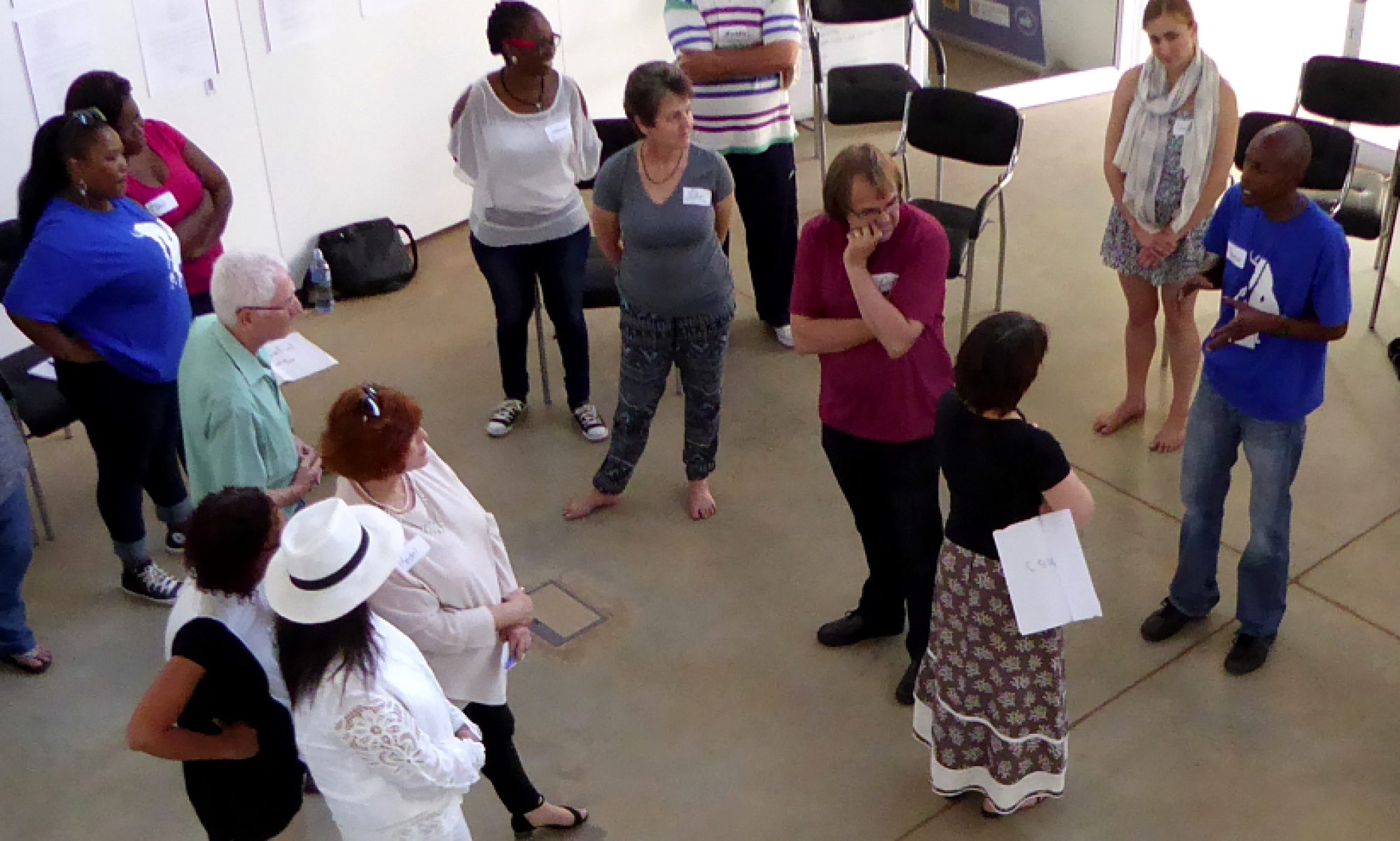
Pig Catching for Coaches and Facilitators on 4 Dec

INVITATION TO CATCH PIGS

Pig catching is what coaches and facilitators do when we chase the moment of insight that brings shift and transformation in our clients.

Please note: No pigs get harmed, our pigs are purely metaphorical and they have wings.

Bring your curiosity, your open minds and your questions.

Join us on Friday if you dare…

Topic:    Moving PeopleFlying Pig

Date:     4 December 2015

Time:    7am for 7:15 to 10am Pig Catching

10:30-12:30 Research conversation (for all who are  interested in Strategic Narrative Embodiment)

NOTE: We will start at 7:15 sharp to make the most of our time.

Facilitator: Hamish Neill (from Drama for Life)

Cost: R250 (Includes a write-up of the session)

Venue: 305 Long Ave Ferndale

Dress: Comfortable clothes you can stretch and move in

Coffee, tea, muffins and fruit on arrival.

RSVP: by 1 December.

More on the topic:

What is this shift in leadership and Organisation Development that everyone is talking about?

Some call it a change from Command and Control to Sensing and Responding

Others say it is Autocratic to Participative Leadership

Some try to explain it by using metaphors for the kinds of Organisations we want e.g. no more machine like organisations, rather organic ones, or ones that work like the human brain. Still others say an organisation should be looked at as  a work of art…

There are also those that talk of a Vision and Values based culture versus a virtuoso culture, or a profit focussed organisation versus one that aims for a triple bottom line i.e. people planet and profit.

Whatever the shift is that our new changing world is asking for, we are the ones that support the transformation.

In this session, we will continue our foray into the symbols, metaphors and images that make up our understanding of this shift with Hamish from Dram for Life. In doing so you will also get insight into the tool called Image Theatre as a means for extracting and eliciting stories from participants.

Read my reflections on our previous session here: Can Image Theatre help us change organisational life in South Africa?

Join us on Friday if you dare…

When and how to use a microphone…

How many times have you seen a speaker fumbling with a microphone at the beginning of a talk?

They seem uncomfortable with the alien object and then look hopefully at their audience: “Do I really need to use this?”

Here’s the thing: An audience will always say ‘yes, use the microphone’ because they have been in too many presentations where they could not hear the speaker. Especially at the beginning of a talk, they have not yet adapted to the speaker’s voice and personality.

The microphone, however, has nothing to do with hearing and everything to do with the speaker’s ability to enclose the audience in their own presence. The power of a speaker’s voice is simply a function of the power of his/her presence. By assessing vocal ability, one really assesses a speaker’s ability to invite an audience into their way of seeing things and to embrace the entire audience with their presence.

The awkward fumbling with the alien object (microphone) and the pleading question as to whether or not to use it, just makes the audience feel certain you will not be able to accomplish this. They feel they must save you from embarrassment and themselves from battling to follow and so they answer ‘yes, use it’.
Whether or not the speaker can actually grow their presence to embrace them, the audience cannot know. Only the speaker knows if they can do that.

How do you know if your voice and presence will carry??

In a room the size of a double garage with about 50 people, most speakers can do it. It takes special speakers to do it in larger rooms with larger audiences. You need not worry about microphones ever again in that size room with that size audience and no other noise (coffee machines or lawnmowers in the back ground).

In a larger room, with a larger audience, or with background noise, you need to work your voice. If you don’t know how, use a mic. But PLEASE, COME EARLY AND TEST IT! When the audience arrives, you must be ready. No sound tests, no fumbling. You must feel comfortable with the extension and at ease with using it, so your audience will have confidence in your ability to invite them into your presence through it.

How do you establish vocal and personal presence effectively?

You have one of two choices:

1. Ease into it by making small talk for a sentence or two to let them get used to your voice, your accent and personality (even if they know you, people need this time to adjust). If you were unsure of anything that you could not test without the audience, like the effect of their bodies on the acoustics, this is your chance to find out and adjust.

2. Come in with immediate power and confidence.
That means you decide beforehand to use the mic or not. You capture them from the get go. You do that with an upright, open posture, deepened breathing, eye contact, a resonating voice and an empathetic energy. In short you use the Confident Speaker’s ABC.

Book now for our workshop on the Confident Speaker’s ABC. 11 November in Cape Town.

Like our  Facebook page and get R 150 discount on your workshop.

Also see our other November workshops:

09 Nov – Team Innovation Read more

10 Nov – Improvisation Skills for Coaches (NEW) Read more

17 Nov – Customer Interaction (NEW) Read more

18 Nov – Story Strategies for Facilitators (NEW) Read more

The Art of Successful Communication

In a European forest, the animals hear of a rumour, saying that the bear has a hit list. All the animals start to wonder whose names are on it.
Finally, the roe buck plugs up all his courage and asks the bear: ”Can you tell me whether I am on your list?” “Yes, says the bear, your name is on my list.” Scared to death, the roe buck runs away. Two days later, he is found dead.
Horror spreads amongst the animals.
The wild boar is the second one who cannot stand the uncertainty any more as to who will be next. He asks the bear whether he is on his list. “Yes”, says the bear, “you are on my list as well”. As fast as he can, the wild boar runs away. Two days later, he is found dead.
Now, panic and agony spread amongst the animals. The rabbit is the only one who still risks a move and ventures to approach the bear. “Bear, am I on your list?” “Yes, you are also on my list.” “Can you scratch me out?”  “Yes, of course, no problem!”

This little story illustrates a crucial aspect about communication: In a nutshell, the process is simple. There is someone, referred to as the sender, who intends to transmit a message. Then there is a recipient, whose task it is to decode the information (s)he receives. If successful, the result is mutual understanding between the two (or more) parties. In the parable, the animal knows “The bear has a hit list and I am on it”.

This is largely what we learn from our parents, in schools and universities. We learn to use words to express ourselves. We learn the grammar, spelling and often even several languages to be able to speak to each other, to read and write and so forth. At last, it is communication that allows us to make sense of the world we live in.

Simultaneously, this is also where the challenges and problems lie. Communication is so inherent and central to human life that people often overlook its relevance and complexity. Therefore, miscommunication lies at the root of many problems we encounter in personal and professional settings. These problems form beyond the surface of a message being transferred, heard and understood.

Here are three reasons why communication is often unsuccessful:

1. Communication is more than transfer of issue-related information. Two thirds of what is being exchanged in a conversation is non-verbal. We use visual and acoustic channels and communicate constantly through our appearance, body language and voice. This includes means such as gestures, posture, facial expressions, voice tone, speed and volume.
Our bodies generate, read and understand this information subconsciously and react accordingly. Thus, knowledge about the meaning and application of non-verbal communication elements can help us to align our messages with our intentions and to understand the true thoughts and feelings of others better.

In the parable: Could the animals have read in the non-verbal elements of the bear’s message that there was room for negotiation?

2. Some of the key situations and challenges that can heavily influence our success in life, depend on our communication skills. It is the ability to communicate confidently, authentically and positively that is required if we want to succeed in a job interview, in small-talk situations when we try to make friends and connections, when we introduce ourselves to a prospective landlord, future parents in law or when we are on a first date. We might also intend to negotiate a higher salary or buy and sell products or services. The mastery of communication skills takes conscious effort and practical exercise for most of us, which only plays a minor role in schools and universities to date. Therefore we stay unable to reach our potential. The reality is even closer to the contrary in light of surveys revealing that one of people’s biggest fears is public speaking.

In the parable: Could there have been a better approach of communication when the  animals went to the bear by which, as a result, the roe buck and the wild boar might have still been alive?

3. We all have different value systems and beliefs through which we see and understand the world. These value systems are inherent in our communication and make sense to ourselves. Unfortunately we often fail to bring these across to our conversation partners. We focus on “facts” that are aligned with our personal belief system and fail to connect with the value systems of others when we communicate. This is true for men who say they will never understand women (and vice versa), for managers and their staff who are permanently frustrated and opposing each other and even for religious leaders who claim to know the truth. In each of these examples, empathic, open-minded communication between the parties, guided by the principles of tolerance, equality and respect, would be the answer. This way of communicating requires more effort and time, since we have to ask questions and listen to our counterpart. The alternatives though, if the communication stays shallow, are permanent arguments and frustration in romantic relationships, burn out syndromes and dismissals at work or hate speech and war against an “enemy” we simply fail to understand.

How often do we leave a conversation wondering what the other person actually meant by
what (s)he said, just like the animals have left the bear without inquiring the context around the hit list?

Throughout our lives as social beings, we are interconnected with others in countless ways. Other people are our best resources, as it is usually them who can open or close doors for us. When we start to consider these points and realize that the systematic and conscious use of communication skills can help us to build better connections, reach our personal goals and therefore live a happier life, then this is where the art of communication starts.

Communication works for those who work at it – John Powell

Playing Mantis has launched a new workshop on ‘The Art of Successful Communication’. The first one will specialize on communication in the business context and is for sales people, customer care personnel, consultants and anyone who interacts with customers on a regular basis and intends to improve his customer relations.

Click here to read more about the workshop.
Personal Success Story Workshop – What’s your definition of success?

I just completed a blog post on why acting is more effective than thinking when it comes to achieving success. I realised that the very same information is as relevant to the Personal Success Workshop of the past week end as to the story class about which I was writing. So I am posting it again from the perspective of the definition of success. Or perhaps you rather just want to go straight to the notes for the Personal Success Story workshop.

When I asked participants in the Personal Success Story to form a continuum showing to what degree they are ready for transformation, most of them placed themselves close to the side that indicates they are sick of being where they are and in dire need of change.

Transformation becomes our definition of success as we embark on the success story together. Success very rarely have anything to do with external changes, but always refer to an internal shift or transformation that then has a direct effect on the outer world of the hero. The lonely Shrek in the first movie makes friends and finds true love not because someone outside of him started to care for him, but because he started to care for them. He chose to go after Fiona while still believing that she thinks he is an unlovable ogre.

There comes a point in everyone’s story, fictional or real, where a shift in perspective is crucial for successful transformation. In real life people look for this shift by reading books, attending seminars, talking to their friends and mentors, going to church and googling for info on the net. Yet all the info and talk and thinking in the world do not bring them to the point of making that internal behavioural shift – that moment that causes them never to be the same again – the moment that embodies their definition of success.

Then that same person goes on holiday, or has to deal with the death of a loved one, or a wedding, or they play a game of soccer with friends or they go for a hike in nature, or they create a piece of art, or join a dance class or just have a great meal with friends and suddenly old things have a new colour.

All these are examples of experiences that bring change: experiential learning. If transformation is your definition of success, these are the kinds of experiences you seek. Typically they have the following 4 aspects in common:

  1. A change of scenery/setting
  2. Involvement of the body i.e. movement
  3. Emotional connection i.e. a heart response and
  4. The presence of others – including the presence of nature or the creative muse

I went to my kinesiologist 2 months ago with a most debilitating pain in my back. She says to me: you think and struggle too much in your head and do not move enough in your body. She prescribed a half hour of walking twice a week so that my mental struggles can come into perspective and move from my head into my body.

Although these shifts can happen to anyone at any time, there is a particular moment in a story designed for it. A place in the story where it is most likely to occur because of all the story stages that preceded it. This moment is typically two thirds into the story just before act three. Some writers refer to it as the pause before the climax that calm before the storm. It is the moment when the hero seems to have lost and the journey seems to be a failure, then something happens that allows him/her to see the bigger picture and the greater good.

This is the moment where Shrek in the first movie realises it is no longer about getting his swamp back, but it is now about getting his love back. It is where Brave Heart realises it is no longer just about his family, but about is entire tribe.

I saw shifts occur in all the Personal Success Story workshop except for the one who was on the furthest end of the continuum regarding his need for change. This participant also happens to be Burgert, who is my business partner, and whose definition of success for this workshop would not have been personal success, but the successful completion of the workshop in creating transformation for our participants.

Congratulations to all of you who were brave enough to come to this very experiential workshop and allowed the processes to impact your lives. I trust that the experience will reveal its layers of truth for you ongoing over the next few months so that you can achieve the change that matches your definition of success.

Click her for the Personal Success Story Notes

Petro Janse van Vuuren


Power of Presence Notes

The following is an outline of my Power of Presence workshop.  It is followed with descriptions of all the exercises.

Workshop outline

Exercise descriptions:

What I need to say to be fully present….

Participants pair up. Each then has the opportunity to state what they need to say to be fully present. They express this sentiment to their partner.  They should start their sentence with “what I need to say to be fully present is….”The partner then mirrors the other persons words exactly by starting their sentence with “I hear that what you need to say to be fully present is…”  It is important that the person mirroring does not give an interpretation of what they have heard, but tries to use the exact same words as far as possible. After the person mirroring has given a satisfactory account of what was said, the roles are reversed.  The exercise is not so much about saying what you need to say to be present, more so it’s about being listened to fully without judgment.  When we listen to people like this we help them to become fully present and be in the moment.  In essence what we are doing is accepting them and showing them that they are welcome and worth being listened to.

Pattern circle

Everyone stands in a circle.  One person starts a category pattern by calling out anything, such as a color, vegetable variety, animal or car brand, and then points to another player.  That player then points to another calling out something else that falls in the same category.  This continues until the last person points back to the first person.  The same pattern is then repeated without pointing.  When the pattern is established a new pattern with a new category is created.  When the second category is also established both patterns are passed around the circle at the same time.  When the group has mastered two patterns a third is added.  Listening and being aware of the other participants  are essential to ensure that not one of the patterns are dropped.  For a fourth round tell the participants to move around and not stay in a circle.  Interestingly this exercise fails when energy is absorbed and not  passed on …ie the pattern is lost and therefore  focus is lost. Key elements to keep in mind are listening and awareness.

I failed

All participants are given a  opening to make a large curtsy(bow)  and say anything to the effect  of “I failed” or “I made a mistake”.  The other participants respond by giving them an enthusiastic round of applause.  This exercise is also called “Circus bow”, named after the bow that a trapeze artist makes after he/she missed his/her partners awaiting grasp resulting in a  fantastic improvised  summersault into the net. The performer leaps out of the net  and makes a beautiful bow, like it was exactly what was supposed to happen. A learning from this exercise  is  a feeling of release  for taking an authenticated risk and not feeling  punished for a mistake.

This is not a…

An every day object such as a rope or a frying pan is placed in the middle of the circle.  Each participant must enter the circle, pick up the object and say “this is not a rope.  This is a snake.” Or “this is a necklace” or anything else that the object could resemble.  Each participant should come up with at least 3 different things that the object could be.   People are always surprised with how many ideas they come up with.  Our minds are far more capable of creative thought than we ever imagined possible.

Mirror mirror

Everyone pairs up with another person and stand facing each other.  Each pair decide who will be A and who will be B.  A is a person looking into a mirror and B is the mirror.  B should therefore copy A’s exact movement.  The idea is not that A should try and outwit B by making sudden movements.  The idea is that they work together and move like they are one so that an observer wouldn’t be able to see who is leading and who is following.  After a few minutes they switch.  A  is therefore now the mirror and B the person looking into the mirror.  For the third round both lead and follow at the same time.  They are therefore both looking into the mirror and being the mirror simultaneously.  Now it gets really interesting.  For it to work both need to take the lead and give up the lead, give and taking control the whole time.  When you get to that point you go into a state of flow in which you no longer know who is leading and who is following.  It is in this state of flow that creativity and relationship can thrive. .

Monster talk

Participants pair up again.  This time instead of mirroring each others’ movement they mirror each other’s speech.  One starts with a question while the other is speaking with them in unison.  The other then answers the question while the one who asked the question follows his speech.  In order to help your partner keep up with your speech it helps to talk a little bit slower.   It doesn’t help to anticipate what the other is going to say.  All you can do is stay in the moment.

Yes lets!

For this exercise you need enough space for everyone to move around.  The game starts with anyone in the group making a suggestion for an action such as “Let’s climb a tree!” or “Lets bake a cake!”  Everyone then replies with the words,  “Yes lets!”, and mimes the action with enthusiasm.   At any point someone else can make a new suggestion and everyone replies again with “Yes lets!”
The best way to make your team members look good is by accepting their suggestions and doing the action with enthusiasm.   If someone said something like “Let’s roar like lions” and just did it by himself, he would look like a fool and most likely feel like one as well.  What I love about this game is that you don’t just say yes I like your idea; you actually have to accept the idea by doing something with commitment.

Make your partner look good story

Last night my wife told me a beautiful story about how a family made their mother look good by accepting an offer and doing something with it.  In this story the offer the mother made wasn’t  an idea; it was a reality that was imposed on her without her choice.  She was diagnosed with throat cancer.  In her final week her last wish was to have a meal with her family, since she loved cooking and sharing dinner with her loved ones.  She couldn’t swallow the food because of the cancer and therefore had to spit it out after chewing it.  Seeing this, her family also spat out their food after chewing.  They made her look good by accepting her reality and doing it with her.  Accepting each  other’s reality, whether it is their creativity, personality or hardship and doing something with it is how you show real acceptance and that is how you build trust in your relationships with others.

Yes and vs. Yes but

The “yes and” practice in improvisation is one of the most important.  It means you accept your partner’s idea and build on it.  This exercise illustrates the difference between when you accept an idea and when you block it.  Participants work in pairs and are instructed to plan a vacation together.  One must start by sharing an idea.  The other replies with the words “Yes but”, a reason why it is not a good idea, and then shares another contrasting idea.  The first then replies with “yes but” and so they go back and forth blocking each other’s ideas.   After a while stop them and ask them to plan the same vacation but this time instead of saying “ yes but”  they must start their sentences with “yes and”, accepting the other’s idea and building on it.

Personal Yes and

Write down on a piece of paper something that you really want to do and the reason why you can’t do it.  For example “I want to read more but I don’t have enough time, so I don’t read more.” The excuse of not having enough time is how you block yourself from not doing what you actually want to do.  So you never read more.  Take out the “but” and replace it with an “and”.  The sentence now reads as “I want to read more and I don’t have enough time so…”  Now you are unblocked.  Not having enough time is not an excuse anymore it’s just a reality that you have to accept and your mind opens up for new possibilities. So your sentence could read something like, “I want to read more and I don’t have enough time so I’ll get audio books to listen to in the car when I travel or exercise.”  By changing the “but” to an “and” you turn the reality of not having enough time from a block into opportunity for new possibilities.

Peter Block Community Building Workshop offer

At the Community Building workshop Playing Mantis made a commitment to offer a free workshop to everyone who attended.

The offer includes:
• 1 half-day workshop per organisation
• 1 Hour consultation before the workshop to understand your story and specific needs
• Transport is not included.
• This offer is only valid for 2010.

If you are interested in our offer please contact us at connect@playingmantis.net

More about Playing Mantis

We use improvisation theatre for action learning, and story-making for metaphoric experiences to develop organisations, individuals and communities to play their roles more meaningfully in a changing world. F

Possible workshop topics:

Team innovation
Whose idea is it anyway?
Collaborative creativity skills to develop an innovative team climate

Change leadership
Think on your feet.
Skills to help you lead through change and uncertainty

Values based leadership
Follow your own flute
Making decisions based on your values and the values of your team

Conflict leadership
Taking the lead role
Choosing which role to play in a conflict so that you and your team can grow.

Transformational leadership
Designing journeys
Using story to design events and processes to ensure transformation of all involved

Customer interaction
Sell with soul
Communication skills to help build better customer relationships

Improv Your Foxy Skills in Gauteng – 10 Oct

Improvisation skills to help you deal with the demands of change and uncertainty

In the uncertain ever-changing world of today you need the ability to adjust quickly, think on your feet and come up with creative solutions. Often you are required to do this in a group without the luxury of time or individual authority to move forward.

This workshop will help you:

  • Cope better in uncertain times.
  • Work better in a team with diverse ideas.
  • Create an atmosphere in which innovation can thrive.
  • Be more aware of changes in your environment.
  • Be more adaptable.

These skills are the same as those employed by improvisation actors who respond to ideas from their audience, fellow actors or the scenario quickly and creatively and in collaboration with one another.  Yet, these skills are not based on talent; they are learnt and can be practiced and honed.

In the words of bestselling author Clem Sunter, you need The Mind of a Fox or according to acclaimed writer Daniel Pink, you need a Whole New Mind. You must develop right brain capacities not just to cope with, but to excel in the world of today.

Playing Mantis specializes in the teaching of these skills and can equip you for an unpredictable world.

We will teach you how to play using your right brain, reflect on the experience and apply it to your real life situation.

Who should attend:

Individuals who want to learn skills to thrive in spite of change and uncertainty.

Leaders who want to inspire their team members to be more innovative as a group.

Can you afford it?


With an economic recession causing avalanches of worry to surge over you, can you afford not to align with your passion and cultivate foxy skills? Consider the time and money you spend on keeping your body physically flexed and ready for action – gym fees, hairdressers, clothing bills, healthy food. Can you afford to spend some time and money on getting your heart, mind and spirit flexed and ready for action?

Free follow up consultation

To ensure that you get your money’s worth; we offer you the option of receiving a free 1 hour consultation after the workshop. This is to make sure you get the help you need to apply the new knowledge in your unique context. The ability to apply the skills we teach is part of our promise and we will do what is necessary to assist you in this step

What people say:

The methods that you use have the extraordinary ability of getting people thinking on their feet, out of “the box” and more creatively than they imagined possible while pushing them to become more adaptable. If improving your team’s creativity, adaptability and unity is what you are after, Playing Mantis is who you are looking for. – Mark Baker, Industrial Psychologist, Excelebrate

I feel that I have tangible skills to use in order to cope with the changes in my life. – Nadia Jappie, Marketing Manager, Symphonia

Workshop details

This is a 6 hour workshop that includes 5 hours contact time
with a 15 min tea break and 45 min lunch break.

Date:

Follow your own flute: Sat 3 Oct
Improv your foxy skills: Sat 10 Oct

Time: 8h30 – 16h00

Venue: Melville Junction Church, cnr of Seventh Avenue and
Fifth Street

Cost: For our first time in Jozi you get these exclusive workshops at the highly reduced price of R650 for 1 / R1100 for both.

We like to keep our workshops small and exclusive, so BOOK NOW to avoid disappointment.

For bookings e-mail us at connect@playingmantis.net or call Burgert on 0822559625

To read more about Playing Mantis and our Facilitators click here

Play reflect apply

Follow Your Own Flute in Gauteng – 3 Oct

Reconnect with your passion and align with your internal motivation

In our interaction with companies and individuals we meet an increasing number of highly talented yet intensely frustrated individuals who feel a deep need for new inspiration. Many express the desire to rekindle their passion and reshape their professional careers to express that passion.

This workshop will help you to:

  • grow in self esteem
  • get a framework of what drives you and the values that guide your choices
  • Acquire confidence in aligning your life to reflect these values.
  • Know the sound of your own voice and the feeling of listening to it.

Join us on a journey back to your unique self, the source of real joy, inspiration, creativity and motivation. Rediscover your passion, feel great about being you and reshape your career to mirror who you really are.

Playing Mantis specializes in helping you grow through connection with yourself, your passion and your relationships.

We use storytelling and improvisation to play with new ideas and perspectives, reflect on the discoveries you make about who you are and apply the new found knowledge to reshape your professional life.

Who should attend:

Individuals who are looking for the security of knowing whether or not they’re in the right place and the ability to trust their own voice.

Leaders who want to lead with self confidence and make clear decisions in spite of uncertainty.

Can you afford it?

In these times of economic uncertainty, can you afford not to align with your passion?

Your passion and unique motivators are the only things that truly distinguish you from others. We would like to help you align your external context with your internal life so that you are more productive and more effective.

Consider the time and money you spend on keeping your body physically flexed and ready for action – gym fees, hairdressers, clothing bills, healthy food. Can you afford to spend some time and money on getting your heart, mind and spirit flexed and ready for action?

Free follow up consultation

To ensure that you get your money’s worth, we offer you the option of receiving a free 1 hour consultation after the workshop. This is to make sure you get the help you need to apply the new knowledge in your unique context. Too many workshops leave people excited and ready for action, but without a practical plan to make it work for them.

The ability to apply the skills we teach is part of our promise and we will do what is necessary to assist you in this step.

What people say:

It was as if a flashlight was shining through my muddy waters. It showed me a way out and that there is more for me in life than mud. – Amanda Jooste, PRO for artists


I enjoyed the creativity – this is the most fun I have had in ages. – British American Tobacco HR team member


Your unique way with stories and characters opened a fresh perspective on my own character and story. I was moved by the way in which the stories brought the participants straight to the heart of their search for meaning. Dr Jeanette de Klerk, Philosophy of Education, University of Stellenbosc

Workshop details

This is a 6 hour workshop that includes 5 hours contact time with a 15 min tea break and 45 min lunch break.

Date:

Follow your own flute: Sat 3 Oct
Improv your foxy skills: Sat 10 Oct

Time: 8h30 – 16h00

Venue: Melville Junction Church, cnr of Seventh Avenue and
Fifth Street

Cost: For our first time in Jozi you get these exclusive
workshops at the highly reduced price of R650 for 1 / R1100 for
both.


We like to keep our workshops small and exclusive, so BOOK NOW to avoid disappointment.

For bookings e-mail us at connect@playingmantis.net or call Burgert on 0822559625

To read more about Playing Mantis and our Facilitators click here

Play reflect apply