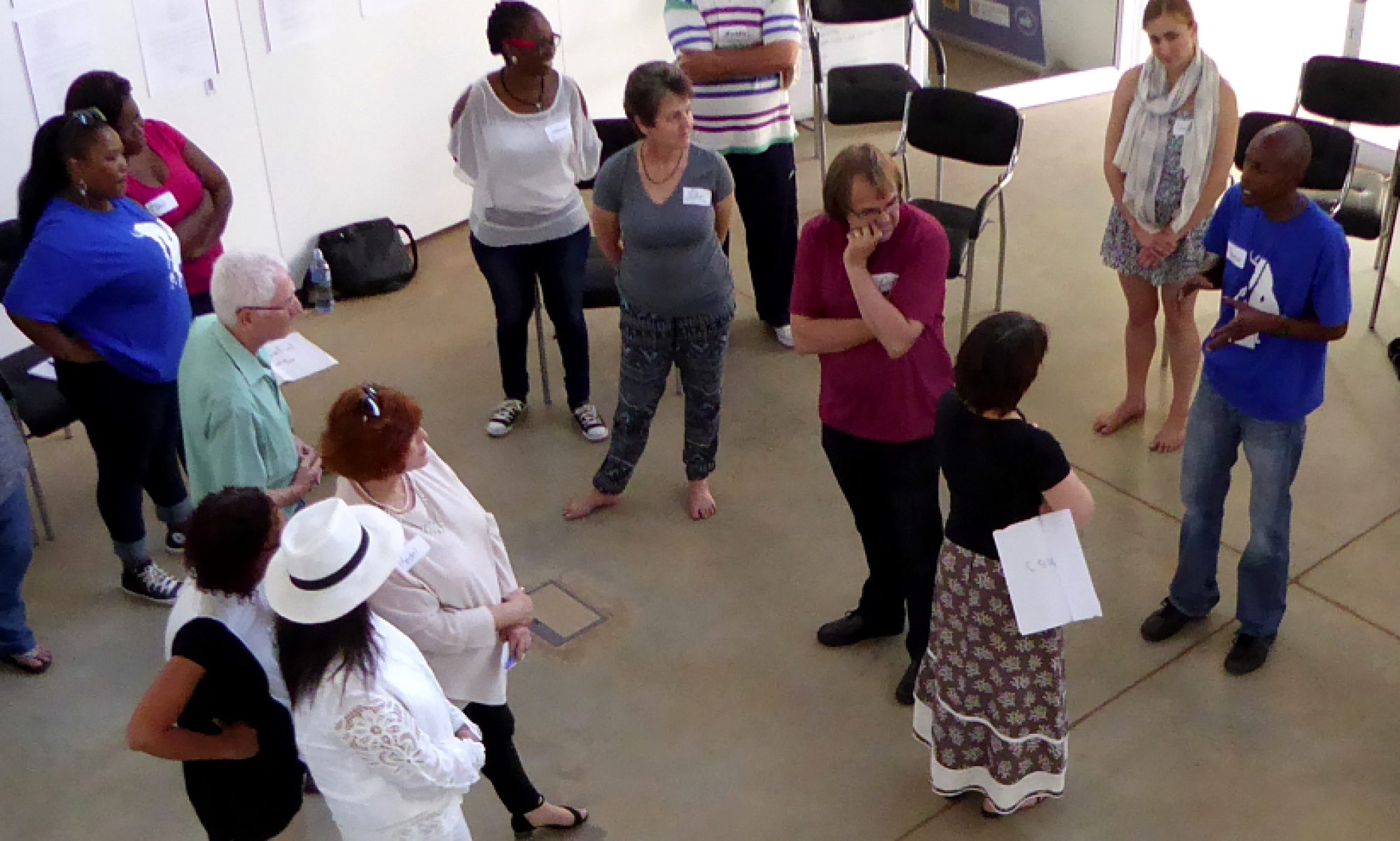
Personal Success Story Workshop – What’s your definition of success?

I just completed a blog post on why acting is more effective than thinking when it comes to achieving success. I realised that the very same information is as relevant to the Personal Success Workshop of the past week end as to the story class about which I was writing. So I am posting it again from the perspective of the definition of success. Or perhaps you rather just want to go straight to the notes for the Personal Success Story workshop.

When I asked participants in the Personal Success Story to form a continuum showing to what degree they are ready for transformation, most of them placed themselves close to the side that indicates they are sick of being where they are and in dire need of change.

Transformation becomes our definition of success as we embark on the success story together. Success very rarely have anything to do with external changes, but always refer to an internal shift or transformation that then has a direct effect on the outer world of the hero. The lonely Shrek in the first movie makes friends and finds true love not because someone outside of him started to care for him, but because he started to care for them. He chose to go after Fiona while still believing that she thinks he is an unlovable ogre.

There comes a point in everyone’s story, fictional or real, where a shift in perspective is crucial for successful transformation. In real life people look for this shift by reading books, attending seminars, talking to their friends and mentors, going to church and googling for info on the net. Yet all the info and talk and thinking in the world do not bring them to the point of making that internal behavioural shift – that moment that causes them never to be the same again – the moment that embodies their definition of success.

Then that same person goes on holiday, or has to deal with the death of a loved one, or a wedding, or they play a game of soccer with friends or they go for a hike in nature, or they create a piece of art, or join a dance class or just have a great meal with friends and suddenly old things have a new colour.

All these are examples of experiences that bring change: experiential learning. If transformation is your definition of success, these are the kinds of experiences you seek. Typically they have the following 4 aspects in common:

  1. A change of scenery/setting
  2. Involvement of the body i.e. movement
  3. Emotional connection i.e. a heart response and
  4. The presence of others – including the presence of nature or the creative muse

I went to my kinesiologist 2 months ago with a most debilitating pain in my back. She says to me: you think and struggle too much in your head and do not move enough in your body. She prescribed a half hour of walking twice a week so that my mental struggles can come into perspective and move from my head into my body.

Although these shifts can happen to anyone at any time, there is a particular moment in a story designed for it. A place in the story where it is most likely to occur because of all the story stages that preceded it. This moment is typically two thirds into the story just before act three. Some writers refer to it as the pause before the climax that calm before the storm. It is the moment when the hero seems to have lost and the journey seems to be a failure, then something happens that allows him/her to see the bigger picture and the greater good.

This is the moment where Shrek in the first movie realises it is no longer about getting his swamp back, but it is now about getting his love back. It is where Brave Heart realises it is no longer just about his family, but about is entire tribe.

I saw shifts occur in all the Personal Success Story workshop except for the one who was on the furthest end of the continuum regarding his need for change. This participant also happens to be Burgert, who is my business partner, and whose definition of success for this workshop would not have been personal success, but the successful completion of the workshop in creating transformation for our participants.

Congratulations to all of you who were brave enough to come to this very experiential workshop and allowed the processes to impact your lives. I trust that the experience will reveal its layers of truth for you ongoing over the next few months so that you can achieve the change that matches your definition of success.

Click her for the Personal Success Story Notes

Petro Janse van Vuuren


Power of Presence Notes

The following is an outline of my Power of Presence workshop.  It is followed with descriptions of all the exercises.

Workshop outline

Exercise descriptions:

What I need to say to be fully present….

Participants pair up. Each then has the opportunity to state what they need to say to be fully present. They express this sentiment to their partner.  They should start their sentence with “what I need to say to be fully present is….”The partner then mirrors the other persons words exactly by starting their sentence with “I hear that what you need to say to be fully present is…”  It is important that the person mirroring does not give an interpretation of what they have heard, but tries to use the exact same words as far as possible. After the person mirroring has given a satisfactory account of what was said, the roles are reversed.  The exercise is not so much about saying what you need to say to be present, more so it’s about being listened to fully without judgment.  When we listen to people like this we help them to become fully present and be in the moment.  In essence what we are doing is accepting them and showing them that they are welcome and worth being listened to.

Pattern circle

Everyone stands in a circle.  One person starts a category pattern by calling out anything, such as a color, vegetable variety, animal or car brand, and then points to another player.  That player then points to another calling out something else that falls in the same category.  This continues until the last person points back to the first person.  The same pattern is then repeated without pointing.  When the pattern is established a new pattern with a new category is created.  When the second category is also established both patterns are passed around the circle at the same time.  When the group has mastered two patterns a third is added.  Listening and being aware of the other participants  are essential to ensure that not one of the patterns are dropped.  For a fourth round tell the participants to move around and not stay in a circle.  Interestingly this exercise fails when energy is absorbed and not  passed on …ie the pattern is lost and therefore  focus is lost. Key elements to keep in mind are listening and awareness.

I failed

All participants are given a  opening to make a large curtsy(bow)  and say anything to the effect  of “I failed” or “I made a mistake”.  The other participants respond by giving them an enthusiastic round of applause.  This exercise is also called “Circus bow”, named after the bow that a trapeze artist makes after he/she missed his/her partners awaiting grasp resulting in a  fantastic improvised  summersault into the net. The performer leaps out of the net  and makes a beautiful bow, like it was exactly what was supposed to happen. A learning from this exercise  is  a feeling of release  for taking an authenticated risk and not feeling  punished for a mistake.

This is not a…

An every day object such as a rope or a frying pan is placed in the middle of the circle.  Each participant must enter the circle, pick up the object and say “this is not a rope.  This is a snake.” Or “this is a necklace” or anything else that the object could resemble.  Each participant should come up with at least 3 different things that the object could be.   People are always surprised with how many ideas they come up with.  Our minds are far more capable of creative thought than we ever imagined possible.

Mirror mirror

Everyone pairs up with another person and stand facing each other.  Each pair decide who will be A and who will be B.  A is a person looking into a mirror and B is the mirror.  B should therefore copy A’s exact movement.  The idea is not that A should try and outwit B by making sudden movements.  The idea is that they work together and move like they are one so that an observer wouldn’t be able to see who is leading and who is following.  After a few minutes they switch.  A  is therefore now the mirror and B the person looking into the mirror.  For the third round both lead and follow at the same time.  They are therefore both looking into the mirror and being the mirror simultaneously.  Now it gets really interesting.  For it to work both need to take the lead and give up the lead, give and taking control the whole time.  When you get to that point you go into a state of flow in which you no longer know who is leading and who is following.  It is in this state of flow that creativity and relationship can thrive. .

Monster talk

Participants pair up again.  This time instead of mirroring each others’ movement they mirror each other’s speech.  One starts with a question while the other is speaking with them in unison.  The other then answers the question while the one who asked the question follows his speech.  In order to help your partner keep up with your speech it helps to talk a little bit slower.   It doesn’t help to anticipate what the other is going to say.  All you can do is stay in the moment.

Yes lets!

For this exercise you need enough space for everyone to move around.  The game starts with anyone in the group making a suggestion for an action such as “Let’s climb a tree!” or “Lets bake a cake!”  Everyone then replies with the words,  “Yes lets!”, and mimes the action with enthusiasm.   At any point someone else can make a new suggestion and everyone replies again with “Yes lets!”
The best way to make your team members look good is by accepting their suggestions and doing the action with enthusiasm.   If someone said something like “Let’s roar like lions” and just did it by himself, he would look like a fool and most likely feel like one as well.  What I love about this game is that you don’t just say yes I like your idea; you actually have to accept the idea by doing something with commitment.

Make your partner look good story

Last night my wife told me a beautiful story about how a family made their mother look good by accepting an offer and doing something with it.  In this story the offer the mother made wasn’t  an idea; it was a reality that was imposed on her without her choice.  She was diagnosed with throat cancer.  In her final week her last wish was to have a meal with her family, since she loved cooking and sharing dinner with her loved ones.  She couldn’t swallow the food because of the cancer and therefore had to spit it out after chewing it.  Seeing this, her family also spat out their food after chewing.  They made her look good by accepting her reality and doing it with her.  Accepting each  other’s reality, whether it is their creativity, personality or hardship and doing something with it is how you show real acceptance and that is how you build trust in your relationships with others.

Yes and vs. Yes but

The “yes and” practice in improvisation is one of the most important.  It means you accept your partner’s idea and build on it.  This exercise illustrates the difference between when you accept an idea and when you block it.  Participants work in pairs and are instructed to plan a vacation together.  One must start by sharing an idea.  The other replies with the words “Yes but”, a reason why it is not a good idea, and then shares another contrasting idea.  The first then replies with “yes but” and so they go back and forth blocking each other’s ideas.   After a while stop them and ask them to plan the same vacation but this time instead of saying “ yes but”  they must start their sentences with “yes and”, accepting the other’s idea and building on it.

Personal Yes and

Write down on a piece of paper something that you really want to do and the reason why you can’t do it.  For example “I want to read more but I don’t have enough time, so I don’t read more.” The excuse of not having enough time is how you block yourself from not doing what you actually want to do.  So you never read more.  Take out the “but” and replace it with an “and”.  The sentence now reads as “I want to read more and I don’t have enough time so…”  Now you are unblocked.  Not having enough time is not an excuse anymore it’s just a reality that you have to accept and your mind opens up for new possibilities. So your sentence could read something like, “I want to read more and I don’t have enough time so I’ll get audio books to listen to in the car when I travel or exercise.”  By changing the “but” to an “and” you turn the reality of not having enough time from a block into opportunity for new possibilities.

Story class 1.5 Why we miss you when you are not there

We ended our previous story class with 5 of the 6 characters (one was away) ready to embark on the search for Duke Tamuz. One, Fair Lilly, would stay behind as contact to this side of the gate, Bluh would stay as guardian of the gate and three would desend to the Underworld in search of the Duke.

I arrived at the class this week, knowing that lollie the dancer would not be present and I have made room for her absence in the planning. Just then 2 more participants excused themselves. So we started our journey to the Underworld with only 3 people, one of whom was not present last week.

How does a facilitator respond to absenteeism? This question is crucial because life happens and you need to be adaptable. This does not mean there is no cost  to all involved. I thought it may be useful for myself as well as for the participants and everyone else in similar circumstances to see why we miss absent people so much.  What is the cost of absenteeism for all sides and what the responsibility of each agent is to minimize this cost.

Let me clarify the context in which these costs are applicable: Learning situations that

  1. are collaborative and rely on team work
  2. seek to ignite creative thinking and problem solving
  3. are designed over a period of time to build one on top the other towards a  particular desired outcome (not stand alone lessons)
  4. employs experiential interactive methods where the learning is not found in notes and reading material.

For a soft ware company such a process could be a 2 day sprint for designing a particular piece of software. For a theatre company it could be rehearsing a play, for a business it could be strategic planning for the coming year.

People who excuse themselves from the process typically think they are the only ones paying a price and they weigh that cost and decide that they are willing to pay it. They are yusually unaware of other costs they are paying and the costs for the other agents:

Silenced voices

Absent participants silence their own voices which means they lose the chance to make choices that wilol impact them and may therefore lead to frustration when having to deal with others’ choices on your behalf. This means you also lose a sense of freedom and control.

Present participants lose the chance to learn how to integrate a large variety of different ideas (because some voices are silent). This means that one of the main objectives of the process i.e. learning to listen to diverse ideas and collaborating  is lost.

Yet, no one feels the high price of silenced voices as much as the facilitator to whom the inclusion of voices and the importance of the collaborative effort carries the  most value. The facilitator has probably spent years in training learning how to be a true facilitator that does not provide answers and does not influence the out come of the project with their own agenda. Facilitators typically have to unlearn the urge to be the saviour of the group and provide the answers and learn the ultimate value of only creating the space for participants to find their own voices and hear their own answers. Absenteeism therefore asks the facilitator a very hing price.

Trust

Absent participants lose a certain amount of trust from the present participants. Often this loss is very big and frustration can be very high. Other times, as in our case, participants are very forgiving and flow with what happens and still a small amount of trust is always sacrificed.

The facilitator therefore need to make provision for this loss of trust and find ways to mend the schism on top of having to rework the plan and make other adjustments.

Lost time

When next a participant who was absent rejoins a group, it will take 15 to 20 minutes to reintegrate the participant into the group. This usually is not a problem, because everyone takes that amount of time to get back into it and they enjoy the chance to share where they are with the member who was absent.

However, when half your group was not there, it will take 15-20 minutes for every absent member. In our case that amounts to 45-50 min i.e. more than half the class time. The reason for it taking so long is that for every extra participant the amount of relationships that need to be re-established after absence increases exponentially.

For the facilitator this creates more frustration than for the participants because she carries the responsibility of keeping the big picture and overall learning process in mind. Somehow, somewhere this lost time will have to be found.

Prescription instead of diversity

All the lost input impoverishes the final product making it less enriching, less inclusive and far less aesthetic. Overall, when voices are kept silent and group decisions are left to a few, the process becomes scripted by the present participants. And script leads to prescription and this in turn leads to a loss of diversity, colour and depth. The whole process looses levels of meaning and of beauty.

In our case this is especially true because one of the participants is working with an existing story in mind. This is not a problem so long as there are enough voices that force her to stretch the boundaries of her story. But with 3 people absent and only one friend who was also present the previous class, the story suddenly became the dominant voice and this raises red flags for me as the facilitator.

On one hand the facilitator is grateful for a participant with a strong idea of where they want the process to go. At the same time it creates a dominant culture that is hard to penetrate once the absent voices as back again.

Loss of transformational power

All the lost time accumulates toward the end of the programme and shortens the time for applying and integrating  the outcome into the real life situation it was designed for. This is probably the most important reason why you are missed when you are absent. Yet, only the facilitator is fully aware of this cost.

How many times have you attended a course or a workshop that left you with the question: So what? How do I use this in my everyday life?

Most processes are well designed around the climactic moment of insight and learning. Many processes fall short on the responsibility to help participants apply that insight and build it into a customised plan for their real life contexts. But if a process have that planned into it, absenteeism can greatly impact on the time set out for it towards the end.

In our case, we would feel the impact most on the second to last day when we are supposed to reflect on the journey and shape it into a tellable story. If there are too many loose ends this will create anxiety, frustration and possibly loss of closure and satisfaction. This means that the transformational power of the process is watered down because it is left unfinished.

IT also means that the transition back into one’s real life context is not cushioned with no buffer. This leaves the participant vulnerable to the very problems they came to the workshop to solve. I recently added 3 hours to my Personal Success Story workshop because the cushioning or return phase of the process was just not enough. Too many people left feeling vulnerable and without clarity as to the path ahead.

My solution for the story class:

Can everyone who was absent please come an hour earlier (6:30) tomorrow so that we can all be closer to the same page when the rest arrive?

This way the only cost is to the absent participants in terms of time and inconvenience and myself as facilitator. But this cost is minimal since I score in contact time and in regaining the momentum of the story.

Story Class 1.4 – How does a character prepare for adventure?

The second stage of a journey is the preparation stage, usually riddled with debate and doubt. Once a character receives a call to adventure there are two kinds of resistance that fuels this debate:

  1. A resistance to accept the challenge and risk that the adventure is offering.
  2. A resistance to the training and groundwork that may be needed to minimise the risks.

Some heroes like Jonah try to run away from the call, others, like Little Red Riding Hood is over eager and resists the warnings of their mentors and the necessary precautions or training that is needed.

Either way, the second part of any story revolves around a debate between the fears and the desires of the character.

For some the desire is so strong they want to act immediately and throw caution to the wind. For others the fear is overwhelming and they refuse to accept the challenge and attempt to run away from it.

In both cases a mentor is needed to help the hero either find the courage to step up, or find the patience to prepare adequately for the risk. Very often in this meeting with the mentor, the latter provides a magical weapon or secret power that will aid the hero in his or her journey. Examples are Luke Skywalker’s light saver, Dorothy’s red shoes in the Wizard of Oz or Snow White’s beauty.

Sometimes the mentor simply offers sound advice that echoes in the mind and heart of the hero. “Do not stray from the path”, Little Red’s mother warned. “You are the one”, echoed the words in Neo’s head (The Matrix) and “May the force be with you” resounds Obi One’s words to Skywalker – lucky bloke, he got a weapon and a phrase.

In our story class this week the king had promised that anyone who is instrumental in the return of the Duke Tamuz from the underworld would receive their heart’s desire. Now each character had to discover what their heart’s desire was and weigh it up against their fear of the underworld. Each had to find a symbol one for their worst fear and one for their greatest wish.  The symbols were a way of concretising the internal debate.

Through structured dialogue characters helped each other to further manifest their main motivations for going or staying.

Then, as the characters met at the gate to the underworld some of the debate became verbalised in conversations with one another…

Homework for the coming week: Please put the process of debate into your story. You can use the following template:

The king’s offer of reward echoed through the town of Bellashrene: “Anyone who is instrumental in the return of the Duke Tamuz from the underworld would receive their heart’s desire. All interested in accepting the challenge must meet at the gate at twilight.”

But… (character has doubts about the underworld)

Yet…(character is motivated by desire)

Because of this…(character has an encounter with a mentor that helps to sort out issues)

Note: You may choose to do this in any way you like. Perhaps she remembers a scene with her mother when she was young/ maybe he visits a spiritual guide/ maybe one of the conversations with another character helped. Use the insights you gained from the listening exercise to help you.

And so…(they commit to their call)

Admittedly this is a little formulaic. If your character’s story breaks the formula it is totally ok. The template is just there to spark the flow. Once it is there, trust the flow and not the template. Only when you are done writing, check that the elements of preparation are all there:

  • Fear
  • Desire
  • Mentor
  • magic item/empowering phrase.
  • Resolve/decision to either go or stay

I look forward to the unfolding adventure next week…

If you read this and are not part of the class, or do not understand how we work, I sympathise. My story class blogs are aimed at clarifying some of the theoretical concepts and structures for the participants. We often play and experience so much in class that we do not get around to the underlying theory. If you are interested in the practical methods, the best I can do is to invite you to subscribe to our use letter or join one of our workshops. Click here to subscribe to our quarterly useletterand workshop updates in your area.

Story class 1.3 – Whose story are we working with, mine or the character’s?

This week in our story class I heard a question that I have heard many times before. It also arose in our Personal Success Story workshop in Cape Town last month. Whose story are we working with, mine or the character’s?

Interestingly enough the question only arise when working with adults. Young people do not ask this question. To them as for me, the answer is obvious: there is no difference – that is why story is so powerful for understanding yourself.

I have worked mostly with youngsters over the last 15 years and just breached the adult market in the last 3 years. Every time it surprises me that for adults the distance between fiction and fact is so vast.

Play and story both help to overcome that distance so that we can once again gain a proper perspective on our own life stories and our own characters. Throughout the ages stories have been told to help simplify our complicated lives and make concrete all the things that seem so abstract to us and hard to grasp with our minds.
Through symbols, archetypes and story patterns it helps us reduce our complex abstract thoughts and experiences into something that is simple and concrete.

So when you choose a character in a story to play with, that character reduces aspects of yourself that is difficult to deal with, or hard to access and makes it simple and accessible.

When you therefore take part in a story and identify with a character, either in one of our workshops or while reading a good book or watching well made movie, that character teaches you about you. Of course, unless you let go of your left brain analysing habits while you play, the new understanding and perspective on your life will remain elusive.

You must suspend disbelief for the time that you play or read or enjoy a movie, else it won’t work.

Thank you to all of you who had asked me this question over the last few years. It has helped me to help other participants understand the importance of letting go the controlling nature of the left brain in favour of the powerful workings of the creative right brain. Thanks to you I have been able to adjust my class introduction so that participants are eased into the play space and understand what is required of them i.e. to play inside the boundaries of the story only with the characters and symbols that are appropriate to the story. Once the story is done we will then reflect on what the story means to us in our real lives.

Because more surprising than the apparent distance between fact and fiction for adults, is the fact that :

What we think is fiction (the right brain created story) contains more truth than the fabrications created by our left brains to help create the illusion of control.

To those of you currently running the story class, my sincere hope is that you will enjoy your characters without restraint. We will get a chance to ask and reflect on what they have to say about ourselves. For the time being, allow them to take on a life of their own without any judgment about what the character has to do with you. The most surprising aspects of the character will relate, but much of it may just be pure fiction and play.

I look forward to playing next week with Lollie the exotic dancer, Friar Charles, The oh so very pregnant Evelyn Haupfleish, Lady Ishta the betrothed, Bluh the disfigured gate keeper of the underworld and the charismatic crown prince…

Our story has explosive possibilities!

At the moment all we know is that Lady Ishtar is betrothed to the charismatic Duke Tamuz who is in love with a, until now ,very ordinary women Evelyn Haupfleish. She now carries his children (triplets). As many of the noblemen in the town does, he has gone to the underworld for rejuvenation, but he is not returning and time is running out. Bluh jealously guards the gate keeping a watchful eye on any irregularities and Friar Charles who blessed the descent is very worried. The only untouched character until now is Lollie the dancer…

With all the characters clarified and the set up complete, we are ready for an event that will focus the action and propel the story forward: the Call to Adventure

Watch this space as the story unfolds.

Petro Janse van Vuuren

Story class 1.2 – The belly of the whale

Jonah 1
Jonah returns

As promised we worked with the story of Jonah this week at our story class. I like this story for three reasons:

  1. The structure of story is very clearly demarcated in this story by location
  2. The Twilight Zones of story are wonderfully elaborated upon
  3. Jonah is not a typical hero, he is an anti-hero.

Structure demarcated by location

The story structure I like to work with is: the Call to Adventure, Preparation and Debate, The Journey, Ordeal and Reward, Return. In Jonah each of these are identified by a different and very symbolical location:

  1. The Call occurs safely on dry land.
  2. Jonah refuses and his doubt takes him on a ship beautifully symbolising debate. A ship is an in-between space neither safely on dry land nor completely immersed in water.
  3. Jonah is plunged into the sea, completely immersed and engulfed. His journey is short but dramatic.
  4. The ultimate in-between space is the belly of the big fish. He is neither dead nor alive, neither safe nor in danger. Caught in the darkest moment that has the potential for the most enlightenment – caught between the Ordeal and the Reward.
  5. Back on dry land Jonah returns to his calling and completes his mission.

The Twilight Zones

Two of the stages of story represent in-between worlds. Like dusk and dawn these stages are full of duality and contrast. They are marked by confusion, emotion, fear and ultimately resolve. I call them the “twilight zones”. A twilight zone is a crucial stage for transformation and often is neglected or fumbled because of its complex and paradoxical nature. It is in handling these stages with care and confidence that will make your story successful and stand the test of time.

In our story class we played with just the first of the two twilight zones: on the ship before the crew drew straws. This, we decided was Jonah’s most fearful moment. We used a version of the structure sometimes called ‘cop in the head’ to identify the different voices in Jonah’s head at this moment.

I invited one person to take a position that shows how Jonah is feeling. Then I invited the rest of the class to take the places of different voices that may be plaguing him. We repeated the exercise twice and what I loved most is the two different Jonah’s we looked at.

The first was stressed out sitting in a heap swearing with voices like: ‘it’s your fault’, ‘you did it again’ and ‘at least you tried’ in his head.

The second Jonah was seasick and hurling over the side of the ship. He was saying to himself ‘time for action’. Some of the voices in his head was “let’s prioritise’, ‘can’t you think of anything better to do than puking?’ and ‘cry out to God Jonah!’

The first Jonah neutralised the voices mainly by accepting his fate and getting ready to be launched into the water.

The second Jonah decided to take matters in his own hands. He did not wait for the crew and jumped in before they even got to him.

Very good example of how different people resolve their twilight zones: some are reactive and some pro-active. It was great fun to play with both and we all learned something about ourselves.

I can’t wait to tackle the second twilight zone in a few weeks’ time. That’s the real biggy…

Jonah the anti-hero

Jonah turns out not to be a classical hero riding into the sunset with his pockets full of dollars and his arms full of damsel. After Jonah’s triumph, we do not find him in a state of exuberant joy. Instead Jonah is an anti hero. He sits complaining to god, angry that god did not destroy Nineveh for their evil. It seems that the real reason for Jonah’s initial refusal of the call of God was precisely his fear that God would not punish Nineveh like they deserved but have mercy on them. His fish experience was therefore not lasting and he is at the start of a whole new journey.

Still the elixir of the story carries beyond Jonah and Nineveh to all who is struck by the love of God for all people. This love is the elixir for the complaining prophet who does not really transform, for wicked sinners like the people of Nineveh and for “also much live stock” (Jon 4:11)….

Here is an article where you can read more: The belly of the whale

For those of you who are not yet part of this class and want to be, you can still join our story class next week, but you will have to commit for 6 weeks at a price of R600. We play at 6 Neetling Street Stellenbosch.

Subscribe to our Useletter and get info on the next course in your area.

Alternatively, keep watching this blog.

Petro Janse van Vuuren


Story Class 1.1 – The Big Picture

The first two sessions of our 8 week story class deals with two big pictures: 1. an overview of story structure and the hero’s transformation. 2. The pivotal moment where the hero sees the big picture and chooses the greater good – or not. The whole story and all its elements revolves around this climactic moment, the elements are as follows:

Five Stages of story structure:

1. The Call to Adventure

 Example: Once upon a time there was a little girl who lived at the edge of a forest. She always wore a red riding hood that her grandmother had made for her. One day her mother called her: ‘Little Red, would you take this basket of goodies to your sick gran on the other side of the woods?”

2. Debate and preparation

“Sure, Mom,” she replied and set off.
Her mom called after her: “Just remember Rad, there is a wolf in the woods, so stay on the path and do not stray.”

3. The Journey (tasks and team)

Little Red skips into the woods singing to herself. She is tempted to pick flowers for her gran. She hears mom’s voice in her head, but she picks them anyway. She meets the wolf and innocently tells him where she is going. She follows his advice and take the wrong path…

4. Ordeal and reward


Little Red and the Wolf

When Little Red gets to Grandma’s house…all is not well. Gran looks very ill indeed. “Gran, why are your eyes so big? Your ears? Your mouth?” So much the better to see you with, hear you with, SWALLOW YOU WITH…


5. Return

A wood cutter hears a disturbing snoring sound from grandma’s house. He finds the wolf, cuts him open and sets the two women free. Yes, Little Red is no longer that little and she never wore the red hood again…

Four Forces for change

1. The hero with the goal: Little Red Riding Hood with a basket for Grandma.

2. The guide who supports: Mom with her advice

3. The obstacles which tempts and distracts: The sick grandma who may like flowers, who must be reached asap…

4. The enemy who opposes: The hungry wolf

Three levels of character

1. Action that can be seen from the outside: Little Red wheres her riding hood everyday, she accepts the challenge without hesitating and she skips into the forest.

2. Attitude that reveals internal motivation: She is eager, innocent and full of energy, motivated by fun and adventure.

3. Awareness that comes from seeing the big picture: she learns about making mistakes and failure, but also about strength and courage. She is now more grown up and far less naieve.

These work together throughout the story in a certain sequence. In the first class last night we played with Little Red Riding Hood. Above is an analysis of the story according to the elements of story structure. What you will not find here is the depth and meaning we each gained from the experience for our individual lives. For that you need to join us next week when we deal with the story of Jona in the belly of the whale!

Here is more info on our story class

Alternatively, whach this blog as we play with the questions :

What stage of the story are you in right now?

What forces work to help you transform your life?

What really drives you as hero of your life story?

How can you use all this in helping others be their own hero’s?

Dr. Petro Janse van Vuuren

The Applied Improvisation Conference in Amsterdam

Street Café in Amsterdam

Schipol International Airport taunted me like Huckleberry to Tom – daring him to trust a raft made of sweat, spit and good old fashioned nylon rope. My heart and stomach clung awkwardly to the Boeing’s ceiling, unconvinced of a safe landing….both on the runway and on the stage. My husband reminded me of a Sunday afternoon frozen yoghurt in Stellenbosch…were we in the same aircraft?

The landing gear brushed the runway with an impressionists, well, impression. We were is Van Gogh’s valley. Land of Bicycles , Stroopwafels, Marijuana, Heineken & Bitterballen…

The AIN conference was scheduled from the Thursday morning until the Sunday afternoon. Our venue…The Felix Meritis, staircases’ would be home to 24 accents trading experiences, laughter and general out of breathness as the building was spread over 5 floors.

As an introvert, the idea of 3 people crammed days was daunting to me. The deer caught in the headlights image pops to mind.  Beautifully contrasted with this thought was my husband… a healthy, well fed wild mustang…energized by the breathing in and exhaling of gusts of words from strangers about to become friends.

We both joined Adrian Jackson’s pre conference workshop on Augusto Boal’s “Theatre of the oppressed” on Thursday… “Yes, an additional day with, what my very unhelpful conscience, proceeded to tell me, were people living the Improvisation dream. I had recently fallen in love with it, but we were by no means an item in my eyes yet…unbeknownst to me…Improv had found its soul mate, and he was planning to propose every day from then on for the rest of my life, and I was going to say yes.

Have you ever met really nice people from a certain country at different intervals in your life? They inadvertently form your opinion of that country. Improv people are like that country; I have never met an improviser I didn’t like. They are open, accepting, honest and possess an enviable children’s quality called a sense of wonder.

Come Friday, fear slept late and I attended a workshop by myself whilst Burgert sat in on another. His was on “Deepening your Debrief”, the key element of an Applied Improvisation Learning Experience, and mine was on “Status, the language for describing and understanding situations”…I hope these sound like exotic dishes, because they are, but with that “home cooking” edge to them. Oh, but the nourishment was no where near finished. Next up was a workshop by the marvelously honest and down to earth  Marjin Visser on “Prejudice, and how to be playful with it”

Make you partner cook good

Saturday, fear was up before I was. I could have sworn I smelled it smoking a cigarette on the porch, nervously tapping its foot. Burgert and I were presenting our “Make your Partner cook good “a cooking workshop for couples later that afternoon. Burgert and I had attended pre marital classes based on Imago relational therapy and were so moved by the principles that we designed a workshop that married it with our other great passions – Improvisation and Creative cooking. We had presented this to test couples in South Africa and were left speech less at the beauty of 2 people working at a relationship.
My fear, in retrospect, was that I would be out of my depth. But, the thing with relationships is – if you’re in a committed one…it is a ship, and it will float and brave every storm without fear of failure.

We started our day with 2 different sessions again:
I joined Amy Carrol – her topic was “Are you predator, pray or partner?”, The Art and Science of Positive Influence. Burgert found his way to “Creative Conflict Resolution” with Barbara S . Tint. These are 2 remarkable women with finesse for performance with depth.

Just after lunch we both attended the “Hero’s Journey as a universal pattern for Personal and Cultural change in Organizations” …again, rich with content and the freedom of expression.

And then we were up… The proof is in the pudding. The feedback ( I love this word) on our workshop was down right pleasing  and instilled a quiet confidence that what we do has the potential to make a lasting difference.

As we flew home the next Sunday I closed my eyes somewhere in mid flight and smiled…for I was in the absence of fear.

Why do we lose our creativity when we grow up?

Have you ever watched small children play? I’m always astounded by their imaginations and creative ideas. We’ve all been creative as children, but why or how do we lose this creativity?

Recently I listened to a talk by Eckhard Tolle called “The Journey within”. In his talk he says that creativity doesn’t come from thought but from a place of stillness. I tested this theory by asking my wife, who is the most creative person I know ,what happens just before she gets a creative idea. After a brief moment of silence she said in her metaphoric way of speaking, “There is stillness. It’s like the wind dies down and there is this moment of utter quiet and then the creative ideas come like a cloud burst. First just one large drop falls into the dry sand then it is followed by this shower of creativity.” “What is the wind?” I asked. “Its thoughts” she replies. I concluded that Eckhard is right. A creative idea isn’t a thought that you manufacture in your mind by trying really hard. The term “creative thinking” is therefore an oxymoron. Isn’t it unfortunate that school only taught us to think and not to be creative by not thinking?

It is also crutial that you trust your own creativity. All people are creative; we just lose it over time. The good news is we can reclaim it. The first step is to be still, and trust. Improv helps one to do this. A great improv game that helps to develop this trust in one’s own creativity is called Freeze Tag. In this game 2 people start a scene. At any moment anyone else can say freeze and tap out one of the players. He/she then takes that player’s position and starts a new scene in a completely new context justifying the position. A variation of this game is called Pimp Freeze Tag. In the variation an outside person calls freeze and tell the participants who should go in and replace another player. This way you don’t have time to think about what you want to do. You just have to trust yourself and see what arises. Participants in my improv class often comment that it is easier to come up with something good if they didn’t have time to think about it.

The next step is to trust the other player that they will take your creativity and do something with it – accept it and build on it (“yes and” it). I believe that the reason why we are afraid to trust our own creativity is because we are so use to other people rejecting our creativity and not accepting it. We all know how much rejection hurts. For most people it is not worth taking that risk anymore, so they label themselves as uncreative to protect themselves from rejection.

Now it’s your turn. Become still. Focus on the sounds around you. Become aware of your breathing. Write down in a comment below what arises.

Personal Success Story Notes

Designing a Personal Success Story for your life

One of the most powerful means for designing journeys of transformation lies in the structure of myth and story. Every story is designed so that the central character undergoes positive life change. Every other character and every event in the story works together for this purpose. In response to the transformation of the hero, his/her community and even the landscape undergo their own transformation also. It all starts with one person and his/her story.

With this in mind it becomes possible to use story structure as a way to look at your own life and see how it can help you to work with your own personal success.  Take a look at the diagram and table below as a starting point. Be mindful of the twighlight zones.

If you want to understand this better take a look at our 8 week face to face story course.

Classic story structure: diagram:

Every story has a beginning, a middle and an end, or Act one, Act Two and Act Three. Yet it is the transition between the acts that are the most interesting and fruitful for change and successful transformation of the main character.

Journey diagram
Journey diagram

Classic story structure:  table (to help you with your homework)

  • The five stages of classic story structure
  • The 6 steps for developing your personal success story.

Two of the stages are italicised. This indicates what I call a “twilight zone”. They are also indicated in the diagram. A twilight zone is a crucial stage for transformation and often is neglected or fumbled because of its complex and paradoxical nature. It is in handling these stages with care and confidence that will make your story successful and stand the test of time.The table shows:

Stages of a journey Steps of personal success story
1. Call to Adventure: Who is the protagonist and in what way is he stuck in his ordinary world with no way of changing it?What opportunity arises for him to change? 1. Get a Great GoalIn what way are you feeling stuck and frustrated? What opportunity do you have to change this?Set a goal that is realistic and actionable and helps you with knowing what to do now.
Preparation for the Journey:What fears do the hero need to overcome/ doubts does he need to settle?Who (mentor) helps him with this and with what (magic tool/weapon)?How does he show his commitment to the journey? 2. Manifest your Main MotivationWhat values drives your choices and which of these support your goal? Can you link it to your identity i.e. what you believe is true of you. What other desires clash with these values?
The journey:What tests and trials does he need to face and how does he plan to overcome them?Who are his friends and who are his enemies in facing his challenges? 3. Put together a Personalised PlanWhat are the most important obstacles in the way of your reaching your goal?What plan can you put in place to help you overcome them?  E.g. restructure your space and resources and identify small habits to replace old unwanted habits.
4. Set up Social Support systemsHow can you get your friends and family to support your goal?How can you eliminate or minimise contact with people who do not support you?
Ordeal and reward:What drives him to his near downfall? How does he face and overcome his nemesis?How does he become aware of the big picture? What immediate reward does he receive for his victory? 5. Achieve Authentic AwarenessThis step is almost impossible to design. It does not always hit when you expect it and it seldom works out how you planned. When you come to a very low uncertain place, you are close to it. Yet often you can dip far lower than that first low. Most importantly, when you are there, in anger or sadness and despair, listen for the still small voice of truth inside you that reminds you of the big picture.Reap the rewards of your perseverance, of reaching your goal even if it turns out so very different from the one you set in the first place What sacrifice do you need to make so that you can focus on what really matters?.
Return home:How does he cross back into his ordinary world? (usually some ritual involved or a chase)How does he prove his sacrifice/death regarding his old ways?What new response to old problems does he model?How does this embody an elixir that heals his community and his land? 6. Turn over and travel with the tide Ritualise your new behaviour so that it can become automatic. Now go through the actions as you have planned them, draw on your support system and keep behaving yourself to success simply following the current you have created. Beware of streams that pull you off course and fight back but let yourself settle in to a new normal.

You can join our 8 week face to face story course for a fun personal success story adventure!

For those of you who had joined one of our Personal Success Story workshops, here is a question to engage with in comments to this blog:

Share with one another what sacrifice you may have to make to reach success? In what way does this relate to the sacrifice your character had to make in the story?

Your success depends on your willingness to go on a journey and make sacrifices for what is truly important to you.