Change how you coach and facilitate with Strategic Narrative Embodiment TM

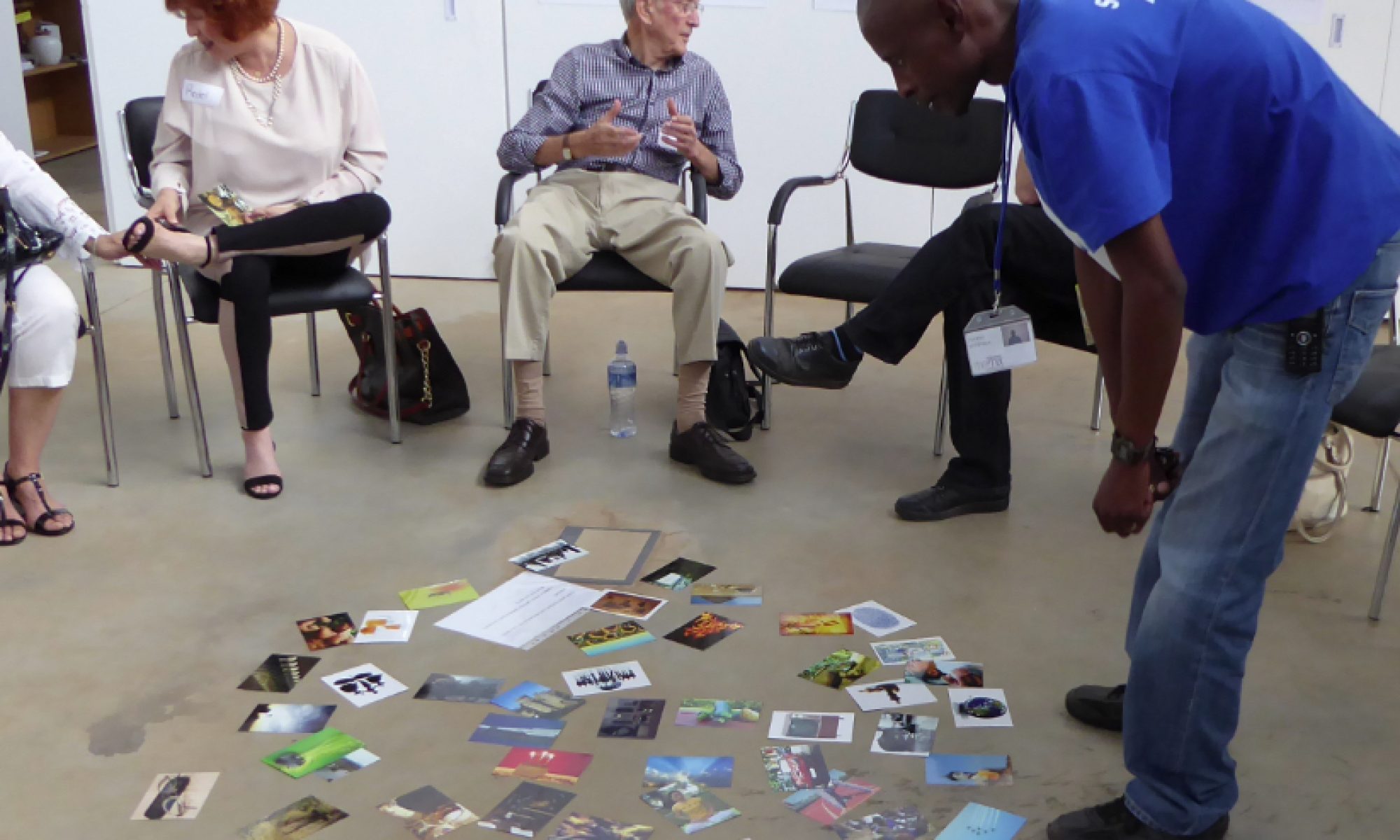
Delegates telling stories

Make your work more effective and longer lasting

Research has shown that processes that incorporate stories and embodiment work in a focused strategic manner, as is the case with SNE, are particularly effective when

  1. Working with millennials
  2. Working in intercultural contexts
  3. The content works with issues of diversity
  4. The challenges the group faces are systemic in nature
  5. The work requires innovation and new thinking.

The reasons for this are that the methods

  1. Incorporate whole brain, whole body thinking
  2. Work with head, heart and hands
  3. Externalise and neutralise power dynamics
  4. Playfully and compassionately identify dominant and habitual narratives
  5. Generates creativity and innovative thinking in the group

In short, it is exactly what South Africa and the world needs right now.

Book your place for the next SNE Essentials course by emailing Faith.Dube@wits.ac.za

Here is what some of our participants said of their experience of our pilot SNE essentials course in partnership with Wits University:

I thoroughly enjoyed the SNE course.  It was eye-opening, challenging and worth the time and effort it required. It is refreshing to look with new eyes at everyday opportunities.  I am looking forward to introducing the methodologies and concepts to clients.
– Karina Reid, Organisational Psychologist | Executive Coach & Team Performance Coach | Master Facilitator

Committed to design, facilitation and coaching practices that drive meaning and impact, I was looking for a learning process to sharpen thinking, tools and skills. The SNE course delivered! The course is a great blend of theory, techniques and practical application. Thank you Petro!
– Elusha Jansen, CEO, The Performance Hub

As presenters, we learned a great deal and are able to give the next cohort an even higher quality experience.

Book your place now, there are already 5 people booked and we expect bookings to pick up quickly now that the lines are open.

The course consists of 2 modules of 2 days each completed with a reflective assessment essay based on a practical application in the workplace. Delegates will be awarded a certificate of competence!

As organisers we take care to design an experience that is rich in diversity, crosses boundaries and lets you experience the value of the methods in their totality.

Course Dates:
Module 1: Fri 6 – Sat 7 Oct
Module 2:.  Fri 13 – Sat 14 Oct.
More detail here:http://www.playingmantis.net/about-us/workshops/playingmantis-essentials-in-coaching-and-facilitation/

Individuals with basic coaching and facilitation training are eligible to apply. Please email your motivation letter with a comprehensive CV to Faith Dube at Faith.Dube@wits.ac.za  copying Petro Jansen van Vuuren at petro@playingmantis.net.
For enquiries call 011 717 4764

Cost R11 800

CLOSING DATE: 15th September 2017, 12H00

For applicants who have completed the 3 day essentials course with Playing Mantis:
You may register for a one day touch up plus assessment and receive the Wits certificate.
Cost: R2850
Date Friday 6 October.
Read more on the course here: http://www.playingmantis.net/about-us/workshops/playingmantis-essentials-in-coaching-and-facilitation/

What can happen when you integrate Applied Improvisation and SNE with your own work

Sunrise skyline of Johannesburg

Last Quarter our Pig Catching process dealt with the question: ‘How can Africa become a global economic player? Janet du Preez from Tools of Greatness, facilitated the process and did a masterful job of blending her own work on employee engagement with the SNE methodology she learned from Playing Mantis.

(Remember Last week I posted about the Graphic Facilitation by Lita Currie at the session)

In the group was a mixture of organisation development practitioners and applied drama facilitators and both groups were mesmerized by the process. One of the applied d drama facilitators was deeply intrigued by Janet’s innovative use of well known processes. 

I will tell you of two such memorable moments here.

The props game reinvented

Janet du Preez
Janet du Preez
Janet used the very well known applied improvisation game in a very strategic manner. The game is sometimes called ‘Props’ and sometimes ‘This is not a water bottle /stick etc.’ Usually the game starts with a group standing in a circle with a single object in the centre, or sometimes a small number of different objects in the centre to choose from. Participants then take up the object (e.g. a water bottle) a and say ‘This is not a water bottle, it is a…’ and then they name something else e.g. a cell phone while at the same time using the water bottle as though it is a phone.

How Janet used Props

Instead of either placing one object in the middle of the circle for all to use, or placing a number of different objects to choose from, she gave everyone the same object, a stick of about two feet long.

Secondly, she did not require us to stand, but allowed us to stay seated in our circle.

Finally, instead of using the game as it often is just to warm up people’s brains and let them randomly come up with things the stick could be, she gave it a particular strategic frame in keeping with the principle of strategic intent as incorporated in the SNE (Strategic Narrative Embodiment) methodology.

We were to use the stick in the first part of the workshop as a way to name all the things that stand in the way of Africa’s economic flourishing. In the second part of the workshop we did the same exercise and used it to brain storm a picture of the ideal Africa. At the end of each round she asked the group to consolidate and integrate the ideas into a single representation by making tableaux – image with their bodies. In between the two rounds Janet did a number of other exercises to lend depth to the conversation.

Reflecting on the exercise, participants experienced elevated levels of creativity coupled with increased levels of safety. Sitting down instead of standing up and being able to hold on to their stick throughout the exercise removed a sense of perpetual vulnerability that they often associate with this exercise. Layering it with the strategic frame and integrating it into a larger design with tableaus and other processes, contributed depth and meaning to the experience.

Integrating individual with group images

It is a common practice to let participants build a real image, then an ideal image and then to transition them from a real to an ideal image using wome kind of process Boal style. My experience is that the practitioner usually chooses to work either with group images, or individual images. Janet used a combination of both in a startling manner.

Graphic of Pig Catching session captured by Lita Currie

To transition the thinking from current obstacles to future ideal image, Janet used the SNE technique called ‘Moving Story structure’. The process is a rather involved technique where the individual moves through a series of individual images that include ones that express our default reactions to obstacles and our defense reactions as well as idealised responses that are not practical etc. The end result is a clear understanding of what is real and practical actions we can take right now to get unstuck and closer to where we want to go.

While this is originally an individual embodiment process, Janet combined the individual work with group work so that we each had a clear experiential knowledge of how we each contribute either to the success or failure of the collective endeavour.

If you take in the fact that the group of people in the room were diverse and representative of various demographic groups of people in our country, such an experience was nothing less than moving and hopeful. Each of us left with a clear understanding of how we may be hindering collective flourishing and what we may be able to do as individuals to move into a thriving Africa.

I felt deeply moved by what happens when people of diverse back grounds and skill come together under the guidance of a masterful and gutsy facilitator like Janet: unusual and powerful things happen.

Join us for the next Pig Catching session on 25 August face to face or online at a later date (to be confirmed). This time our flying pig is: “How do I find time for meaningful deep work in the midst of the chaos of living and surviving?” Read more next week or in the quarterly Muse-letter – subscribe here.

The heart of Strategic Narrative Embodiment (SNE)

September Muse Letter

There is a war going on – a war for your heart and your soul, for mine. A bit melodramatic?

I wake up in the morning with an unreasonable fear lodged in my chest. What if I lose? Lose what, I ask myself?

  • The battle against boredom and overwork.
  • The fight to stay fit and healthy when all I want is another doughnut and a good long sit in the sun.
  • The struggle against loneliness, as I long to be with my family but despise them for crowding my headspace.
  • The strife I feel when trying to get friends to come over – do I even have friends? And then the fear that they won’t enjoy it here; so why bother?
  • The war against entropy, in my money matters, my house, my garden, my paperwork, when at the same time I would rather turn a blind eye and read another novel.

I am not one of those people caught up in the rat race: I refuse! I have been there and bought into all its frenzy, and I didn’t get the big house and the two cars, the housekeeper and the swimming pool.

In fact, my rat race brought my family and me to the brink of bankruptcy as we ploughed all our resources into ‘making it’ and failed.

Now that both my husband and I have jobs in education – with a good enough income to survive, but not to get rich, or even get ahead – ­we are much happier and have much more time for our kids, each other, the garden, the house, the friends, and the paperwork.

BUT…

  • We long for action.
  • We yearn for significance.
  • We pine for the opportunity to express our innermost selves.
  • We wish with all our hearts that someone else would wash the dishes, do the garden, organise our papers.

We now have the time, but no motivation to do all the things on the list. So, and I will only speak for myself here, I sit around wishing for action, for someone to come visit, for some external impetus to get me off my butt to go, go, go! Of course the moment the impetus comes I resent it for stealing my peace and dictating my responses. When is sitting in the sun ‘being mindful’ mad when is it laziness? When is being present with my children healthy and when is it an excuse not to engage with something else?

How much more divided can I get?

This is the war that is destroying my heart and soul.

Inside the race, I feel controlled, diminished and taken advantage of. Outside it I feel useless, insignificant and without value.

Where is the third side of this coin?

That is the essence of my quest through war-torn territories: the search for the third side of the coin – not just in this current struggle, but in all struggles that seem so two dimensional, so binary, so colourless:

Does this mean we should take up more colourful and complex struggles like the one between the students and the government with the Universities and the parents and the whole of South Africa’s history in between?  The same one that colours all organisational and leadership interactions, whether we know it or not: the struggle between those who have and who can and those who have not and can’t – along with all the colours of our rainbow nation getting involved in the mess?

I think so.

This is the heart of the SNE lens: between the strategic plan and embodied reality, you find the narrative, the story, which can integrate opposites, transform ambiguities, dance with contradictions. Between the head that plans and the hands that act, lies this treacherous landscape of the heart, the landscape of stories. Stories long to heal the broken heart. They yearn to bridge the chasms between warring opposites and mend the rifts between binary dichotomies.

Join me on this quest to mend broken hearts – especially those broken by the race for more money, opportunity and power.

Meet me at the next Pig Catching session to help process the grief of your broken heart.

Date:     7 OCt 2016
Time:    7am for 7:15 to 10am Pig Catching
10:30-12:30 Research conversation or maybe we simply continue with the session. NOTE: We will start at 7:15 sharp to make the most of our time.
Facilitator: Petro Janse van Vuuren
Cost: R250
Venue: 305 Long Ave Ferndale
Dress: Comfortable clothes you can stretch and move in
Refreshments: Coffee, tea, muffins and fruit on arrival.
RSVP: by  Wed 5 Oct.

Other Pig Catching dates this year:
9 Dec
Please diarise!

Join our group on Facebook<http://playingmantis.us10.list-manage2.com/track/click?u=bd2144f97d4741293f68d899e&id=5904ae36ee&e=ef28aa4955>:

Bring your curiosity, your open minds and your questions.

About Pig Catching:

Pig catching is what coaches and facilitators do when we chase the moment of insight that brings shift and transformation in our clients.

Please note: No pigs get harmed, our pigs are purely metaphorical and they have wings.

Why we used Strategic Narrative Embodiment (SNE) at the 2016 Southern African Knowledge Management Summit

SNE at SAKM summit
SNE at SAKM summit

What SNE did, and did not, deliver

Background

During our planning for the 2016 Southern African Knowledge Management Summit (2016SAKMS) we pondered the current state and needs of the KM network in South Africa. Based on Etienne Wenger’s stages of community development it seemed to us that the current KM network in South Africa represented a potential community, with a desire to coalesce towards community. It was this move to a next stage in the lifecycle of  a community that we wanted to stimulate.  According to Wenger & Snyder (2002) the emergence of the strategic purpose or intent for the community is a core construct in this shift from a potential community to a coalescing stage. The structure, role and activities of the community to-be need to fit and adapt with this strategic purpose.

The discovery of strategic intent or purpose is supported and informed by the finding and recognition of common ground and engaging issues on a communal level. There must be a sense of the development of a shared domain together with the redirection of attention towards seeing own issues as a communal fodder. People also need to see how their passions and desire for community can translate into something useful. They find energy for coalescence around recognising similar problems, passions, and contributions.

These typical aspects of a potential community informed the design for the Summit.

Strategic Narrative Embodiment (SNE) presented an interesting opportunity as methodology and conversation partner for our summit design. Not only is it a methodology designed for organisation (and per implication community) development, but it would also be fresh and innovative. We were intrigued by the embodiment component especially since the possibility of accessing tacit knowledge located in the body is a hot emergent topic in the KM space.

Initial conversations made us curious about:

  • What knowledge in and about our network can such a process access and externalise?
  • How can it enable the network to shift from potential community to coalescence towards community?
  • What can it tell us about emergent narratives in the KM network?
  • What level of engagement can it elicit from delegates?
  • How can it facilitate the interplay between individual and collective learning?

Read the rest here…