Calamities and miracles

Objectives:

  • To convey the concept of reframing their own stories
  • To help participants become present and positive
  • To help overcome doubts and reservations for the session to come

Overview: In pairs participants share a part of their own stories first as a series of calamities and then as a series of miracles.

Group size: 4+ (join in if you don’t have an even number)

Time: 10-15 min

Game flow:

For the participants For the facilitator
In pairs share with each other your story of how you came to be here today. Tell it as a series of obstacles, challenges and calamities that you had to overcome. Time participants for 2 min each. Warn them ahead of time about the time constraint.. Give them a half time warning and count them down from 10 sec.
Tell the same story of how you came to be here, but this time, tell it as a series of miracles that serendipitously worked our exactly in the right way to get you here right now ready for the session. Again 2 min with warnings and count down.

Debrief questions:

What was this exercise like for you?

which one is the true story?

All answers are correct, because the true story is the one that you believe right now. It can be any of the two or both at once, it does not matter what people say all will be right.

Thanks

Thank each other for sharing stories – stories are precious and personal and must be appreciated.

Tips and variations:

  1. You can ask people to relate any story, even their entire life stories (give them at least 3 min then).
  2. It can also be related to a specific topic (weight loss, challenging careers, your relationship with your partner etc)  e.g. Tell the story of how you have tried to lose weight and failed up until today and then how all the events in your story about weight loss leads miraculously to this point making it the perfect moment in time to be where you are.


Story exchange

Objectives:

  •  To turn a personal story into one that influences the group culture
  •  To allow people to connect deeply with each other and themselves around things that matter.
  • To illustrate the idea of filtering
  • To give each person the gift of their own story seen through the eyes of others.
  • To tease out conversation about ownership and responsibility

Overview: In pairs participants share a story where they experienced flow/fulfillment. Participants then exchange stories and retell each others stories as their own to new partners. After 3 exchanges participants share the stories in the large group.

Time: 25 min

Number of participants: 6-12  (if the group is of an uneven number, you can join them)

Game flow

For the participants For the facilitator
Choose an object that you can identify as your own e.g. pen/ sunglasses/ note book/ ear ring etc. Hold it in your hand. This object is just something to help you manage the game. Each person’s story will be symbolized by the object that they own.
Think of a moment in your life when you experienced an ‘aha-moment’. You can adapt the question any way you like, but keep it about something positive and inspiring e.g. a moment where you felt fulfilled at work etc.
In pairs tell each other your story. Time participants for 2 min each. Warn them ahead of time about the time constraint.. Give them a half time warning and count them down from 10 sec.
Swop objects with your partner.  This is the object you chose earlier and  is a representative of your story. Your partner now holds your story, and you hold theirs.  
Find new partners and this time tell the story of the person whose object you hold in your hand as if it is your own. Tell it in the first person. You can choose to let them say who they are , or you can ask them deliberately not to reveal whose story they hold. Play with it and see what you like best in what situation.
Swop objects again, find new partners and repeat the process a third time. Make sure people do not end up with someone holding their own story. The objects help people sort this out.
Swop objects for the last time. This time do not find other partners, you will share this last story you heard with the entire group as your own in the first person. IF people know each other well, it is fun to let them imitate the mannerisms of the person whose story they hold. This only works, of course, if you chose to let them reveal the identity of the people as objects are swopped.

Debrief

What was this exercise like for you?

Who do the stories belong to?

What was it like to get your own story back after it was filtered by the group? r

Let them write down what theylearned about themselves and the group from this exercise.

Thanks

Thank each other for taking care of the stories and for the gift of giving it back in a new package.

Tips and variations

  1. IT is not always useful to do the writing exercise, it depends on where and why you use the strategy.
  2. In a very large group, divide them into smaller groups of 6. In the final round people will be hearing their own stories back to themselves if they did not swop outside the group of six.
  3. This strategy works very well early in a workshop for people to get to know each other. It is fun to let them swop name tags instead of objects. Of course you will make the story light and not to personal for the start of a process.
  4. If you want to keep the source of each story anonymous, use ordinary playing cards for people to swop. Only the person who had a particular card would know if it was theirs or not.


Team Innovation

This full day workshop is designed to develop a team’s capacity for innovation. Participants will be introduced to a model for participative decision-making and practice skills to enhance collaborative creativity. The workshop is highly interactive and guaranties to get everyone’s creative juices flowing towards a common purpose.

How to use stories to make learning stick

Over and over you may have heard or experienced how a story can really make an idea stay with you. You have heard someone relate something that had happened to them and you retell it struck by what the story says about your world and its people.

What about stories that you remember from childhood or from literature? They create metaphors and symbols that we use in everyday life to refer to some kind of truth that we learned through them. The proverbial goose who lays the golden egg, or the black sheep in the family. What about Afrikaans people saying “ek is nie die vark in hierdie verhaal nie” (I am not the pig in this story).

Stories make learning stick because they involve the left and the right brain, they excite the emotions and they connect concepts with one another in surprising but memorable ways. They make what is abstract suddenly concrete and doing so creates aha-moments that stay with you over time. Stories even give you practical solutions and show you things you can do to make your life different.

There is another untapped but extremely powerful way in which stories can make learning stick – not through their content, but through their structure.

If you have read the Bible, or studied Greek mythology, or heard fairy tales from your grandmother, studied some Shakespeare at school, or just seen a few Hollywood films, you would recognize this structure right away. It is the dramatic structure underlying almost all stories and serves the purpose of taking the main character in the story on a journey of self discovery and personal growth.

Stories take the hero on a journey of learning – a kind of learning that not only sticks with him/her the hero, but impacts their entire community and often the land itself: they lived happily ever after,  their people prospered, and their land was fruitful.

A story is designed to teach the hero lessons that will stick – can the same structure do the same for you and your team, client or audience?

There are three levels on which this story structure works: the fictional, the personal, and the communal.

1. The fictional level

When you read or listen to a story you can distinguish the elements of the structure quite easily. Knowing the elements can then help you understand the story and use it to make your own stories.

2. Your own life journey.

Whenever you experience change, uncertainty, or heightened emotion, Once you understand stories, you can apply their meaning to your own life. your story is moving through one of the stages of story structure.

3. The growth of a group, company or community

Entire communities may go through change and again the same pattern is recognizable. You can therefore use story structure to understand and shape the growth of a group, company or community.

If you understand how the story structure of the hero’s journey works, you can use it in the lives of other people to play an important role in their growth. You can

  • shape information to fit into a story so that people are inspired to change;
  • use it to design presentations and proposals
  • design and organize workshops  and events that will help people open up to new ideas and change.

The three levels of the story’s function is very hard to separate from one another. The hero’s personal journey is woven into the journey of her own community.  In your own life too, the stories you read influence and mirror your life and your life influences and mirrors the lives of those around you. If you understand how this works, you may be able to use stories to manage your own growth and play a great role in shaping the stories of those of others.

Playing Mantis offers a one day workshop on Story Strategies for Facilitators where we explore how to use the structure of story as tool for designing learning experiences that will make the learning stick.

When and how to use a microphone…

How many times have you seen a speaker fumbling with a microphone at the beginning of a talk?

They seem uncomfortable with the alien object and then look hopefully at their audience: “Do I really need to use this?”

Here’s the thing: An audience will always say ‘yes, use the microphone’ because they have been in too many presentations where they could not hear the speaker. Especially at the beginning of a talk, they have not yet adapted to the speaker’s voice and personality.

The microphone, however, has nothing to do with hearing and everything to do with the speaker’s ability to enclose the audience in their own presence. The power of a speaker’s voice is simply a function of the power of his/her presence. By assessing vocal ability, one really assesses a speaker’s ability to invite an audience into their way of seeing things and to embrace the entire audience with their presence.

The awkward fumbling with the alien object (microphone) and the pleading question as to whether or not to use it, just makes the audience feel certain you will not be able to accomplish this. They feel they must save you from embarrassment and themselves from battling to follow and so they answer ‘yes, use it’.
Whether or not the speaker can actually grow their presence to embrace them, the audience cannot know. Only the speaker knows if they can do that.

How do you know if your voice and presence will carry??

In a room the size of a double garage with about 50 people, most speakers can do it. It takes special speakers to do it in larger rooms with larger audiences. You need not worry about microphones ever again in that size room with that size audience and no other noise (coffee machines or lawnmowers in the back ground).

In a larger room, with a larger audience, or with background noise, you need to work your voice. If you don’t know how, use a mic. But PLEASE, COME EARLY AND TEST IT! When the audience arrives, you must be ready. No sound tests, no fumbling. You must feel comfortable with the extension and at ease with using it, so your audience will have confidence in your ability to invite them into your presence through it.

How do you establish vocal and personal presence effectively?

You have one of two choices:

1. Ease into it by making small talk for a sentence or two to let them get used to your voice, your accent and personality (even if they know you, people need this time to adjust). If you were unsure of anything that you could not test without the audience, like the effect of their bodies on the acoustics, this is your chance to find out and adjust.

2. Come in with immediate power and confidence.
That means you decide beforehand to use the mic or not. You capture them from the get go. You do that with an upright, open posture, deepened breathing, eye contact, a resonating voice and an empathetic energy. In short you use the Confident Speaker’s ABC.

Book now for our workshop on the Confident Speaker’s ABC. 11 November in Cape Town.

Like our  Facebook page and get R 150 discount on your workshop.

Also see our other November workshops:

09 Nov – Team Innovation Read more

10 Nov – Improvisation Skills for Coaches (NEW) Read more

17 Nov – Customer Interaction (NEW) Read more

18 Nov – Story Strategies for Facilitators (NEW) Read more

The Art of Successful Communication

In a European forest, the animals hear of a rumour, saying that the bear has a hit list. All the animals start to wonder whose names are on it.
Finally, the roe buck plugs up all his courage and asks the bear: ”Can you tell me whether I am on your list?” “Yes, says the bear, your name is on my list.” Scared to death, the roe buck runs away. Two days later, he is found dead.
Horror spreads amongst the animals.
The wild boar is the second one who cannot stand the uncertainty any more as to who will be next. He asks the bear whether he is on his list. “Yes”, says the bear, “you are on my list as well”. As fast as he can, the wild boar runs away. Two days later, he is found dead.
Now, panic and agony spread amongst the animals. The rabbit is the only one who still risks a move and ventures to approach the bear. “Bear, am I on your list?” “Yes, you are also on my list.” “Can you scratch me out?”  “Yes, of course, no problem!”

This little story illustrates a crucial aspect about communication: In a nutshell, the process is simple. There is someone, referred to as the sender, who intends to transmit a message. Then there is a recipient, whose task it is to decode the information (s)he receives. If successful, the result is mutual understanding between the two (or more) parties. In the parable, the animal knows “The bear has a hit list and I am on it”.

This is largely what we learn from our parents, in schools and universities. We learn to use words to express ourselves. We learn the grammar, spelling and often even several languages to be able to speak to each other, to read and write and so forth. At last, it is communication that allows us to make sense of the world we live in.

Simultaneously, this is also where the challenges and problems lie. Communication is so inherent and central to human life that people often overlook its relevance and complexity. Therefore, miscommunication lies at the root of many problems we encounter in personal and professional settings. These problems form beyond the surface of a message being transferred, heard and understood.

Here are three reasons why communication is often unsuccessful:

1. Communication is more than transfer of issue-related information. Two thirds of what is being exchanged in a conversation is non-verbal. We use visual and acoustic channels and communicate constantly through our appearance, body language and voice. This includes means such as gestures, posture, facial expressions, voice tone, speed and volume.
Our bodies generate, read and understand this information subconsciously and react accordingly. Thus, knowledge about the meaning and application of non-verbal communication elements can help us to align our messages with our intentions and to understand the true thoughts and feelings of others better.

In the parable: Could the animals have read in the non-verbal elements of the bear’s message that there was room for negotiation?

2. Some of the key situations and challenges that can heavily influence our success in life, depend on our communication skills. It is the ability to communicate confidently, authentically and positively that is required if we want to succeed in a job interview, in small-talk situations when we try to make friends and connections, when we introduce ourselves to a prospective landlord, future parents in law or when we are on a first date. We might also intend to negotiate a higher salary or buy and sell products or services. The mastery of communication skills takes conscious effort and practical exercise for most of us, which only plays a minor role in schools and universities to date. Therefore we stay unable to reach our potential. The reality is even closer to the contrary in light of surveys revealing that one of people’s biggest fears is public speaking.

In the parable: Could there have been a better approach of communication when the  animals went to the bear by which, as a result, the roe buck and the wild boar might have still been alive?

3. We all have different value systems and beliefs through which we see and understand the world. These value systems are inherent in our communication and make sense to ourselves. Unfortunately we often fail to bring these across to our conversation partners. We focus on “facts” that are aligned with our personal belief system and fail to connect with the value systems of others when we communicate. This is true for men who say they will never understand women (and vice versa), for managers and their staff who are permanently frustrated and opposing each other and even for religious leaders who claim to know the truth. In each of these examples, empathic, open-minded communication between the parties, guided by the principles of tolerance, equality and respect, would be the answer. This way of communicating requires more effort and time, since we have to ask questions and listen to our counterpart. The alternatives though, if the communication stays shallow, are permanent arguments and frustration in romantic relationships, burn out syndromes and dismissals at work or hate speech and war against an “enemy” we simply fail to understand.

How often do we leave a conversation wondering what the other person actually meant by
what (s)he said, just like the animals have left the bear without inquiring the context around the hit list?

Throughout our lives as social beings, we are interconnected with others in countless ways. Other people are our best resources, as it is usually them who can open or close doors for us. When we start to consider these points and realize that the systematic and conscious use of communication skills can help us to build better connections, reach our personal goals and therefore live a happier life, then this is where the art of communication starts.

Communication works for those who work at it – John Powell

Playing Mantis has launched a new workshop on ‘The Art of Successful Communication’. The first one will specialize on communication in the business context and is for sales people, customer care personnel, consultants and anyone who interacts with customers on a regular basis and intends to improve his customer relations.

Click here to read more about the workshop.
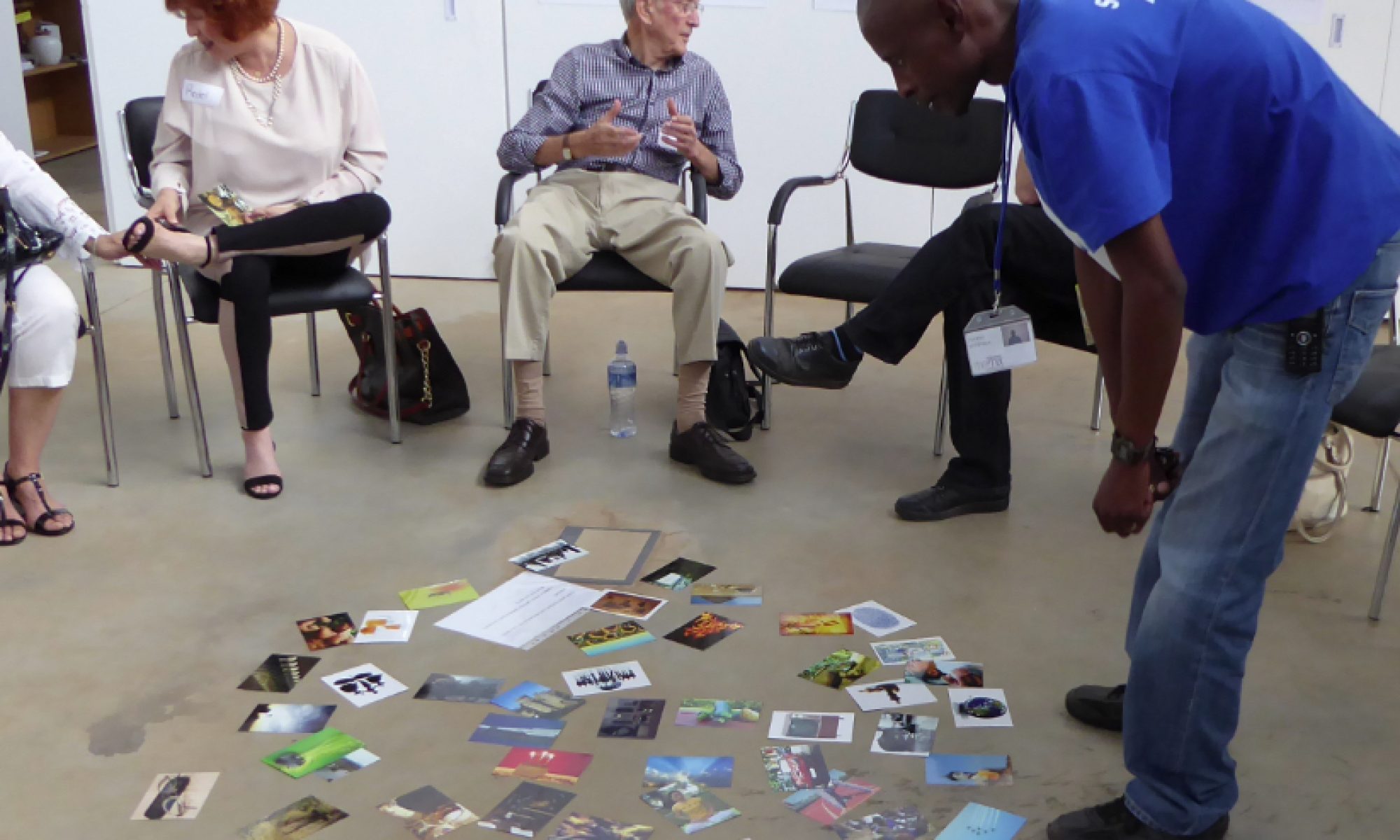
Change 3 things

Goal:

• Practice awareness skills.
• Practice creativity.
• Ice breaker.

Overview:

In Pairs participants observe each other then turn around and change 3 things about their appearance. When they turn back to each other they must try to identify everything that their partner has changed.

Time: 10 min

Number of participants: 2 – 200

Game flow:

Ask all the participants to pair up. Tell them to observe each other. Then tell them to turn around and change 3 things about their appearance. For example role up one sleeve or take off an earring. Let them turn back to one another and try identifying everything that the partner has changed. You can repeat the game a few rounds, every time increasing the amount of changes.

Tips:

People are often resistant to change their appearance but don’t let that flounder you. When people get over their initial resistance they will get great value from the exercise.

Debrief questions:

• What struck you about the exercise?
• How did you feel during the exercise?
• How was your awareness different than usual?
• Was it difficult or easy to find so many things to change about your appearance?

Yes and story

Goals:

• Practice listening and awareness
• Practice accepting offers and building on them
• Practice focusing and reincorporating.

Overview:

Participants tell a story in a circle, each participant contributing one sentence at a time.

Time: 20 min

Number of participants: 4-12

Game flow:

Have everyone sit in a circle. Get a name for an original story from the participants. Anyone in the circle may start to tell the story by saying an opening sentence. The person on their left then builds on the opening line by adding the next sentence to the story by starting their sentence with “yes and”. The person on their left then adds the next sentence also starting with “yes and.” Continue the telling of the story, each person starting their sentence with “yes and”, until it comes to a conclusion.

Tips:

The easiest way to get a name for the story is to first get a name for the main character (ex. Jimmy). Then ask what Jimmy is (ex. a donkey). Then ask what the main character’s biggest challenge is (ex. to win the J&B Met). The name of the story could then be something like: “The day Jimmy won the J&B Med.”
Often people struggle to get the story to a conclusion. This could be a very interesting observation to debrief. When participants struggle to conclude the story, remind them of the title. For more advanced players you can tell the story without a title.

Debrief questions:

• What was interesting about this exercise?
• What made it difficult?
• What did you do to make it easier?
• What would you do next time to tell a better story?
• How did the title help or inhibit the story telling?

Variation: One word story

In this variation instead of contributing one sentence at a time the participants only contribute one word at a time.

Yes lets

Goals:

• Build positive energy.
• Practice acceptance and appreciation.

Overview:

Participants suggest random activities to be done by the group. The rest of the participants support these suggestions by responding enthusiastically with the words “Yes lets!” and then mime the suggested activities eagerly.

Time: 15 min

Number of participants: 6 – 20

Game flow:

Have everyone walk around in the space. Tell them that anyone in the group can make a suggestion for an action such as “Let’s climb a tree!” or “lets bake a cake!” Everyone then replies with the words “Yes lets!”, and mimes the action with enthusiasm. At any point someone else can make a new suggestion and everyone replies again with “Yes lets!” and again mimes the action. Continue until everyone has made at least one suggestion.

Tips:

For this exercise you need enough space for everyone to move around.
Encourage everyone in the group to make at least one suggestion.

Debrief questions:

• How do you feel after playing this exercise?
• What was interesting about the exercise?
• How did it feel to have your suggestions supported with so much enthusiasm?
• How did it feel to support other’s ideas with so much enthusiasm?

Notes:

The best way to make your team members look good is by accepting their suggestions and doing the action with enthusiasm. If someone said something like “let’s roar like lions” and just did it by himself, he would look like a fool and probably feel like one as well. What I love about this game is that you don’t just say yes I like your idea; you actually have to accept the idea by doing something with commitment. Often we will say we accept someone’s ideas but it’s just lip service, because we don’t actually take any action. The safety, trust and support that is generated when everyone in the team is committed to making the rest of the team look good, creates a energetic atmosphere in which innovation can thrive.

Gifts

Goal:

• Building energy.
• Accepting offers.
• Practice appreciation.
• Practice creativity.

Overview:

Participants hand each other imaginary gifts. The giving participant only makes a physical offer, while the receiving participant names the gift and accepts it with enthusiasm.

Time: 15 min

Number of participants: 2 – 200

Game flow:

Have the participants stand in a circle. If there are more than 12 players let them pair up. Tell them to hand each other imaginary gifts. The giver only makes a physical gesture with their hands. The receiver then justifies the shape and weight of the giver by naming it appropriately. The receiver over accepts the gift with enthusiasm as if it is the one thing they have always wanted.

Tips:

When doing the game in a circle let them pass gifts around the circle. In other words everyone gives a gift to the person on their left or right. Only one person gives a gift at a time while the others observe. When doing it in pairs the partners just give each other gifts.

Debrief questions:

• What was interesting about the exercise?
• How did it feel to have your gift appreciated like this?
• What did it feel like receiving the gift?
• How does this apply to creativity and collaboration?

Online adaptations

Since people in an online room cannot stand in a circle or make eye contact to connect with each other, the following adaptations can be made:

  1. The names of participants are visible on the screen, these names may be changed by participants if they wish. These names can be used in the game so that the participant wanting to pass a gift simply call the name of the person they wish to pass their gift to before doing so.
  2. Participants may also be given a number alongside their name as they enter the room. These numbers may be used to establish an order and in this manner replace the convention of a circle for deciding order.
  3. Encourage people to use distance from the camera as a way to create variety in the size and quality of the gift:  move away from the camera for big gifts that require large movements and come closer for smaller gifts and smaller movements.