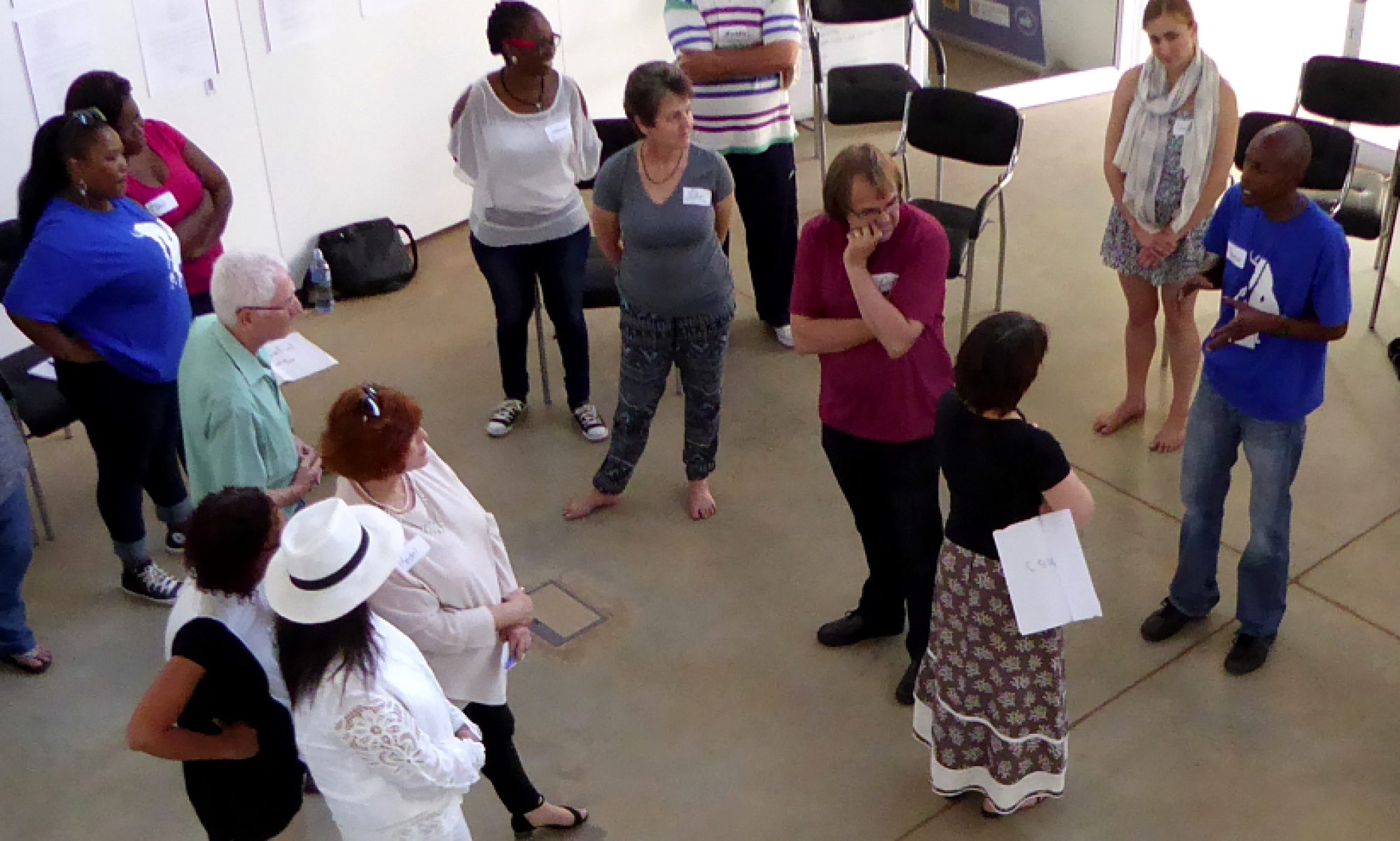
Improvisation class 5 – Stories

By Luci and Burgert

The focus of last nights class was story.
As the participants trickled in and we moved our chairs into the habitual circle De Wet shed a little natural light on his story by telling us about his drumming days with a band called Jesse Jordan. I googled “Jesse Jordan Band” this morning…they are on Wikipedia. I am impressed. On their album “Flipside” ( were you still with them when they released this one De Wet?) there is a song titled “ There goes my mind”. This track title has inspired this morning’s blog.

As mentioned, the theme for last night was “ Story” . Normally when people think of stories or re telling stories they make an effort to alert their mind that mental files will need to be pulled up ASAP and that no dawdling or “ absentmindedness will be tolerated. The internal judges stand at the gates like rodeo cowboys ready to bring in that wild idea before it sees the light of day…

This process is not conducive to the spirit of Improvisation. As you step onto the stage with someone… say these words…” There goes my mind”, and then, you play…

Herewith a short list with descriptions of games we played:

Todododo – a word association game with a rhythm.
Word association – simple word associations around the circle
Random sentences – One player thinks of 4 random sentences that another must relate together in a story.
Automatic story – one player has to ask yes/no questions about the storyline of an unknown story that the other player has in mind. What the questioning player doesn’t know is that the person answering the questions is only saying yes to questions starting with a vowel and no to questions starting with a consonant.
What happens next? – In this game one player stands in the middle of the circle and acts out a story that the rest of the group make up one sentence at a time. After each sentence the player asks “What happens next?”
Voices from the grave – 3 Players tell a story of how they all died at the same place at the same time.

Voices from the grave may sound somber and at times the subject matter does twirl on the dark side but it is a wonderful tool for “co creating” a new reality.
Cindy gave an Oscar worthy performance as the disgruntled blind nurse, whilst Manuela provided a critically praise worthy portrayal of a depressed psycho therapist at the end of her tether. Charl gave, excuse the pun, “life” , to the chirpy car salesman and together these three caused for immense entertainment with the rest of the group…thanks for sharing what’s left when your mind goes…

Key concepts:

Free association: Free associated ideas create the material from which a story can be constructed.
Reincorporation: Reincorporation is the recycling or re-using of ideas or situations from earlier in the story. By reincorporating ideas and situations you make sense of the random ideas generated by free association.
Platform: The who, what and where of a scene. Success of a scene often depends on a solid and clear platform.
Breaking routine: A good story that will engage an audience is a series of routines that are broken creating new routines.

More thoughts on story:

Stories are how we make sense of the world. We link random events together to form stories. This is a great skill, but it also has a dark side. The dark side is that we make up stories about ourselves and others that are not the truth. Then we tell ourselves these stories over and over until we believe them to be true. Here is an example of how this happened on a flight from Dubai to Amsterdam. Last year Luci and I went to Amsterdam to present our Improv cooking for couples workshop at the Applied Improvisation Network conference. During our flight from Dubai there were a few men of Middle Eastern appearance standing around in the open space by the bathroom. They were talking and the one young guy looked somewhat nervous. Luci saw them and started making up a story in her head about the men being terrorists and that they were going to hijack the aeroplane. She became very nervous and couldn’t focus on the movie that we were watching. I saw this and asked her what was going on. She showed me the men and told me what she thought they were up to. I told her that what she just told me was mostly a story and that the likely hood of the men being terrorists was very small. So I asked her what other story she could construct about the men that could also be the truth and that was not so scary. So she made up a story about the nervous looking young man that was on his way to get married and that the other men were there to support him. This story calmed her down and made her smile, and we could enjoy the rest of the movie. Who knows what the real story was. The fact is most of our experiences are only stories that our brains construct by linking random facts together. It is important to be aware of this function of the brain. The brain does this as it does not like uncertainty so it would rather create a story to create some form of certainty. However as soon as we start believing the stories our brains make up we become less present and unable to notice facts that do not support our stories. Being aware of this function of the brain is very useful. Firstly, next time your brain starts to make up a story you can be aware of it and just notice that it is your brain making up a story and stay present to notice the truth of the moment. Secondly, you can use your brain’s ability to make up stories to create very entertaining improvised performances.

See you all next week!

Improvisation class 4 – Characters

Class 4 was about characters – how they walk talk and feel. We started with gibberish games (Emotion gibberish, Gibberish switch and Gibberish Insults). Gibberish helps one to focus more on how a character talks than what they say. How a character talks is just as important if not more important than what the character says. Gibberish also helps you to get out of your head. Next we did Character Walks. These game shows you how your body can think for you to make up a character by just changing something about the way you move. You can change any part of your body, the speed of your movement or how you fill the space around you. It is amazing how the way you carry your body influence your feelings. We ended the class with a gibberish performance game called Cluedo. In the end it is not about getting it right but about making a strong choice and sticking to it.

Key concepts

Gibberish – A made up language of witch the meaning is conveyed by action, expressions, or tone of voice.

Let your body think for you – By just changing something in your body you can come up with a whole character with feelings, wants and passions.

Make a strong choice and stick to it.- It is not always important what you choose but how you choose

Improvisation class 3. Present in every moment

The third class was all about listening, awareness and being in the moment. We started the class with a relaxation exercise to help us become aware of our bodies. Becoming aware of your body is a great way to get out of your head and become present.

Next we played Mirror Mirror. In this game participants partner up and mirror each other’s moves. In the first 2 rounds only one person is in control while the other just follows. In the last round the two participants must give and take the control. This forces you to be present in the moment. Sometimes when there is a high level of trust between participants control totally dissolves and the two players just flow together.

After that we played a series of group awareness exercises. First one person had to go in the middle and make a move and a sound, give the focus to another player, who had to copy the move and sound and then go to the middle and morph into a new move and sound. We played two other variations of this game. In the first everyone copied the person in the middle and at any point anyone could take the lead and change the move and sound into something else. In the second variation we didn’t stay in a circle and anyone could take the lead. These exercises feel awkward and odd when you do them the first time, but if you can let go and really pay attention to what others are doing and once again make them look good (in this case accepting whatever they are doing and do it with them) it is a wonderful experience of connecting with others and being in the moment. Check out this Ted Talks Video about how a crazy nut is turned into the leader of a movement by someone else who made him look good by mirroring his moves.

A good improviser is aware of everyone in the group and can pick up subtle offers. A good improviser is also aware in every moment, knowing when he/she needs to take control and take initiative and when he/she needs to give over control and allow someone else to take the focus.

After the awareness exercises we played Monster talk (Speaking in unison) which is also a great exercise in active listening and the “give and take” principal. We ended the class with Monstertalk scenes.

Key concepts:

Give and take – It’s all about giving up and taking control, and sharing and taking the focus. To do this well, you have to be aware and present so that you know whether the situation requires of you to take or give up control/focus.

Listening and awareness: In Improvisation this is referred to as “being in the moment” .It requires you to be present, pay attention to what is happening around you and to focus. To do this you need to let go, get out of your head and into your body.

Improv Class 2 – Yes and

Yes and is a phrase used to describe the most fundamental practice in improvisation. Yes and means you accept an offer and do something with it. And remember from last week’s class that “everything is an offer even a so called mistake. Not accepting an idea is refered to as a “block” in improv. To illustrate this we played a game called Yes and vs. Yes but. In this game players pair up and plan anything like a road trip or a party. In the first round each participant starts their sentence with “yes but” and a reason why the other person’s idea is not a good idea. In the next round each participant starts their sentence with “yes and” – accepting their partner’s idea and building on it. The difference between accepting and blocking are very evident when you play this game. Blocking results in negative energy and competition that gets stuck in disagreement while accepting leads to positive energy and collaboration that leads to possibility and flow.

The next game we played was Gifts. In this game participants give each other a physical offer in the form of an imaginary gift. The receiver then accepts the gift with appreciation and builds on the offer by saying what it is. By naming the gift, the participant accepts the physical offer by justifying its shape and weight. We also played a game called “blind offers” in which one participant makes a physical offer and then another participant makes sense of the physical movement by saying something.

We ended the class with a game called “One Word Story”. In this game all the players tell a story by adding one word at a time. This is a very difficult game and often the stories that are created aren’t very satisfactory. It takes time for a group to really flow in this game. At first the players get frustrated with each other and try to control the story somehow. The only way to really succeed in telling a story like this is to be present, listen, let go of your own idea and just accept what your fellow players say before you and build on it. It requires a lot of trust in the rest of the group and in yourself. Just always remember to accept your own and others mistakes and make your partners look good.

Improv class 1 – Just play

On my way to the opening class in a series of 8 in Improvisation, I came to the realisation that the current series is the 5th since the inception of these classes last year. I felt so honoured that every time I present a class between 6 and 12 people show up and unquestioningly open themselves to the power of vulnerability by letting down their guard and become fully alive in the present moment.

The theme of the first class was “play”. We started the class with an introductions game called story exchange. After everyone was introduced we played a couple of name games (Name circle, Bang bang and superheroes)to get better acquainted with everyone’s names. We then played Bodyguard. In this game each player picks 2 other players in his/her mind and assign them with the roles of bodyguard and enemy. When the game starts each player must make sure that his/her enemy is always between him/her and his/her enemy. This causes a lot of playful running around and laughter. I remember the first time I played this game I felt the freedom of being a child again. I think what makes this game so much fun and creates so much laughter is the fact that you have a very simple goal that you can never completely attain without moving. Another reason why I think the game is so much fun is because you can see how your movement impacts everyone else and that gives you an exhilarating sense of belonging. The next game we played is called “Bunny bunny”. This game is too wondrously absurd to explain on paper. It requires a constant focus and being present. Our fear for failure is often what prevents us from being present. That is why we say in improvisation there is no such thing as a failure or a mistake. In improv everything is an offer, even a so called “mistake”. An exercise that I use to illustrate this is very aptly called “I failed” or also known as Circus bow. In the game every participant is given a chance to make a large bow and say anything along the lines of, “I failed” or “I made a mistake”. The rest of the group then gives a big round of applause…as though this failure was a beautifully constructed success.

The last game for the evening was “Yes lets!” In this game any one can make a suggestion like, “Lets play soccer” or “Let’s howl at the moon”. The others then respond very excitedly with the words, “Yes lets!” and mime doing what was suggested with enthusiasm. It’s amazing how much fun this game is if you really commit to it. It is not very often that people accept our ideas with so much enthusiasm and not just say they support it but also do it right away. This is absolutely the spirit of improvisation – contributing and appreciating. What a great way to end our first class. Thank you for everyone’s participation.

How to Communicate Confidently

Grow your voice book cover

“A voice is a human gift; it should be cherished and used, to utter fully human speech. Powerlessness and silence go together.” – Margaret Atwood, Writer

I learned the secret of confident speaking when I was 16. I was performing before a judges’ panel at the Stellenbosch Eisteddfod. The category I was performing in? Poetry. The poem? ‘Die Dag op Nuweland’ – a satire by Jeanne Goosen about a typical South African rugby match, a day at Cape Town’s Newlands rugby stadium.

The judges had already heard me perform, but they had called me back to do it again. As I stood there I had no idea why.

Since I was 11 I had taken part in speech and drama classes and competitions. This was the first time I saw the judges requesting a repeat and, believe me, I had been at many of these competitions.

Were they thinking it had been so great that it must have been a fluke and they wanted to see whether I could do it again? Did they not like my performance? Had I failed so miserably that they wanted to give me a second chance?

I remember deciding to forget why, and to give it my best shot.

I also remember doing two very specific things during my second performance.

First, I looked straight in their direction, fixing my gaze on them and unveiling my eyes so that they could see into my soul. Fearlessly, I allowed them to see what I saw in the words.

Second, I remember matching that unveiling of my intention with my voice.

I took the first words: “Hoera Boland en Haak Vrystaat!”

It was as if I had the ball tucked in the crook of my arm, was aiming at the goal line and pumping my legs, running free, fast and furious.

My voice was controlled by my breath, supported by a rock hard diaphragm, allowing it to resonate in a completely relaxed chest cavity, while the muscles in and around my mouth clearly and carefully shaped each word as I followed the rhythm and melody of the poem.

I did not allow tension or fear to show, and not once did I let nerves and uncertainty interfere with my voice.

As I drew the performance to a close, I held the attention in silence for a moment and then broke off my gaze. The audience was quiet for moment and then one of the judges stood up and began to clap. The rest of the audience followed with thunderous applause (well, thunderous for the twenty-odd people who were there for their own children’s performances). It was the first time I received 100% for a performance. I had cracked the secret of pulling an audience into the performance as opposed to bombarding them with it.

Here is the thing: I could only guess at where the judges sat and whether I was looking them in the eyes or not.

You see, I am partially sighted, I cannot look anyone in the eye without faking it. I have no central vision (I call it doughnut vision because all the good stuff is on the sides with just a hole in the middle). If I look straight at anyone, I cannot see them. This can either cause me to look blank and unreceptive, or I can choose to look straight at them and not see them, but unveil my eyes and let them see into my soul.

This is a trick I had learned long before, so that the cute, cruel boys in grade 5 would not call me Crossed Eyes. Unmasked authenticity is disarming, intriguing, rare and memorable.

But once the audience is inside, they must find something there that is worthwhile and meaningful, something that is powerful and promising, especially if they are to be part of it. This is where your voice and your message come into the picture.

At my poetry performance of ‘Die Dag op Nuweland’, I learned to match that pull of the unveiled soul with a voice that did the same, but this time with something worthwhile to offer in return. Drawing the audience into how you see things invites them into a world set apart from their own.

If that world is inviting and engaging, they are moved by the confidence you have in your message and material. This is the opposite of what most people think communication is about. Most people think it is about getting the message across the big divide between you and someone else. They think it is about throwing it out there and hoping it will hit the mark.

It is not about throwing the message out, but about drawing the audience in.

A speaker’s voice must invite confidence and instil trust, while at the same time it commands attention and motivates the audience.

A voice that is both inviting and influential possesses certain physical qualities. Most voices do not have these qualities naturally. Yet, with knowledge and practice you too can cultivate this kind of voice.

As with training for the Comrades marathon (89 km between Durban and Pietermaritzburg), your body needs to unlearn bad habits and relearn new ones. When you train for a marathon, you need to teach your muscles to persist working under strain. You have to condition them so that adjusting to the road and the conditions becomes automatic and you can keep your mind on your goal.

“If you don’t ever stop singing, your voice stays in shape. It’s like the marathon runner. You’ve got to run, run, run to stay in shape.” – Sammy Hagar, Musician

Similarly, speaking invitingly and confidently with a trained voice can become automatic so that you can keep your mind on the message and the audience.

To replace unwanted habits with new ones takes at least six weeks of dedicated hard work. This course is designed to lead you through such a six-week training programme so that the vocal habits you need for confident, inviting communication becomes automatic.

Grow your voice is a six-week course designed to help you automatically

• find a good posture that helps you relax and communicate confidence

• use breath to control your voice and your nerves

• produce a rich, warm voice that invites attention and instils trust

• shape sounds skilfully so that every word is heard without strain

• create emotional engagement by enticing the listener to keep on listening.

“It usually takes more than three weeks to prepare a good impromptu speech.” – Mark Twain

You have just read the introduction to my book: Grow your voice to Speak with Confidence. The book is a 6 week course and includes a training CD with exercises.

Click here if you would like to buy the book.

Come to one of our workshops or courses.

Or contact me for individual coaching options.

Dr. Petro Janse van Vuuren

“Yes and” exercise

“Yes and” is a phrase that improvisers use to describe the principle of accepting ideas and building on them.  This principle is important for any team that wants to develop an innovative team climate (click here for an article on innovative team climate).

Here is a quick exercise to introduce the principle of “Yes and” to your team. Let everyone pair up with a partner.  Tell them that together they have to plan a company Christmas party.  One must start by sharing an idea. The other replies with the words “Yes but”, and a reason why the afore mentioned idea cannot work, and then this participant shares another idea. The first then replies with “yes but” and so they go back and forth blocking each other’s ideas.  After a while stop them and ask them to plan the same party but this time instead of saying “yes but” they must start their sentences with “yes and”, accepting the other’s idea and building on it. Reflect on the exercise and ask the following questions.

  • How did accepting feel different from blocking?
  • How were their outcomes different?
  • How did they feel about the other person when being blocked or being accepted?
  • What are the benefits and the costs of accepting?
  • What are the benefits and costs of blocking?

<iframe title=”YouTube video player” width=”480″ height=”390″ src=”http://www.youtube.com/embed/w2Y3oh5Jcqc” frameborder=”0″ allowfullscreen></iframe>

Team Innovation Workshop

A half day workshop for managers and team leaders who want to learn practical ways to develop their team’s ability to collaborate and innovate.

Contact us to make a booking or find out more.

Innovation, Teamwork and Improvisation

The world of work is characterised by high levels of uncertainty due to constant change, forcing organisations to innovate recurrently in order to survive. Researchers agree that working as part of a team plays a very important role in the process of innovation within organisations, as teams stimulate creativity and innovation. The development of Team Innovation is therefore crucial to help organisations to adapt faster to the demands of change. This emphasis on team innovation is very prevalent in value statements and guiding principles of many organisations.

Having teamwork and innovation as values laminated on your wall is however not going to improve your team’s ability to work more creatively together. Having people work in teams and expecting them to therefore automatically be more innovative, often has the opposite effect. Individuals become in many cases less innovative when they work in a team. The reason for this is the nature of the team’s climate. Team climate refers to the shared perceptions of team members in terms of what is expected of them, work standards, recognition and their feelings about their manager and one another.

The following table shows the characteristics of an innovative team climate in contrast to a non innovative team climate.

Innovative team climate Non-innovative team climate
All the members participate in discussions and decision making. Members don’t participate and decisions are made by the most dominating person.
Members are aware of others and listen to one another. Members don’t listen to one another.
Members take risks and make it safe for others to take risks by accepting failures. Members don’t take risks and ridicule others who take risks that fail.
Control is shared by the whole group.  Individuals take initiative and allow others to take initiative . Control belongs to one person and others aren’t empowered to take initiative.
Ideas are appreciated and there is a high level of trust and support amongst team members. Members don’t trust or support one another and ideas are criticised rather than appreciated.
Members accept and build on each other’s ideas. Members block each other’s ideas.
Members share a clear and common goal. The goal is not clear and not shared by everyone in the team.

So is your team’s climate innovative or non-innovative?  And if it is non-innovative, how can one change it to become innovative?

This was the question that I grappled with when I was doing my Masters research in Industrial Psychology. I looked for teams who succeeded in working together in a team, very creatively under high pressure and much uncertainty, to see what I could learn from them. I found such teams in a place very out of the ordinary, namely Improvisational Theatre. Improv theatre groups work together very creatively under the pressure of a demanding audience and the uncertainty of having no script. How could these people do something so daunting that most people would rather die than do? And this may also be exactly the reason why most teams tend to be more non-innovative that innovative – it is because being creative is scary. It is making yourself vulnerable in front of others. Yet, somehow improvisers have found a way to make it safe and to create a team climate in which creativity can thrive. Improvisers do this by applying a few basic principles of which I will share two in this article.  These are 1) appreciation and 2) building on ideas or in Improvisation lingo … as 1) “make your partner look good” and 2) “yes and”.

In her book, “Time to think”, Nancy Kline emphasizes the importance of appreciation to create a thinking environment. This appreciation of another’s idea is described in Improv by the phrase “Make your partner look good”. It means that when a fellow player makes an offer you make him/her look good by accepting it with enthusiasm. This relates in an organizational context that whatever idea your team members share, you don’t make them feel foolish for sharing it.  You regard their offer as a gift of great value. When team members start appreciating each other’s ideas by focusing on the value of the idea instead of criticising it and looking for reasons why it won’t work it builds trust amongst the members and people start feeling safe to share their ideas.

It doesn’t stop with appreciating ideas however. After you appreciated your team member’s idea, build on it. Actors in an Improvisation theatre group call this acceptance and building on ideas the “yes and” principle. When an idea is not accepted, it is called a “block”. The way we often block one another in real life is by saying “yes but”. Most people are more used to saying “yes but” than “yes and”. Every time someone shares an idea and it is blocked by another team member, the likelihood that the person will share another idea is diminished. Therefore to create an atmosphere that promotes idea sharing, start applying the “yes and” principle.

The “yes and“ principle is more a mindset than anything else. In her TED talk entitled “Improv not just for comedy anymore”, Cat Koppet states that applying “yes and” doesn’t mean that you agree with everyone, but rather that you accept others reality. It is a mindset of accepting a situation and doing something useful with it. Kline notes that the human mind works best in the presence of a whole picture of reality. This contains positive and negative aspects. Most of the time there are more positives than negatives in the complete picture of a situation. Carol Painter, the developer of the Negative Reality Norm Theory, states that according to society a realistic picture of reality is more negative than positive.  Being positive is regarded as naïve and vulnerable. Whereas being critical is informed and sophisticated. Therefore most organizations function on this negative norm, resulting in the pervasiveness of “yes butting” and team climates that stifle innovation.

Right now you might think “yes, but I can’t say yes to all ideas all the time”.  Yes and you might be saying this because you are already in a mindset of “blocking” rather than “accepting”. It is true there are appropriate times to block, but they are far less than appropriate times to accept. Try the “yes and” principle for a day and see what happens.

Click here for an exercise to introduce the “yes and“ principle to your team.

Team Innovation Workshop

A half day workshop for managers and team leaders who want to learn practical ways to develop their team’s ability to collaborate and innovate.

Date: 20 May
Time: 9:00 – 13:00
Venue: Stellenbosch
Contact Burgert on 0822559625 or burgert@playingmantis.net

Improv class 7 – Physicalization

Physicalization is the method used by improv players to create imaginary locations, objects, and events. The best way to help the audience and your fellow players see the objects and environments that you create is if you, yourself, create those imaginary environments.

We started the class with a warm-up game called “Sound ball” or “Morph ball” as I like to call it. In this game participants pass imaginary balls accompanied with a sound to one another. The one catching the ball receives it with the same characteristic (wait, size, consistency ect)) as the one passing it and then morphs it into a new ball with different characteristics.

I then took the class on a guided fantasy into their imaginations. The adventure began on the beach, moved to a second-hand store, into a forest, into a castle with a table with delicious food, into a room with paintings of significant events, into a room with a person on a throne and finally into a garden. It is amazing to see how your imagination and your past experiences along with your current state of mind work together to create this dream like experience. Stephan saw King Arthur and Luci saw BA Baracus who demanded to know why she was so afraid…

In the following exercise we passed imaginary objects to each other. It was funny to see how the rat turned into a hatching egg.

For the next exercise everyone had to reach under their chairs and pull out an object without thinking beforehand what it was going to be. They had to discover something and then explore it until they got an emotional reaction from it. It is easier said than done not to think ahead and just let go and discover something. However ,when you allow yourself to discover, your discovery is much more interesting and your emotional reaction far more authentic. The essence of improvisation is making discoveries in the moment. This means you have to trust yourself and let go of the need to plan ahead. When you plan ahead you are not open to all the possibilities that are present in the moment.

Next we played an environment exercise. For this exercise a location is determined and then one by one each character must enter the location and use all the objects that all the previous players used and then add another object. It is important to remember where each object was placed. A good way to practice your physicalization is to notice in everyday life how you hold different objects. Doing this will help you to be more present in your day to day actions. We picked a band practise room and a dance studio for our locations. I really enjoyed the characters that everyone used in the environment. When you explore in a character you find a lot more fascinating things to do with the object. Choosing a character and acting and reacting from that character are probably one of the most important improv practices. For me it is also one of the best applications of improv in everyday life. Who you are, is more important than what you do, because who you are determines what you do. Therefore it is more important to figure out who you are than what it is that you are suppose to do.

For the final exercise we played two person scenes where the first player had to establish an environment through physicalization (the where of the scene). The second player had to establish the relationship between the characters (the who of the scene). The scenes were lovely, thanks for everyone’s participation.

Comments?

Improvisation class 6 – Status


We started the class with 2 name games, namely Bang bang and George. What I love about George is how the clapping is like the principles of improv. At first it is really difficult to get the clap sequence right, but after some practice you don’t even think about it anymore. It becomes a structure around which you can just improvise. After George we played “What are you doing?”. This game stretches your mind and shows how much you actually think with your body.

For the first status exercise I gave everyone a number that only they could see and told them to play a gibberish scene on a pirate ship. They had to exhibit their own status and try to figure out the status of the other players. It was interesting to note that how much you speak has no influence on your status. Someone who speaks a lot can be a babbling fool or on the flip side…one who barks orders at everyone else. Someone who is silent can feel they don’t have anything worth saying or by adjusting the energy behind that very silence, command the attention of others. It all depends on how you talk or stay silent. It is also fascinating to see how people with different status interact with their environment – players with high status move around a lot like they own the space, while low status players only occupy small spaces.

For the next exercise I stuck a number on each person’s forehead representing their status, 1 being the lowest and 10 the highest and told them to play a scene in a castle. The aim of the game is to discover your own status by the way others react towards you. It was interesting to see how those with low status bond with each other, while those with high status often find themselves in conflict.

For the last part of the class we played silent 2 person scenes using different statuses. The silent, scenes forces players to show and not tell. It also helps players to pay more attention to what the other player is doing and react more truthfully. I instructed the players to naturally switch their status during the scene. This switch made for attention-grabbing interactions. It builds on the idea of breaking routines that we played with in the previous class about story (read more about story here). Changing the status hierarchy in a scene is a great way to break a routine and creates great story. People love stories in which the underdog triumphs or where the oppressed is liberated and the oppressor taken from power.

More thoughts on status:
In all human interaction there is some form of status interaction taking place. In everything you are saying or doing you are either heightening or lowering your status, however subtle it might be. People usually have a natural preferred status that they play. Whether it is high or low, it is usually a form of defence mechanism. People who prefer high status very often want to keep others at a distance while those who play low status may be people pleasers. High or low status isn’t inherently good or bad, but understanding how to use status in your interactions with people is a very useful social skill.

Please share some of your thoughts on status.