What is Applied Improvisation?

What is Applied Improvisation?

Improvisation (without the ‘Applied’ part) is a kind of theatre or music where performers make up the scenes or songs on the spot in front of the audience in real time.

Applied Improvisation is the practise of applying and developing the same skills that actors or musicians use, but in contexts that are not linked to the stage. These are contexts like the workplace or in your personal life where the skills are equally important for success. (For the historic development and examples of Applied Improvisation see Wikipedia-article).

That means, instead of learning to act on stage like the guys from ‘Whose line is it anyway’, , you learn to act with greater confidence, collaboration and innovativeness in your work or personal life.

Improve your improv skills e.g.:

Self confidence and spontaneity

  • Building rapport and communication skills
  • Knowing when to lead and when to follow
  • Finding your creativity and allowing the creativity of others to flow
  • Accepting mistakes and using failure
  • Laughing and playing more
  • Thinking on your feet

Easing past social resistance

Who is in this with me?

Do I fit in?


EeyoreEvery coaching client or participant wants to know:  am I alone in this? Many times somewhere in a coaching session a client would ask something like: “Is it just me who have these issues?” or “I sometimes wonder of my situation is more messed up than other people’s”. Just yesterday one asked me: “Do other women also struggle with the fact that their male colleagues are allowed to rant and rave and get all emotional, but as women they get patronised when they get upset?”.

In facilitations, it is often feedback like: “we discovered that our problems are very similar” or “i am so glad I am not alone in this”, that helps the facilitator know that social resistance is breaking down. Yet, this is not one you can give a single blow and be done with, it can take some people a long time to feel part of a group. This type of resistance must be gently worked on throughout a coaching session or a facilitation.

In the Lord of the Rings Frodo has learned that he is chosen (breaking through personal resistance) he has learned that he can trust Gandalf  (relational resistance) and he has heard the plan (practical resistance). Now he trembles as he almost accepts his duty…”So I must go to Mordor and deliver this ring into the fires that created it. And I must go alone…” But Gandalf surprises him. The wizard gets up, opens the door and brings in Samwise who had been eavesdropping the entire time. Neither Samwise nor Frodo can believe their good fortune when Gandalf informs them that Samwise must accompany Frodo. Sam is thrilled because of the promise of adventure, Frodo is thrilled because he would not be alone.

Samwise becomes Frodo’s loyal companion and it is thanks to him that Frodo finally manages to achieve the objective. We all need loyal support when we accept a new idea, try out a new habit or open up to a new perspective. But there are other social forces too that are needed to make sure we succeed and we must work on all of them throughout a process. I will share six of them with you here. Note that they work together in pairs.

1. The Sidekick and the Sceptic

Samwise is an example of the Sidekick – someone usually in the same peer group as the hero (the hero is of course your audience member). It can help to tell a story or produce a testimonial from someone like them who has gone through a similar problem as them and successfully made it through.  It is even more powerful if you can let people in a team coaching session or facilitation share stories and they become each others’ supporters. Like Piglet for Winnie the Pooh it is important that people are supported unquestioningly and with positivity. Yet opposite piglet sits Eeyore…

Sceptics who end up succeeding provide the most powerful success stories. A sceptic’s voice is even more powerful when he/she is of a higher status than the general status of your audience: if their boss’s is willing to share their own story of struggle, it can be an especially meaningful experience for participants, especially of this person really struggled to accept a certain truth or perspective that may be useful for their learning. Piglets bring positivity into a room, but Eeyores bring gravity and credibility.  What would it mean to my client who asked the question about men and women in the workplace if she could talk to an influencail woman leader about her frustrations? Especially if it was also someone who were sceptical about voicing her thoughts out loud at first, but had begun to speak out?

2. Emotion and Reason

People need to know that they will be both emotionally and mentally accepted into the fold. They need to feel good about participating and be able to satisfy their logic. If both Tigger and Owl support take part, they will be likely to accept it too. Ever wondered why advertisements either use sex appeal or scientific proof to make their point? Your case is doubly stronger if you can do both. This is why so many presentations use either a celebrity or a professor’s quote or story to strengthen an idea.

In both coaching and facilitation it is important to strike a careful balance so that you make room for emotions and listen to them, but also provide models and structures for the brain to make sense of the learning.  It is, for instance, important for me to allow my client to explore both the feelings and logic around the different behaviour of men and women in the workplace. Focussing on feelings may make her feel that her experiences were only emotional and not also logical. Focussing on the logic could cause her not to deal with her emotions around it and keep her from reflecting on it rationally and come up with solutions.

3. The Guide and Contagonist 

When all is said and done, you as the guide will be inviting the audience into your peer group. They need to like and  trust you and they need to know if you like and trust them. But is extremely important in coaching and facilitation that you are careful to applaud or judge too readily. Because your status is very high, your response can cloud your clients’ reading of his or her own inner responses – inner responses that are essential for the long term success of your processes. Grateful acceptance of absolutely any contribution is vital so that people do not clam p and put up their defences once more.

You as Guide face the opposite energy of the Contagonist. These are people or ideas that will distract, tempt and confuse your audience. Your job is to guide them through these possible misunderstandings, distortions and false solutions that may be hidden in the ideas that arise in the process you are facilitating. Failing to do so will leave people vulnerable to failure, but will also leave the process open to criticism.  How you deal with distractions and confusing ideas is important to keep the faith of those who want to follow you through the woods to deeper insight and wisdom.

sometimes it may be important for you take a strong stand against interruptions and unmask them as disruptive threatening to highjack the process that people are on. How you handle such interruptions can greatly influence the levels of resistance in your audience.

But be careful, for seven whole volumes Harry Potter distrusted and suspected Severus Snape, but Snape ended up playing a vital role in saving both Hogwarts and Harry from destruction.  After Harry heard his true story,  sadly a little too late, Harry named one of his own sons after him. Like sceptic’s sometimes make the best witnesses, distractions can sometimes turn out to hold the best solutions.

My client’s question of earlier was the very kind of distraction I am talking about. We were just at the end of our session about how she could be more assertive in meetings and not so disengaged. My first reaction was to think that this question had nothing to do with anything until I realised that, in fact, it was at the core of her disengagement. Rather than risking becoming upset in meetings and be labelled as over emotional woman, she was checking out. The session went to a much deeper level after that.

When you can welcome loyal supporters, sceptics, emotion, reason and valuable distractions into the room, while at the same time modulating your own applause or judgement and handling negative distractions, you have reached the pinnacle of your career as coach and facilitator. This is indeed an art. The better you are at it, the less resistance there is in the room.

Of course, you can stack up all of your tricks to help people move past resistance and then a hand goes up at the back and they ask: So what is the plan? How will this work?  That is when you face practical resistance . More on this next time.

For more on the archetypes google Dramatica.

Click here to get more training in facilitation and coaching through Story-Strategy and Applied Improvisation
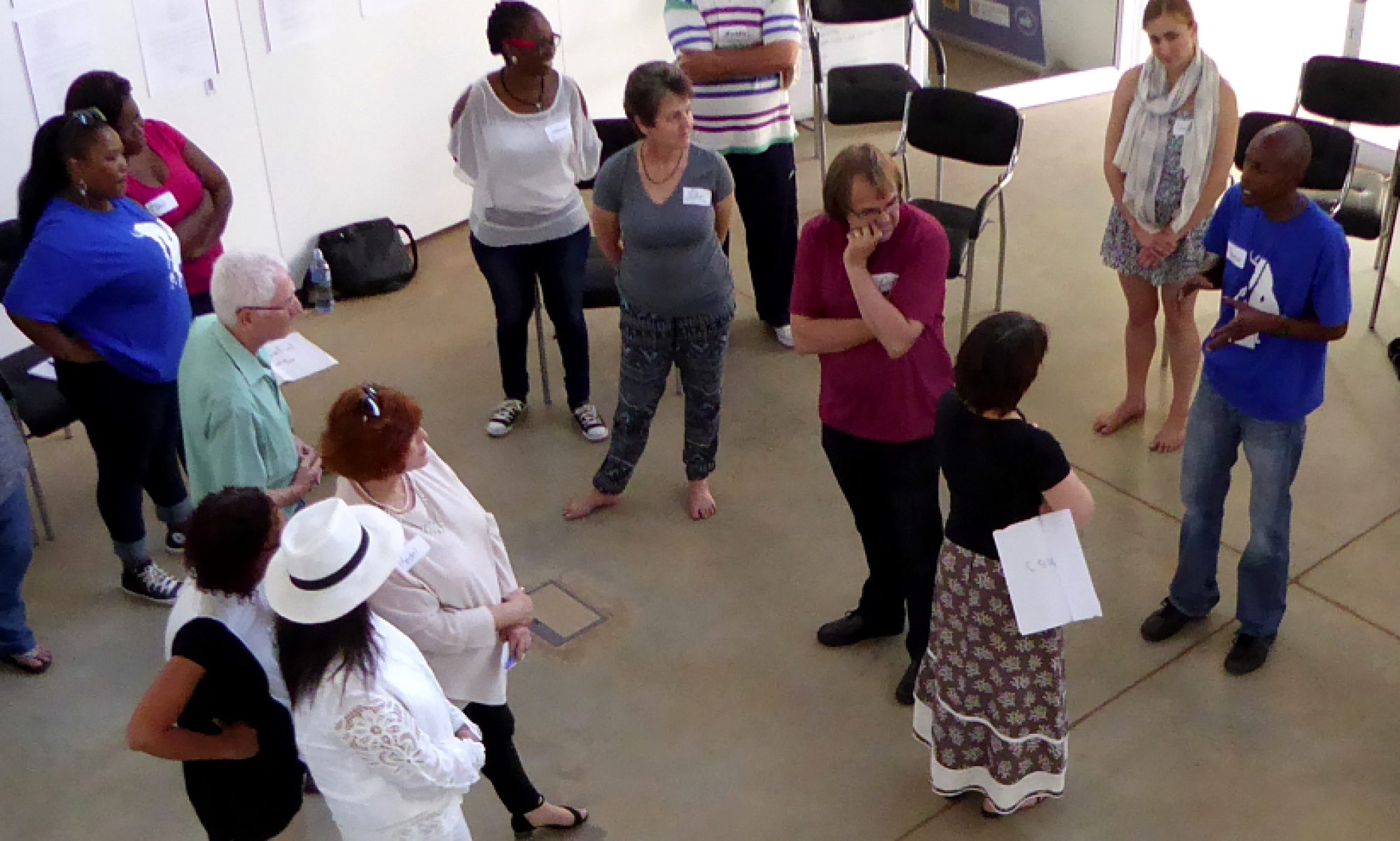


Personal ‘yes, and…’ application

This exercise is an individual application of the ‘yes, and…’ principle and requires a quiet reflective atmosphere.

You need a pen and paper.

Step 1. Reflect on an issue in your personal or professional life that you would really like to change. Complete the following sentence:

Concerning this issue, I really want  … (fill in what it is that you want to see happen).

But… (list one to 3 things that are in the way of you achieving this outcome – things that are blocking or frustrating your efforts).

Step 2. Cross out the ‘But’ and replace it with the word ‘and’. Now the obstacles become mere conditions for the solution, they are no longer blocks.

Step 3. Complete a final sentence:

So what if … (what alternatives can you think of that accepts the conditions for the solution.)

Example 1

Step 1.

I really want to read more in order to keep up to date and in step with developments in my field

But I have no time

Step 2.

I really want to read more in order to keep up to date and in step with developments in my field

But  AND I have no time to read

Step 3

So what if I get some audio books and listen in my car, or while I do the disches.

Example 2(actual example from a workshop participant)

As the event co-ordinator of a large networking evening, I really want my guests to feel at home and set the scene for a wonderful event. I also want to enjoy the event myself.

But  AND I am not a good speaker, my hands shake and I am afraid I will forget important information. I stress so much that the whole evening is a blur usually.

So what if I rehearse a short welcoming speech to set the scene and then get an MC to co-ordinate the rest of the event, so I can sit back and enjoy it.

The Alpha Name, Something nice

Possible outcomes:

Learning everyone’s names.
Creating relatedness between participants.
Creating a positive atmosphere.

Overview:

Participants line up alphabetically in a circle.  Each person gets a turn to share something nice that happened to them in the last week.

Time: 5-10 minutes
Number of Participants: 4-12.  For larger groups devide the group in smaller circles.

Game flow:

Invite participants to line up in the circle alphabetically by first name and then say their name and something nice that happened to them recently. When facilitating this, describe and model the length of answer you’d like.

Tips:

keep it short – a sentence or two. (E.g. – My name is Burgert and yesterday an old friend from high school called me out of the blue.)
If there are more than 10 people, have people say their names and then get them into pairs and share with each other something nice that’s happen. Hear a few in the big group.

Origin: I learned this from Belina Raffy who learned it from Paul Z Jackson, President of the Applied Improvisation Network.

Sound Ball

Possible outcomes:

  • Practice listening and awareness skills.
  • Practice being present.
  • Practice spontaneity.
  • Builds energy and connection.

Overview:

Players pass an imaginary ‘energy’ ball to each other in a circle, while cknowledging and creating sounds.

Time: 5 – 10 min
Number of Participants: Optimally 5-10, can run larger circles as demonstration, then split into smaller circles.

Game Flow:

Ask people to stand in a circle. Say, we’re going to throw an imaginary ball to each other.  The person who throws the ball mimes the characteristics (shape, size, consistency and weight) of the ball.  She then makes eye contact with another player and throws the ball to that person.  As she throws the ball she also gives the ball a sound. The person who receives the ball catches it with the same characteristics and sound that it was thrown to him.  The receiver then gives the ball new characteristics and throws it to someone else in the circle with a new sound. Gently correct as needed. Get a good rhythm going. The ‘ball’ should move fluidly and pick up speed in a comfortable way within the group. If people are holding on to the ‘ball’ and breaking the rhythm, after a few passes, pause the game and invite them to see if everyone can keep the rhythm/energy flowing without breaking/pausing.

Debrief Questions:

  • What did that activity encourage you to focus on?
  • What did it feel like if the ball paused?
  • What helped you to do this exercise well?
  • What delighted you?
  • What was hard?

Source: Remy Bertrand. http://www.imprology.com/

Online adaptation

Since people in an online room cannot stand in a circle, make eye contact to draw attention or aim the ball in the direction of the person they want to catch it, the following  adaptations can be made:

  1. The names of participants are visible on the screen, therefore, in order to throw the ball to someone, simply call out their name so they know it is for the.
  2. Encourage people to use distance from the camera as a way to create variety in the size and movement of the ball:  move away from the camera for big high energy balls and come closer for smaller and  more sluggish,  balls.
  3. Because of time lag, it can be tricky to foster a collective rhythm. However, you may still be able to speed up the game and create fluidity as people get into its flow.

Thank you, Alison Gitelson, for playing this game with me online and teaching me more about how to adapt it for online rooms!

The Playing Mantis (and SNE) coaching-facilitation philosophy

Strategic Narrative Embodiment participants in discussion

Conventional, also called ‘authoritarian’, learning and development philosophies are usually based on the idea that a learner is a ‘tabula rasa’ or clean slate onto which knowledge must be transferred. Learners are empty vessels into which the expert can pour information. In contrast, contemporary inclusive learning models view learners as participants rich with a personal body of knowledge acquired through experiences within unique contexts. Coaching and facilitation are processes that have developed out of these models, but are often still plagued by remnants of the transmission models of learning.

Here follows how SNE sees coaching and facilitation. (How do you see it?)

  1. Coaching-facilitation is a conversation not a monologue: for us, learning and development is no longer a top-down, one-way process, but rather a dialogical interaction between equal partners: facilitator-participant and participant- participant. Your expertise, therefore, lies in how well you can allow everyone to listen to a multiplicity of divergent ideas in one conversation, not in how well you get everyone to agree with your opinion.
  2. Delegates, not the agenda, need to drive the process: Where conventional methods assume that there is a notional ‘average delegate’ at which training should be aimed and who determines the standard, we believe that no such assumptions can be made. Rather, a systemic map must be created of participants’ needs and expectations and the facilitator’s own needs and expectations must be articulated. This is not a once-off occurrence, but happens continuously throughout the process.
  3. The process is driven by difference not sameness: In other words, participants do not form a more-or-less homogenous group where those who differ from the group can be categorised as ‘other.’ Rather, all people differ from one another and these differences are fundamental to our planning, processing and provision.
  4. Coaching-facilitation is more listening and responding than talking and controlling: As inclusive coach-facilitators the focus of our processes is not on content that needs transmission, and our role is not to control the outcome of the process. Rather, our focus is on the delegates with their experience, and our role is to facilitate the dialogue between the intention of the process (which may include information sharing) and the delegate. We become mediators of knowledge, not mere transmitters of it.
  5. Coaching-facilitation is creating experience, not merely transmitting information: Our workshop materials are therefore not mere extensions of a trainer, like a slide projector, transmitting information while learners participate mainly by looking (reading) and listening. Our materials, and indeed our entire methodology, aim to create or draw on experience where participants can take part with as many faculties as possible. It is a whole-brain, whole-body approach that allows delegates to take part in the meaning making.
  6. Relevance is more important than accuracy: In our sessions we value not so much questions relating to the material, but rather questions relating to the relevance of the learning for each delegate’s individual role and personal journey.
  7. There is more than one kind of knowledge: In our processes there is not just the coach-facilitator’s knowledge in the room, but also the tacit knowledge participants carry in their bodies and the group genius that arises from the collaboration between participants as they work to interpret and apply knowledge.
  8. Action and implementation speak louder than words and learned answers: The responsibility and ownership of the learning becomes that of the facilitator and the delegates alike. Assessment then focuses not on the reproduction of knowledge taught, but on its integration and implementation in the workplace – not on words, but on action.

Note: We acknowledge that some contexts ask for a certain amount of content as well as the accuracy of its application. 1+1=2 no matter how you look at it (or does it?). Still, we believe that information transmission, while it serves its purpose in many contexts, is overused and overvalued. This is especially true in situations where coach-facilitators and delegate-participants do not share the same frames of reference, so that much of the information that is being transmitted is lost in a fog of misunderstanding.

The role of improvisation

Acting in a set context without the benefit of scripted words and only the tacit knowledge accumulated through experience is called improvisation – the central concept around which our training revolves. Improvisation also draws on the ability of a group to generate solutions together and use dialogue to drive the story, and indeed the learning, forward.

Story exchange

Objectives:

  •  To turn a personal story into one that influences the group culture
  •  To allow people to connect deeply with each other and themselves around things that matter.
  • To illustrate the idea of filtering
  • To give each person the gift of their own story seen through the eyes of others.
  • To tease out conversation about ownership and responsibility

Overview: In pairs participants share a story where they experienced flow/fulfillment. Participants then exchange stories and retell each others stories as their own to new partners. After 3 exchanges participants share the stories in the large group.

Time: 25 min

Number of participants: 6-12  (if the group is of an uneven number, you can join them)

Game flow

For the participants For the facilitator
Choose an object that you can identify as your own e.g. pen/ sunglasses/ note book/ ear ring etc. Hold it in your hand. This object is just something to help you manage the game. Each person’s story will be symbolized by the object that they own.
Think of a moment in your life when you experienced an ‘aha-moment’. You can adapt the question any way you like, but keep it about something positive and inspiring e.g. a moment where you felt fulfilled at work etc.
In pairs tell each other your story. Time participants for 2 min each. Warn them ahead of time about the time constraint.. Give them a half time warning and count them down from 10 sec.
Swop objects with your partner.  This is the object you chose earlier and  is a representative of your story. Your partner now holds your story, and you hold theirs.  
Find new partners and this time tell the story of the person whose object you hold in your hand as if it is your own. Tell it in the first person. You can choose to let them say who they are , or you can ask them deliberately not to reveal whose story they hold. Play with it and see what you like best in what situation.
Swop objects again, find new partners and repeat the process a third time. Make sure people do not end up with someone holding their own story. The objects help people sort this out.
Swop objects for the last time. This time do not find other partners, you will share this last story you heard with the entire group as your own in the first person. IF people know each other well, it is fun to let them imitate the mannerisms of the person whose story they hold. This only works, of course, if you chose to let them reveal the identity of the people as objects are swopped.

Debrief

What was this exercise like for you?

Who do the stories belong to?

What was it like to get your own story back after it was filtered by the group? r

Let them write down what theylearned about themselves and the group from this exercise.

Thanks

Thank each other for taking care of the stories and for the gift of giving it back in a new package.

Tips and variations

  1. IT is not always useful to do the writing exercise, it depends on where and why you use the strategy.
  2. In a very large group, divide them into smaller groups of 6. In the final round people will be hearing their own stories back to themselves if they did not swop outside the group of six.
  3. This strategy works very well early in a workshop for people to get to know each other. It is fun to let them swop name tags instead of objects. Of course you will make the story light and not to personal for the start of a process.
  4. If you want to keep the source of each story anonymous, use ordinary playing cards for people to swop. Only the person who had a particular card would know if it was theirs or not.


Presence exercise: 1 2 3

Goal:

• Helping participants to become more present
• Practice listening and awareness skills
• Introducing improvisation fundamentals

Overview:

In pairs participants count to 3 alternating between each other who says the next number.
Time: 5 – 10 minutes
Number of participants: In pairs
Game flow:

Ask the group to divide in pairs and face each other. Let them count to 3 each person contributing the next number. Demonstrate using a volunteer. It should look and sound something like this:
A: 1
B: 2
A: 3
B: 1
A:2
B: 3 ect.

Have the participants do this for a while. Stop them and tell them to replace 1 with a sound. So instead of saying one they have to make a sound. This same sound is repeated every time.

It might sound something like this:
A: boink
B: 2
A: 3
B: boink
A: 2
B: 3

Again, allow participants a brief time to go through the new action. Then, stop the participants and have them replace the number 2 with a physical move like a wave, clap or a jig. Let them do it for a while and then for the last round let them replace 3 with a random word. The last round would then look and sound something like this:

A: boink
B: (jig)
A: flower
B: boink
A: (jig)
B: flower

Debrief questions:

• What was interesting about the exercise?
• What did it feel like counting like this?
• What made it difficult?
• If you would have to do it again what would you do differently to make less mistakes?
• What influence did this exercise have on your relationship with your partner?

Notes:

This is a very easy exercise and yet people struggle with it a lot at first. Often people try to do it better by planning ahead and anticipating what their next number will be. This results in them not listening to their partner totally losing the flow. In actual fact the easiest way to play the game is to just be present in the moment and listen to your partner and just respond. All you need to know is what comes after 1 and 2 and 3. How easy is that? These are the fundamentals of improvisation and collaboration. Be present, listen and contribute by building on your partner’s contribution.

Presence exercise: What I need to say…

Goal:

• Helping participants to become more present
• Practice listening and awareness skills

Overview:

In pairs participants share with each other what they need to say to be fully present. The sharing participant’s exact words are then mirrored back to them by his/her partner.

Time: 5 – 10 minutes

Number of participants: In pares or triads

Game flow:

Ask the group to divide in pairs or triads. Tell them that each person will get a turn to tell their partner/s what they need to say to be fully present. They should start their sentence with “what I need to say to be fully present is….” Their partner must then mirror their exact words back to them by starting their sentence with “I hear that what you have to say to be fully present is…” The person mirroring then may ask whether he/she heard correctly. The Sharing person may then add detail that the mirroring person missed or mirrored incorrectly. The mirroring person then without apologising mirrors the bits that they missed. When the sharing person is happy that the mirroring person got everything they thank their partner by saying “Thank you for listening” and the mirroring partner replies with “Thank you for sharing”.

Tips:

Ask them to share any thought or feeling that is pulling them either into the past or the future that is preventing them from being present. They only have to share what they are comfortable sharing with the other person.
It is important that the person mirroring does not give an interpretation of what they heard, but try to use the exact same words as far as possible. The other person in the group can then add if any detail was not mirrored back to the speaker. The exercise is not so much about saying what you need to say to be present, but being listened to fully without judgement.
Demonstrate using a personal example. Not only will this help the participants to understand the exercise better but it will help you to feel more present and build trust between you and the participants.

Debrief questions:

• How did you experience the exercise?
• How was your listening different than usual?
• What did it feel like being listened to like this?
• Did this exercise help you to become more present?
• Why or why not?

Notes:

When we listen to people like this we help them to become fully present. In essence, what we are doing is accepting them and showing them that they are welcome and worth being listened to. And as you focus and listen to the other person you also become more present. So it is being listened to as well as listening that helps one to become more present. This exercise was adopted from Imago relationship therapy, a style of dialogue aimed at restoring connection between partners ,by guiding them to the present moment. It was developed by American psychologist, Harville Hendrix.

Improvisation class 3. Present in every moment

The third class was all about listening, awareness and being in the moment. We started the class with a relaxation exercise to help us become aware of our bodies. Becoming aware of your body is a great way to get out of your head and become present.

Next we played Mirror Mirror. In this game participants partner up and mirror each other’s moves. In the first 2 rounds only one person is in control while the other just follows. In the last round the two participants must give and take the control. This forces you to be present in the moment. Sometimes when there is a high level of trust between participants control totally dissolves and the two players just flow together.

After that we played a series of group awareness exercises. First one person had to go in the middle and make a move and a sound, give the focus to another player, who had to copy the move and sound and then go to the middle and morph into a new move and sound. We played two other variations of this game. In the first everyone copied the person in the middle and at any point anyone could take the lead and change the move and sound into something else. In the second variation we didn’t stay in a circle and anyone could take the lead. These exercises feel awkward and odd when you do them the first time, but if you can let go and really pay attention to what others are doing and once again make them look good (in this case accepting whatever they are doing and do it with them) it is a wonderful experience of connecting with others and being in the moment. Check out this Ted Talks Video about how a crazy nut is turned into the leader of a movement by someone else who made him look good by mirroring his moves.

A good improviser is aware of everyone in the group and can pick up subtle offers. A good improviser is also aware in every moment, knowing when he/she needs to take control and take initiative and when he/she needs to give over control and allow someone else to take the focus.

After the awareness exercises we played Monster talk (Speaking in unison) which is also a great exercise in active listening and the “give and take” principal. We ended the class with Monstertalk scenes.

Key concepts:

Give and take – It’s all about giving up and taking control, and sharing and taking the focus. To do this well, you have to be aware and present so that you know whether the situation requires of you to take or give up control/focus.

Listening and awareness: In Improvisation this is referred to as “being in the moment” .It requires you to be present, pay attention to what is happening around you and to focus. To do this you need to let go, get out of your head and into your body.