How do I improve learning and development programmes?

SHIFT Act 1, Episode 1: Current reality

FUNDA is a training and conferencing company who specialises in providing the knowledge and resources their clients need to train their people and develop their teams. FUNDA (funda is the Zulu word for ‘learn’) started out 17 years ago and quickly made a name for themselves in the organisational learning and development sector. Their clients praised the quality of the content they provided and the expertise of the specialists they hired to present the training.

Over the last 7 years or so, FUNDA had been losing clients, though. When they ask defecting clients why they are leaving, they get mixed answers:  ‘we are cutting costs, so we are opting for online learning courses’, ‘We felt that we needed more entertainment and inspiration mixed into the learning – something wow’, or ‘our people want something that is more fun and challenging, something that brings the team together ’and ‘we are looking for something different, that is more relevant to us specifically and can cater for the diversity of people we employ’.

The owner and CEO of FUNDA, Claire Pillay, started looking at what her competitors were offering. She noticed that the speaker’s burro across the square from her had halted their office renovations. A few years ago when the renovations at Motivation Inc started, it looked like they were doing great, now it seems they were cutting costs. “If people are really looking for inspiration and entertainment mixed into the learning, why is Motivation Inc not booming?” Claire wondered.

A previous loyal client of her company dropped in one day to give her a pamphlet: ‘Team Adventures’ it read ‘every extreme adventure you can think of for your whole team’. She looked at her client with raised eyebrows: “So is this the trend now?”

“No,” he answered “too expensive and nothing changes at the office after you go on one of these”. Can’t you get us something that is fun and meaningful? Isn’t there a way in which we can learn, bond, be inspired and shift our company into the 21st century so that we can keep up with the changing times?”

Claire realised that the lecture based, information transmission model her company was built on, no longer served. People can get everything they wanted to know off the internet in various forms to fit their individual needs, from blog articles to full online courses. But people are also no longer looking for pure motivational or inspirational speakers who can both entertain and teach them at the same time. While people enjoy the ‘show’, they still leave without the message impacting and changing their work environment. Yet, when organisations try to remedy this by taking their teams on teambuilding experiences to build relationship and connection, still people do not integrate the experience into everyday work life.

“So what is the solution?”  Claire asked herself, “How do I improve our learning and development programmes?”


The Playing Mantis (and SNE) coaching-facilitation philosophy

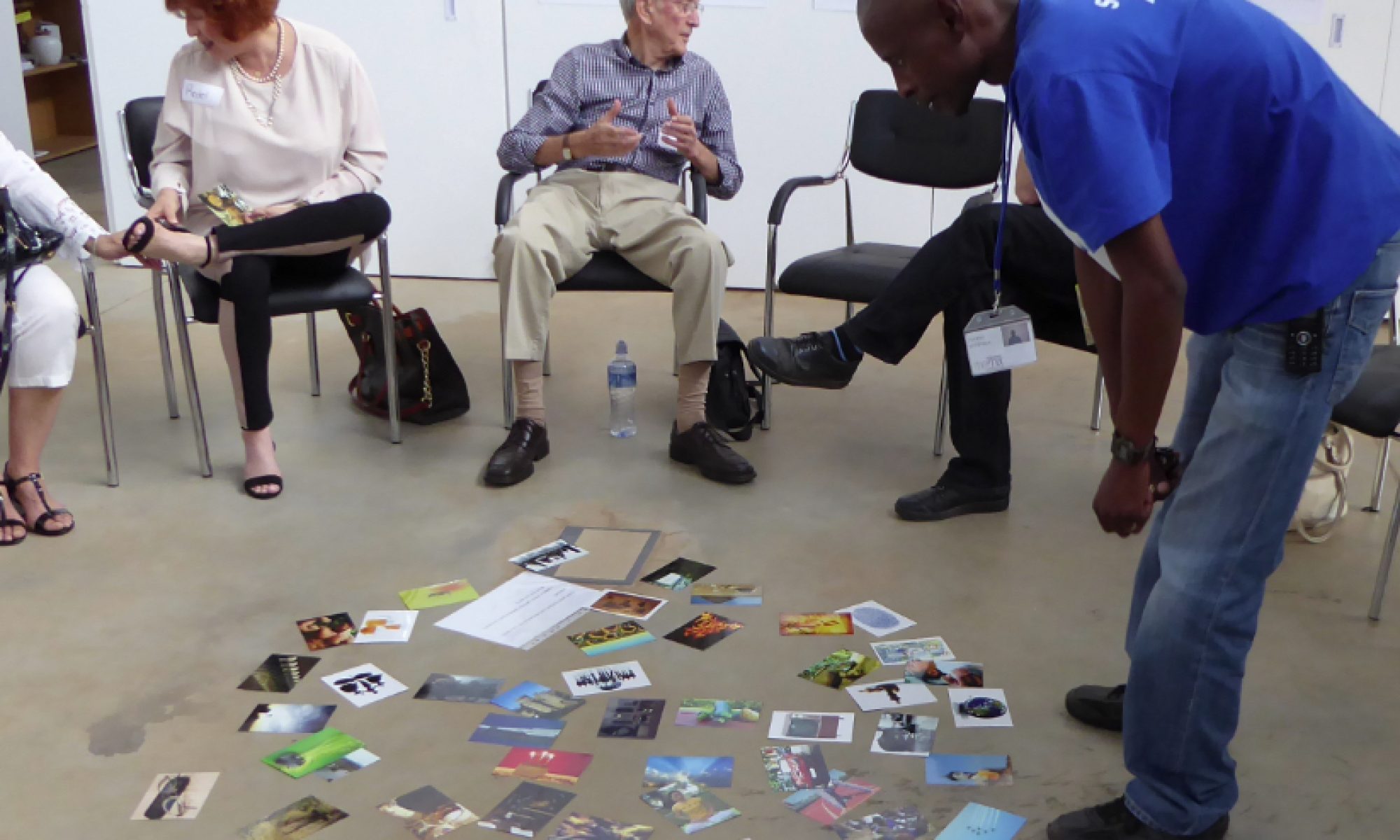
Strategic Narrative Embodiment participants in discussion

Conventional, also called ‘authoritarian’, learning and development philosophies are usually based on the idea that a learner is a ‘tabula rasa’ or clean slate onto which knowledge must be transferred. Learners are empty vessels into which the expert can pour information. In contrast, contemporary inclusive learning models view learners as participants rich with a personal body of knowledge acquired through experiences within unique contexts. Coaching and facilitation are processes that have developed out of these models, but are often still plagued by remnants of the transmission models of learning.

Here follows how SNE sees coaching and facilitation. (How do you see it?)

  1. Coaching-facilitation is a conversation not a monologue: for us, learning and development is no longer a top-down, one-way process, but rather a dialogical interaction between equal partners: facilitator-participant and participant- participant. Your expertise, therefore, lies in how well you can allow everyone to listen to a multiplicity of divergent ideas in one conversation, not in how well you get everyone to agree with your opinion.
  2. Delegates, not the agenda, need to drive the process: Where conventional methods assume that there is a notional ‘average delegate’ at which training should be aimed and who determines the standard, we believe that no such assumptions can be made. Rather, a systemic map must be created of participants’ needs and expectations and the facilitator’s own needs and expectations must be articulated. This is not a once-off occurrence, but happens continuously throughout the process.
  3. The process is driven by difference not sameness: In other words, participants do not form a more-or-less homogenous group where those who differ from the group can be categorised as ‘other.’ Rather, all people differ from one another and these differences are fundamental to our planning, processing and provision.
  4. Coaching-facilitation is more listening and responding than talking and controlling: As inclusive coach-facilitators the focus of our processes is not on content that needs transmission, and our role is not to control the outcome of the process. Rather, our focus is on the delegates with their experience, and our role is to facilitate the dialogue between the intention of the process (which may include information sharing) and the delegate. We become mediators of knowledge, not mere transmitters of it.
  5. Coaching-facilitation is creating experience, not merely transmitting information: Our workshop materials are therefore not mere extensions of a trainer, like a slide projector, transmitting information while learners participate mainly by looking (reading) and listening. Our materials, and indeed our entire methodology, aim to create or draw on experience where participants can take part with as many faculties as possible. It is a whole-brain, whole-body approach that allows delegates to take part in the meaning making.
  6. Relevance is more important than accuracy: In our sessions we value not so much questions relating to the material, but rather questions relating to the relevance of the learning for each delegate’s individual role and personal journey.
  7. There is more than one kind of knowledge: In our processes there is not just the coach-facilitator’s knowledge in the room, but also the tacit knowledge participants carry in their bodies and the group genius that arises from the collaboration between participants as they work to interpret and apply knowledge.
  8. Action and implementation speak louder than words and learned answers: The responsibility and ownership of the learning becomes that of the facilitator and the delegates alike. Assessment then focuses not on the reproduction of knowledge taught, but on its integration and implementation in the workplace – not on words, but on action.

Note: We acknowledge that some contexts ask for a certain amount of content as well as the accuracy of its application. 1+1=2 no matter how you look at it (or does it?). Still, we believe that information transmission, while it serves its purpose in many contexts, is overused and overvalued. This is especially true in situations where coach-facilitators and delegate-participants do not share the same frames of reference, so that much of the information that is being transmitted is lost in a fog of misunderstanding.

The role of improvisation

Acting in a set context without the benefit of scripted words and only the tacit knowledge accumulated through experience is called improvisation – the central concept around which our training revolves. Improvisation also draws on the ability of a group to generate solutions together and use dialogue to drive the story, and indeed the learning, forward.

Body guard

Possible outcomes:

• Playfulness.
• Fun and laughter.
• Illustrates how one person’s action influences a whole system.

Overview:

Everyone stands in a circle. Each player chooses 2 other participants in their mind, who are their enemy and their bodyguard. When the game starts each player must ensure that his bodyguard is always between him and his enemy.

Time: 5 – 15 min
Number of participants: 8 – 30

Game flow:

Everyone stands in a circle. Ask the participants to each choose 2 other players in the circle and assign them with the letters A and B. Tell them that person A is their enemy and that person B is their bodyguard. Tell them that when you say “go” they must move to ensure that their bodyguard is always between them and their enemy. This results in a very dynamic movement of all the players that never reaches a state of equilibrium.

Tips:
• When explaining the rules it helps to show an example using yourself and 2 other players as your enemy and bodyguard.
• Tell the players to take care of each other and that they are not allowed to hold on to another player. This is especially important when playing the game with teenagers.

Debrief questions:
• What did you notice while playing the game?
• What feelings did you experience while playing the game?
• What made the game fun?
• How did the movement of one player influence the rest of the players?

Variation:

Tell the players that they are the bodyguard and that they must ensure that they are always between person A and B. This will result in everyone bundling up together.

I learned this game in Jet Eveleth’s class at the IO theatre in Chicago

Monster talk

Possible outcomes:

• Practices listening in the moment.
• Practices non-judgemental listening.
• Practices giving and taking control.

Overview:

Participants all pair up with another player and have a conversation in which they speak in unison. Each player mirrors their partner’s speech in the moment.

Time: 5 – 15 min
Number of participants: 2 – 200

Game flow:

Ask participants to pair up with another player. Tell them that they are going to have a conversation and that the listener must mirror the speaker’s speech as she speaks. Ask a volunteer to help you give an example. The aim of the exercise is to speak at exactly the same time, so if the speaker notices that the listener is struggling to keep up, the speaker must slow down. The result sounds a bit like Dory speaking whale in the movie “Finding Nemo”.

Debrief questions:

• What did you notice while playing the game:
• How was your listening different than usual?
• What made the exercise difficult?
• What could you do to make it easier?

Got this game from the book Playing Along: 37 Group Learning Activities Borrowed from Improvisational Theater by Izzy Gesell

Group counting

Possible outcomes:

• Practice listening and awareness skills.
• Practice holding the silence.
• Trusting your intuition.

Overview:

Participants stand in a circle and count to 20 without having a set sequence of whose turn it is next. Whenever 2 or more players say a number at the same time, they start from one again.

Time: 5 – 10 min
Number of players: 4 – 20

Game flow:

Everyone stands in a circle. Tell the participants that they have to count from one to twenty in order. Have them close their eyes or focus on the centre of the circle. Each person can say the next number whenever they wish. Whenever two players start to say a number at the same time they have to start from one again.

Tips:

• If they struggle tell them that they should only speak when they feel it is their turn and that they should remain silent if they want to speak out of anxiety. Tell them to speak only when they feel it is their turn.

Debrief questions:

• What did it feel like playing the game?
• What helped you to get better at the game?
• How did you decide when it is your turn?
• When did you decide to stay silent?
• How is this like group processes at work?

I learned this game at the IO Theatre’s summer intensive course.

The Rant

Possible outcome:

• Practice deep listening.
• Become aware of own values
• Become aware of shared values

Overview:

In pairs participants each get a chance to rant about something. The listener must listen for the value underneath the ranting and respond with “I hear you really care about…”

Time: 10 – 15 min
Number of participants: 2 – 200

Game flow:

Ask participants to pair up and sit in chairs facing each other. Tell them to think of something that really irritates them. Each participant then gets a chance to rant about this frustration for 2 minutes while their partner just listens. Tell them to fill the whole 2 minutes with their ranting. The listener’s task is to listen past the frustration for the underlying value that is really important to the speaker. After the 2 minutes are done the listener responds with the words “I hear you really care about…” The value that the listener listens for must be something positive. For example if the speaker rants about how she hates it when people are late, the listener shouldn’t say “I hear you really care about people not being late”. The right response could be “I hear you really care about respecting someone else’s time”.

Debrief questions:

• What did feel like being listened to like this?
• What did it feel like listening like this?
• What is the value of listening like this?

I learned this game from Holly Thorsen in a coffee shop in Amsterdam after the 2010 Applied Improvisation Conference.

Story from feeling

Game for coaches and counsellors

Possible outcomes:

• Gets client out of a stuck emotional state.
• Helps client to get new perspective on their situation.

Overview:

The client uses their current feeling as a springboard to tell a third-person fictional story. The coach assists by asking interjectory questions to advance the action.

Time: 5 – 15min

Game flow:

Ask the client to focus on their current emotional state. Let them think of a character that would wake up in the morning with the same emotion. Instruct the client to tell a story about this character. Tell them just to allow the story to come and not to try and steer it. Let them know that if they get stuck you will help them by asking a question. For example you may say, “the character hears a knock on the door, who is it?” or “she receive a parcel in the mail, what is in it?” You can also just say “suddenly….” or “but then…” Usually the client tells a story about a character with their same emotional state that goes on an adventure and ends in a positive note. The story doesn’t have to have a happy ending though.

I got this game from the book Rehearsals for Growth: Theater Improvisation for Psychotherapists by Daniel J. Wiener

Colour/Advance

Possible outcomes:

• Develop story telling skills
• Use for needs assessment.
• Use for reviewing after a workshop.
• Getting new perspective on an issue.

Overview:

In pairs participants tell stories in which one player tells the story and the other guides by saying colour or advance to instruct the teller to focus on detail or action.

Time: 5 – 15 min
Number of participants: 2 – 200

Game flow:

Let everyone pair up with another person. Ask them to choose a story teller and a guide. The story teller starts to tell a story. At any time the guide can say “colour the…” instructing the teller to embellish on some detail. Colour can include any description such as physical details, mood and inner thoughts or feelings of the characters. When the guide is satisfied he says “advance” and the teller continues with the action of the story. When the story ends or the time is finished let them switch roles.

Debrief questions;

• How did you decide to say colour or advance?
• How did it feel to be led in telling the story?
• How did the description and action influence each other?
• How do you feel about the stories that you told?

I got this game from the book Training to Imagine: Practical Improvisational Theatre Techniques to Enhance Creativity, Teamwork, Leadership, and Learning by Kat Koppett and Joel Goodman

Three Ways to be Thrown for a Loop

When life throws you for a loop, it usually means you are greatly taken by surprise when your guard is down. This can be either positive or negative. Most success stories you hear are about people who are dealt an unexpected blow and they turn it into a positive outcome. How many times have you heard someone say you need to turn your challenges into opportunities? Or to see obstacles as possibilities? Yet, while some people are born naturally positive, most of us learn to do this over time. Most of us, even children, need time to adjust and reset when life ‘throws you for a loop”.

The Success Story Loop model will show you 7 steps for moving through change so you can make sure you end up with the happy ever after.

You can download the eBook for Getting More Personal Success Authentically Right Here.

If it is not happy, it is not the ending

There are Three ways, though, to understand the ‘loop’ concept:

1. The Drama’s of life
Every myth, fairytale, Bible story, Shakespeare play, feature film or novel you have ever read, heard or seen that has a happy ending, follow someone overcoming the odds after being thrown for a loop. They are designed to help you know how to do it when you are living your story. Even the sad stories and tragedies comment on the same pattern by showing you what happens when something goes wrong somewhere and the character takes a wrong turn. If, after all these stories, you don’t know yet how, let me clear the trees for you so you can see the wood. This model reveals to you the overarching dramatic pattern of change and growth so you can have a future distinct from your past.

You may think I am making a sweeping statement here: really, all stories? If you know about ‘the hero’s journey’ or mythic structure’ or have read about the recipes Hollywood uses to concoct their stories, you may say: this is over simplified, there are many other versions that do not fit the bill so beautifully. Of course you are right. I am not ‘buying’ any specific model or theory about structuring stories. I am responding to the dramatic cycle of change: that thing which all stories try to deal with – that occurrence of life throwing you for a loop. And yes, some stories deal with it far more plausibly than others with far more aesthetics and cognizance of the complexities of life than others – but they still respond to the same underlying dramatic structure of change, of learning and of making a success of adversity.

Perhaps you are naturally skeptical about the use of such farfetched nonsense thinking ‘life is not so simple’, ‘life is not a fairy tale’. You are right! But many fairy-tales are nasty and do not even end in marriages and the discovery of treasure. Yet all of these stories try to relate to you and me something of how it works when things change and what you and I can do in response so that we do not take a dive or just survive, but thrive.

2. Big and small loops

The loop idea goes further than just an expression about life’s little surprises. It also refers to the cyclical nature of change and of life. The same seven steps function in the smallest of shifts you experience in your life to the biggest life cycle you can observe. You can look at a single event in your life and see the 7 moments, or you can look at your entire life cycle and see them there too. From the despair you experience because your business is not making enough money this month to the stages of your life from baby to golden oldie, the same cycle is evident. So use this model to create a success of just one date with your partner, or use it to make a success of your entire career. You can play with it on small scale moments or apply it to large scale events with high stakes. You will never need to fall apart over anything in your life again if you know where it fits into your story and how to respond to it.

3. The loop of succession

There is one more way in which a success story becomes a loop. The actual structure of the story follows a loop. Every character sets his or her course in some direction, is thwarted and must adapt or refocus to try again and succeed. The very essence of the word ‘succeed’ holds this idea of following in the same path. Think of the word ‘succession’ which refers to the son or daughter following in the footsteps of the royal parent. In the Success Story loop you get to literally follow in your own footsteps to review the situation you are in from a new perspective so that you can try again with greater success. The entire story revolves or ‘loops’ around this moment of big picture insight. It is the moment of presence, of ‘being in the now’, of getting the ‘aha-experience’ that will shift the balance in your favor. Yet this moment is preceded by a certain sequence of events and choices and followed by similar events and choices now acted upon from a new point of view. Yet, the second time round it is sealed by a certain attitude that is impossible to fake because of the access you gained to the present moment.

Want to know how Cinderella became queen? How Little Red overcame the wolf? How Shrek found true love? How Frodo became the hero of Middle Earth? How Salander in ‘the Millennium Trilogy’ overcame the ‘bastards’ who hate women? How Brave Heart found peace and victory in spite of being killed? These are just some of the stories I will play with to help you map out your own success. There will be a success story for you. Down load the eBook.

So, use the Success Story Loop to

  • Engineer your own success
  • Discover which stage you are in right now and how to get to the next one
  • Choose the kind of help you need
  • see what sort of obstacles you can plan for
  • Find out what you have control over and what not
  • Learn to forgive yourself and others for failure
  • Accept the uncertainties and unpredictability of life
  • Find the route into the present moment
  • Increase the amount of ‘aha-experiences’ you have
  • Stop taking life so seriously: it is just a story!

Making a success of your life, is as easy and as hard as telling a story.
Download the eBook and Get More Personal Success Authentically Right Here.