How does improvisation relate to the corporate world?

Like a troupe of improvisers on stage who collaborate under high pressure to satisfy an audience’s need for entertainment that is fresh and creative, leaders and teams too must collaborate under high pressure to satisfy the needs of their clients in a fresh and innovative way.

Because the actors create in front of the audience, they have to do it in a way that is respectful to each other while at the same time building trust and rapport with the audience. To get the best out of their teams employers and employees too must work in a respectful manner with each other while at the same time building rapport with clients and customers.

The improv actors incorporate ideas from the audience with ideas from one another to create an integrated high quality performance. Just like people in organisations might have to incorporate input from the client with input from each other to provide the best possible product and service.

Finally, improvisers deliver their performance by playing ‘games’ which follow strict rules and parameters. These parameters could be a metaphor for the policies and procedures people need to follow in order to ensure high quality products and processes.

“Playing Mantis is committed to achieve that which is required from your specific needs. They work along side the client and if things change along the way, they are happy to move with that. They are experienced with people and understand what makes people tick and how to extract the best results from them..” Warren Young, Chief Risk Officer, Sanlam Investments:

Does that mean you put people on the spot to perform?

No. We have found that the most learning takes place when people feel a mixture between excitement and anxiety. Research in neuroscience shows that excitement motivates people to participate and a bit of anxiety keeps them alert. BUT too much anxiety is negative for learning and that’s why we’ll gently draw people into the learning process, by creating a very safe space that is caring, where people can connect on a human level and discover that they are much more creative and courageous than they ever thought possible. That is how improvisers create the safety for each other on the stage to perform at their peak.

 “Playing Mantis managed to get the whole company involved very quickly. They had great chemistry with everyone and it was so easy to engage with the work. They made it simple and easy and very quick to get into both the theatre making and the values of the company. Somehow they also managed to get people to own their work. Everyone was empowered to take action and take charge of their own process. I was very happy with them. You cannot fake that kind of connection with people, people will see through you.” Sinikiwe Dube, HR manager at EPPF.

What is Applied Improvisation?

What is Applied Improvisation?

Improvisation (without the ‘Applied’ part) is a kind of theatre or music where performers make up the scenes or songs on the spot in front of the audience in real time.

Applied Improvisation is the practise of applying and developing the same skills that actors or musicians use, but in contexts that are not linked to the stage. These are contexts like the workplace or in your personal life where the skills are equally important for success. (For the historic development and examples of Applied Improvisation see Wikipedia-article).

That means, instead of learning to act on stage like the guys from ‘Whose line is it anyway’, , you learn to act with greater confidence, collaboration and innovativeness in your work or personal life.

Improve your improv skills e.g.:

Self confidence and spontaneity

  • Building rapport and communication skills
  • Knowing when to lead and when to follow
  • Finding your creativity and allowing the creativity of others to flow
  • Accepting mistakes and using failure
  • Laughing and playing more
  • Thinking on your feet

Five types of resistance and how to break through

James and the Giant Peach

Introduction:  Paint a picture of the possibility

What made James in ‘James and the Giant Peach’ climb inside a giant peach, befriend life size bugs and steer across an ocean to go to New York? What made Cinderella get out of the ashes and off to the Prince’s ball? What made the frog turn into a prince?

The answer to all these questions is the same: they believed that it was possible. OF course, none of them started out believing it, they all needed someone to paint them a picture of the possibility. James lost hope when his cruel aunts destroyed the picture his deceased father had given him showing the big vibrant city of New York.  This dream needed reviving by the peculiar little man with the shiny green things. Cinderella was shattered and crying in the ashes when the Fairy Godmother found her. As for the frog: it was the arrival of the princess that sparked his hope.

Before the dream was planted, there was no resistance to change, only stuckness and possibly despair, or maybe just ignorance of what is possible. Yet, once a dream is planted, one type of resistance after another pops up to frustrate both the dreamer and the dream giver, the hero of the story and the story weaver, both you and your client.

Do you have a dream for your people?

Any dream will inspire some people immediately, but as they try to realise it, they will hit obstacles. Some of these obstacles are personal, some are relational, practical or social. Others are just nasty interruptions from outside.

On the other hand, some of the people you want to influence may be skeptical from the outset, seeing all the problems that might occur and anticipating (or inventing) problems that may never happen.

Either way, there are 5 types of resistance. In stories these five types often follow a similar sequence in which they occur. Here they are in the most common sequence.

1. Personal Resistance – Why me? How is this relevant to me?

2. Relational Resistance – Why you? Why would you know how to help me?

3. Social Resistance – Who is in this with me? Do I belong with them and they with me?

4.  Practical Resistance – How is this going to work? What is the process and the strategy?

5. Cosmic Resistance – What happens when things don’t work out as planned? If it or I fail?

Each type of resistance corresponds with a certain kind of information that your people need in order for them to come with you. Over the next few posts I will share these with you one by one and give suggestions on how you can overcome them. I will offer practical tools that you can try out or adapt as you like.

What makes break through possible?

Without a proper dream, you may not even encounter resistance because your invitation is not different enough from the status quo. Too often that French proverb comes true that says: The more things change, the more they stay the same. That is because no true shift was made and true break through never occurred.

The term ‘break through’ only makes sense in the context of resistance. Without resistance, there is no break through needed and no real change occurs. What makes break through possible is the fact of resistance itself – resistance that arises because the Call to Adventure that you issue is so different from the Current Reality that people experience.

What does a proper dream look like?

It takes the form of a Visionary Goal, not a SMART goal.

A Visionary Goal is one that paints a picture of a possibility that seems unrealistic and that no-one in the room really knows how it can be reached. This is in contrast to so called ‘SMART’ goals which are Specific, measurable, actionable, Realistic and Time oriented. A visionary goal can be specific and measurable and it may even have a target date for completion, but it is not realistic and few people can see how to make it happen.

An example of such a dream is the Volkswagen (VW) visionary goal of 1, 10, 100 by 2010. They wanted to be first in the country on customer service, among the top ten in terms of local quality and make a turnover of 100 million (I am going on memory here, let me know if I have it wrong). In her talk at the Knowledge Resources Organisational Development Conference earlier in 2014, Joan Peters, Leadership Development Manager at Volksvagen explained how few people in the organisation thought reaching this dream was possible, and yet they were mobilised into action and managed to achieve it.

Even though visionary goals do not seem realistic or actionable, they inspire action by releasing positive energy in the brain. The brain loves to dream and follow visionary goals..

Why does the brain like to dream?

The brain loves to dream because of the effect expectation of reward has on its chemistry. Dreaming inspires hope. Hope is an expectation of something positive being fulfilled in the future. This expectation of reward releases dopamine into your brain, the same stuff that gets released when you laugh and exercise.

What is extra interesting here, says Dr. Ward Plunet, is that studies show people with higher status is more prone to hope in relation to people in lower status positions. This is because they have more hope of getting the pick of the crop in terms of food, shelter and sexual partners. A sense that you have power to choose adds to the feeling of autonomy and certainty that you will not go hungry, cold or deprived.

This means that the more people think they have control, the more they are likely to take action on your invitation, but the more they feel dis-empowered, the more they will block your enthusiasm. This ‘blocking’ of ideas can be termed a ‘yes, but’ energy. It stands in stark contrast to a ‘yes, and’ energy that accepts new ideas and builds on them.

As we explore the five types of resistance and how to overcome them, both neuro-science and the ‘yes and’ principle will be our conversation partners.

What do I need to do?

As guide and mentor the first step in breaking through resistance is to paint a picture of the possibility so that they can ‘feel the pain’ of not being there yet and begin to yearn for change. Your first job is to ask ‘What if…” What if a neglected orphan  could go to New York in a giant peach What if a lowly Cinderella could dance with the royal heir?  What if a frog could be a prince?

What if you understood the five types of resistance and get Cinderellas and frogs to change their own fates?

The next instalment will look at the first type of resistance, Personal Resistance, and how you can increase your people’s sense of autonomy and move them to say ‘yes and’.

Watch this space for the next instalment of using SNE (Strategic Narrative Embodiment) to break through five tyes of resistence…

Dr. Petro Janse van Vuuren

Professional Facilitator, Coach  and Story Strategist
How do I bring about shift that lasts?

Story-Strategy, Act 1, Episode 2: Possibility

If you are a speaker, trainer, facilitator, coach or OD (organisational Development) practitioner, you would have noticed that audiences, trainees, participants and teams have become more and more distracted, demanding and opinionated. Like Claire in the previous blog post (How do I bring about shift that lasts?):

We need new moves to move the people we serve.

With the explosion of the internet, everyone can be an expert, everyone can personalise and customise their programmes, profiles and preferences and everyone can choose what information they want to allow in their headspace. In addition, the shaky state of world economies and the uncertainty created by political shifts and health threats, people are more and more weary of solutions that would either waste their money, or cause more uncertainty.

Lectures

Old fashioned lecturing, like FUNDA Training and Conferencing was used to, does not work anymore. On one hand lectures are content driven and the content dictate the design and flow of the presentation. On the other hand, the content proposes to be a one size fits all solution that is not customisable and adaptable for every individual particularity. Furthermore, lectures do not leverage the power of human connection and emotion as a way to drive messages home and make them stickable.

Shows

Motivation Inc and Team Adventures, from yesterday’s story, had each tried to solve some of these problems. Motivational speakers liven up presentations by turning it into more of a show.  Through showmanship they artfully design their content using story, evolving emotion, clever presentational gimmicks like props, visual aids and performance skills. In addition, motivational speakers are high impact, but low in time investment. And while the really good speakers are expensive for the time they put in, a once off payment is still cheaper, than a process that unfolds over time and consumes both time and money.

However, traditional motivational speakers cannot bring about shift that lasts. They get a high rating from people attending their talks, but a very low rating in terms of creating real shift. What they lack is the ability to help people connect their own individual stories to the story in the room. They provide a grand show, but still offers a one size fits all solution that cannot shift the individual. It is a known fact enough speakers that only 5% of the people in your audience will be deeply moved and impacted by your presentation. While many may enjoy it, only 5% will be at a place where your story and their stories intercept to create shift. There is still something missing.

Games

Team building programmes step into this gap by offering game like solutions. A game is not content driven, it is structure driven. This means that within the confines of the game, people have a certain amount of control to manipulate the rules to their advantage. A game can be individualised. A game is also good for connecting people and building relationship, something that often enhance emotional connection either by awakening competitiveness or by leveraging people’s feeling of belonging. However, unless games are structured around content that can bring about learning, people often leave a teambuilding experience warm and fuzzy, but without a lasting shift notable in the workplace.

Shift

If lectures, shows and games do not offer lasting solutions that can bring about shift, there must be a fourth option – a solution we simply term SHIFT. The Playing Mantis SHIFT model is the subject of the next blog.


How do I improve learning and development programmes?

SHIFT Act 1, Episode 1: Current reality

FUNDA is a training and conferencing company who specialises in providing the knowledge and resources their clients need to train their people and develop their teams. FUNDA (funda is the Zulu word for ‘learn’) started out 17 years ago and quickly made a name for themselves in the organisational learning and development sector. Their clients praised the quality of the content they provided and the expertise of the specialists they hired to present the training.

Over the last 7 years or so, FUNDA had been losing clients, though. When they ask defecting clients why they are leaving, they get mixed answers:  ‘we are cutting costs, so we are opting for online learning courses’, ‘We felt that we needed more entertainment and inspiration mixed into the learning – something wow’, or ‘our people want something that is more fun and challenging, something that brings the team together ’and ‘we are looking for something different, that is more relevant to us specifically and can cater for the diversity of people we employ’.

The owner and CEO of FUNDA, Claire Pillay, started looking at what her competitors were offering. She noticed that the speaker’s burro across the square from her had halted their office renovations. A few years ago when the renovations at Motivation Inc started, it looked like they were doing great, now it seems they were cutting costs. “If people are really looking for inspiration and entertainment mixed into the learning, why is Motivation Inc not booming?” Claire wondered.

A previous loyal client of her company dropped in one day to give her a pamphlet: ‘Team Adventures’ it read ‘every extreme adventure you can think of for your whole team’. She looked at her client with raised eyebrows: “So is this the trend now?”

“No,” he answered “too expensive and nothing changes at the office after you go on one of these”. Can’t you get us something that is fun and meaningful? Isn’t there a way in which we can learn, bond, be inspired and shift our company into the 21st century so that we can keep up with the changing times?”

Claire realised that the lecture based, information transmission model her company was built on, no longer served. People can get everything they wanted to know off the internet in various forms to fit their individual needs, from blog articles to full online courses. But people are also no longer looking for pure motivational or inspirational speakers who can both entertain and teach them at the same time. While people enjoy the ‘show’, they still leave without the message impacting and changing their work environment. Yet, when organisations try to remedy this by taking their teams on teambuilding experiences to build relationship and connection, still people do not integrate the experience into everyday work life.

“So what is the solution?”  Claire asked herself, “How do I improve our learning and development programmes?”


The Playing Mantis (and SNE) coaching-facilitation philosophy

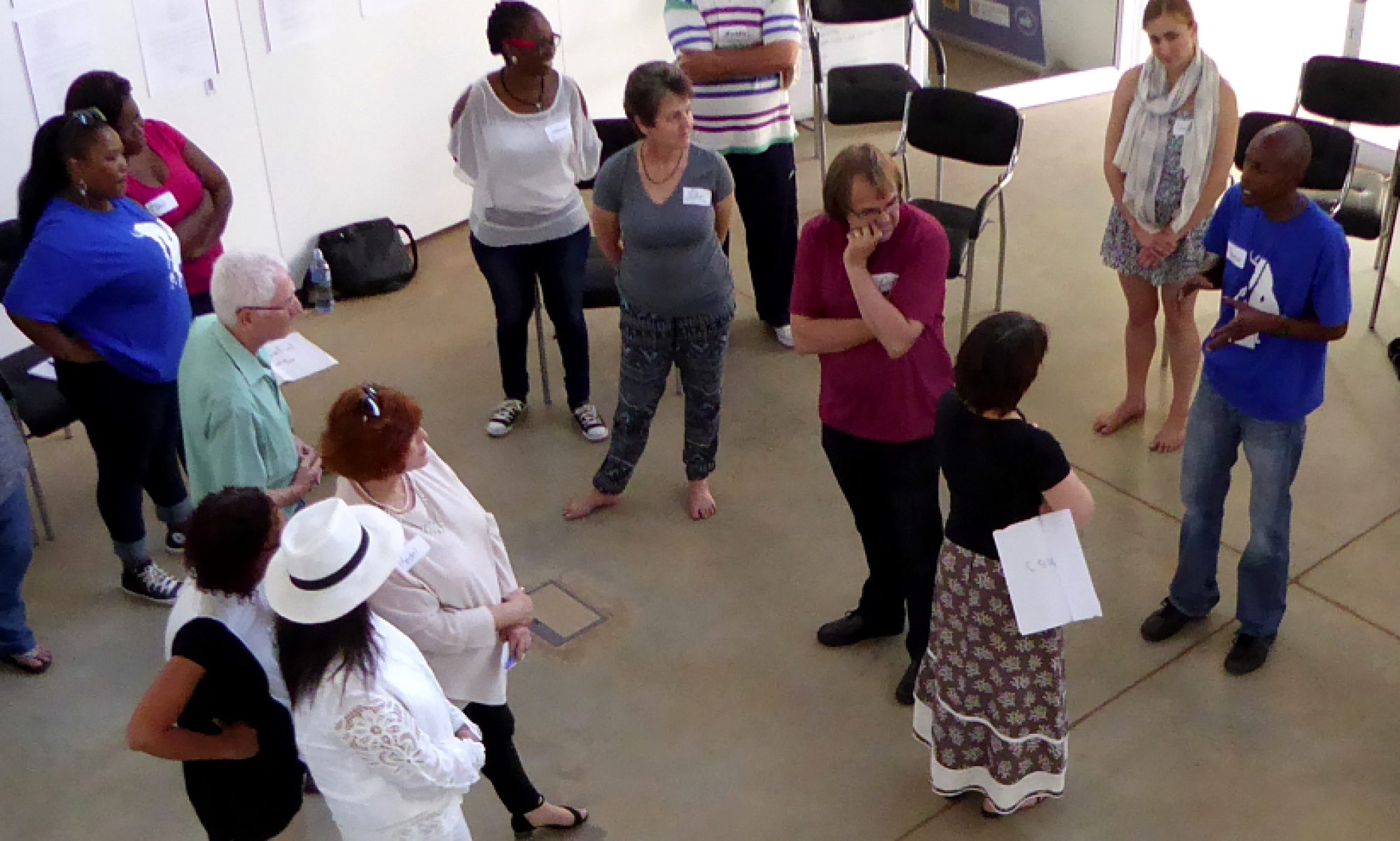
Strategic Narrative Embodiment participants in discussion

Conventional, also called ‘authoritarian’, learning and development philosophies are usually based on the idea that a learner is a ‘tabula rasa’ or clean slate onto which knowledge must be transferred. Learners are empty vessels into which the expert can pour information. In contrast, contemporary inclusive learning models view learners as participants rich with a personal body of knowledge acquired through experiences within unique contexts. Coaching and facilitation are processes that have developed out of these models, but are often still plagued by remnants of the transmission models of learning.

Here follows how SNE sees coaching and facilitation. (How do you see it?)

  1. Coaching-facilitation is a conversation not a monologue: for us, learning and development is no longer a top-down, one-way process, but rather a dialogical interaction between equal partners: facilitator-participant and participant- participant. Your expertise, therefore, lies in how well you can allow everyone to listen to a multiplicity of divergent ideas in one conversation, not in how well you get everyone to agree with your opinion.
  2. Delegates, not the agenda, need to drive the process: Where conventional methods assume that there is a notional ‘average delegate’ at which training should be aimed and who determines the standard, we believe that no such assumptions can be made. Rather, a systemic map must be created of participants’ needs and expectations and the facilitator’s own needs and expectations must be articulated. This is not a once-off occurrence, but happens continuously throughout the process.
  3. The process is driven by difference not sameness: In other words, participants do not form a more-or-less homogenous group where those who differ from the group can be categorised as ‘other.’ Rather, all people differ from one another and these differences are fundamental to our planning, processing and provision.
  4. Coaching-facilitation is more listening and responding than talking and controlling: As inclusive coach-facilitators the focus of our processes is not on content that needs transmission, and our role is not to control the outcome of the process. Rather, our focus is on the delegates with their experience, and our role is to facilitate the dialogue between the intention of the process (which may include information sharing) and the delegate. We become mediators of knowledge, not mere transmitters of it.
  5. Coaching-facilitation is creating experience, not merely transmitting information: Our workshop materials are therefore not mere extensions of a trainer, like a slide projector, transmitting information while learners participate mainly by looking (reading) and listening. Our materials, and indeed our entire methodology, aim to create or draw on experience where participants can take part with as many faculties as possible. It is a whole-brain, whole-body approach that allows delegates to take part in the meaning making.
  6. Relevance is more important than accuracy: In our sessions we value not so much questions relating to the material, but rather questions relating to the relevance of the learning for each delegate’s individual role and personal journey.
  7. There is more than one kind of knowledge: In our processes there is not just the coach-facilitator’s knowledge in the room, but also the tacit knowledge participants carry in their bodies and the group genius that arises from the collaboration between participants as they work to interpret and apply knowledge.
  8. Action and implementation speak louder than words and learned answers: The responsibility and ownership of the learning becomes that of the facilitator and the delegates alike. Assessment then focuses not on the reproduction of knowledge taught, but on its integration and implementation in the workplace – not on words, but on action.

Note: We acknowledge that some contexts ask for a certain amount of content as well as the accuracy of its application. 1+1=2 no matter how you look at it (or does it?). Still, we believe that information transmission, while it serves its purpose in many contexts, is overused and overvalued. This is especially true in situations where coach-facilitators and delegate-participants do not share the same frames of reference, so that much of the information that is being transmitted is lost in a fog of misunderstanding.

The role of improvisation

Acting in a set context without the benefit of scripted words and only the tacit knowledge accumulated through experience is called improvisation – the central concept around which our training revolves. Improvisation also draws on the ability of a group to generate solutions together and use dialogue to drive the story, and indeed the learning, forward.

Three Ways to be Thrown for a Loop

When life throws you for a loop, it usually means you are greatly taken by surprise when your guard is down. This can be either positive or negative. Most success stories you hear are about people who are dealt an unexpected blow and they turn it into a positive outcome. How many times have you heard someone say you need to turn your challenges into opportunities? Or to see obstacles as possibilities? Yet, while some people are born naturally positive, most of us learn to do this over time. Most of us, even children, need time to adjust and reset when life ‘throws you for a loop”.

The Success Story Loop model will show you 7 steps for moving through change so you can make sure you end up with the happy ever after.

You can download the eBook for Getting More Personal Success Authentically Right Here.

If it is not happy, it is not the ending

There are Three ways, though, to understand the ‘loop’ concept:

1. The Drama’s of life
Every myth, fairytale, Bible story, Shakespeare play, feature film or novel you have ever read, heard or seen that has a happy ending, follow someone overcoming the odds after being thrown for a loop. They are designed to help you know how to do it when you are living your story. Even the sad stories and tragedies comment on the same pattern by showing you what happens when something goes wrong somewhere and the character takes a wrong turn. If, after all these stories, you don’t know yet how, let me clear the trees for you so you can see the wood. This model reveals to you the overarching dramatic pattern of change and growth so you can have a future distinct from your past.

You may think I am making a sweeping statement here: really, all stories? If you know about ‘the hero’s journey’ or mythic structure’ or have read about the recipes Hollywood uses to concoct their stories, you may say: this is over simplified, there are many other versions that do not fit the bill so beautifully. Of course you are right. I am not ‘buying’ any specific model or theory about structuring stories. I am responding to the dramatic cycle of change: that thing which all stories try to deal with – that occurrence of life throwing you for a loop. And yes, some stories deal with it far more plausibly than others with far more aesthetics and cognizance of the complexities of life than others – but they still respond to the same underlying dramatic structure of change, of learning and of making a success of adversity.

Perhaps you are naturally skeptical about the use of such farfetched nonsense thinking ‘life is not so simple’, ‘life is not a fairy tale’. You are right! But many fairy-tales are nasty and do not even end in marriages and the discovery of treasure. Yet all of these stories try to relate to you and me something of how it works when things change and what you and I can do in response so that we do not take a dive or just survive, but thrive.

2. Big and small loops

The loop idea goes further than just an expression about life’s little surprises. It also refers to the cyclical nature of change and of life. The same seven steps function in the smallest of shifts you experience in your life to the biggest life cycle you can observe. You can look at a single event in your life and see the 7 moments, or you can look at your entire life cycle and see them there too. From the despair you experience because your business is not making enough money this month to the stages of your life from baby to golden oldie, the same cycle is evident. So use this model to create a success of just one date with your partner, or use it to make a success of your entire career. You can play with it on small scale moments or apply it to large scale events with high stakes. You will never need to fall apart over anything in your life again if you know where it fits into your story and how to respond to it.

3. The loop of succession

There is one more way in which a success story becomes a loop. The actual structure of the story follows a loop. Every character sets his or her course in some direction, is thwarted and must adapt or refocus to try again and succeed. The very essence of the word ‘succeed’ holds this idea of following in the same path. Think of the word ‘succession’ which refers to the son or daughter following in the footsteps of the royal parent. In the Success Story loop you get to literally follow in your own footsteps to review the situation you are in from a new perspective so that you can try again with greater success. The entire story revolves or ‘loops’ around this moment of big picture insight. It is the moment of presence, of ‘being in the now’, of getting the ‘aha-experience’ that will shift the balance in your favor. Yet this moment is preceded by a certain sequence of events and choices and followed by similar events and choices now acted upon from a new point of view. Yet, the second time round it is sealed by a certain attitude that is impossible to fake because of the access you gained to the present moment.

Want to know how Cinderella became queen? How Little Red overcame the wolf? How Shrek found true love? How Frodo became the hero of Middle Earth? How Salander in ‘the Millennium Trilogy’ overcame the ‘bastards’ who hate women? How Brave Heart found peace and victory in spite of being killed? These are just some of the stories I will play with to help you map out your own success. There will be a success story for you. Down load the eBook.

So, use the Success Story Loop to

  • Engineer your own success
  • Discover which stage you are in right now and how to get to the next one
  • Choose the kind of help you need
  • see what sort of obstacles you can plan for
  • Find out what you have control over and what not
  • Learn to forgive yourself and others for failure
  • Accept the uncertainties and unpredictability of life
  • Find the route into the present moment
  • Increase the amount of ‘aha-experiences’ you have
  • Stop taking life so seriously: it is just a story!

Making a success of your life, is as easy and as hard as telling a story.

Download the eBook and Get More Personal Success Authentically Right Here.

The Art of Successful Communication

In a European forest, the animals hear of a rumour, saying that the bear has a hit list. All the animals start to wonder whose names are on it.
Finally, the roe buck plugs up all his courage and asks the bear: ”Can you tell me whether I am on your list?” “Yes, says the bear, your name is on my list.” Scared to death, the roe buck runs away. Two days later, he is found dead.
Horror spreads amongst the animals.
The wild boar is the second one who cannot stand the uncertainty any more as to who will be next. He asks the bear whether he is on his list. “Yes”, says the bear, “you are on my list as well”. As fast as he can, the wild boar runs away. Two days later, he is found dead.
Now, panic and agony spread amongst the animals. The rabbit is the only one who still risks a move and ventures to approach the bear. “Bear, am I on your list?” “Yes, you are also on my list.” “Can you scratch me out?”  “Yes, of course, no problem!”

This little story illustrates a crucial aspect about communication: In a nutshell, the process is simple. There is someone, referred to as the sender, who intends to transmit a message. Then there is a recipient, whose task it is to decode the information (s)he receives. If successful, the result is mutual understanding between the two (or more) parties. In the parable, the animal knows “The bear has a hit list and I am on it”.

This is largely what we learn from our parents, in schools and universities. We learn to use words to express ourselves. We learn the grammar, spelling and often even several languages to be able to speak to each other, to read and write and so forth. At last, it is communication that allows us to make sense of the world we live in.

Simultaneously, this is also where the challenges and problems lie. Communication is so inherent and central to human life that people often overlook its relevance and complexity. Therefore, miscommunication lies at the root of many problems we encounter in personal and professional settings. These problems form beyond the surface of a message being transferred, heard and understood.

Here are three reasons why communication is often unsuccessful:

1. Communication is more than transfer of issue-related information. Two thirds of what is being exchanged in a conversation is non-verbal. We use visual and acoustic channels and communicate constantly through our appearance, body language and voice. This includes means such as gestures, posture, facial expressions, voice tone, speed and volume.
Our bodies generate, read and understand this information subconsciously and react accordingly. Thus, knowledge about the meaning and application of non-verbal communication elements can help us to align our messages with our intentions and to understand the true thoughts and feelings of others better.

In the parable: Could the animals have read in the non-verbal elements of the bear’s message that there was room for negotiation?

2. Some of the key situations and challenges that can heavily influence our success in life, depend on our communication skills. It is the ability to communicate confidently, authentically and positively that is required if we want to succeed in a job interview, in small-talk situations when we try to make friends and connections, when we introduce ourselves to a prospective landlord, future parents in law or when we are on a first date. We might also intend to negotiate a higher salary or buy and sell products or services. The mastery of communication skills takes conscious effort and practical exercise for most of us, which only plays a minor role in schools and universities to date. Therefore we stay unable to reach our potential. The reality is even closer to the contrary in light of surveys revealing that one of people’s biggest fears is public speaking.

In the parable: Could there have been a better approach of communication when the  animals went to the bear by which, as a result, the roe buck and the wild boar might have still been alive?

3. We all have different value systems and beliefs through which we see and understand the world. These value systems are inherent in our communication and make sense to ourselves. Unfortunately we often fail to bring these across to our conversation partners. We focus on “facts” that are aligned with our personal belief system and fail to connect with the value systems of others when we communicate. This is true for men who say they will never understand women (and vice versa), for managers and their staff who are permanently frustrated and opposing each other and even for religious leaders who claim to know the truth. In each of these examples, empathic, open-minded communication between the parties, guided by the principles of tolerance, equality and respect, would be the answer. This way of communicating requires more effort and time, since we have to ask questions and listen to our counterpart. The alternatives though, if the communication stays shallow, are permanent arguments and frustration in romantic relationships, burn out syndromes and dismissals at work or hate speech and war against an “enemy” we simply fail to understand.

How often do we leave a conversation wondering what the other person actually meant by
what (s)he said, just like the animals have left the bear without inquiring the context around the hit list?

Throughout our lives as social beings, we are interconnected with others in countless ways. Other people are our best resources, as it is usually them who can open or close doors for us. When we start to consider these points and realize that the systematic and conscious use of communication skills can help us to build better connections, reach our personal goals and therefore live a happier life, then this is where the art of communication starts.

Communication works for those who work at it – John Powell

Playing Mantis has launched a new workshop on ‘The Art of Successful Communication’. The first one will specialize on communication in the business context and is for sales people, customer care personnel, consultants and anyone who interacts with customers on a regular basis and intends to improve his customer relations.

Click here to read more about the workshop.

Are your workshops and courses really designed to change lives?

The transformational power of any learning experience relies on two main angles: structure and participation.

Structure: If a learning experience is structured so that a participant is provoked, acknowledged, trained, challenged, allowed to reflect and rewarded, s/he is more likely to accept and internalise the learning than when s/he is simply expected to accept information poured over him/her. This is true even if the information itself is of excellent quality and the speaker is exceptionally persuasive.

Participation: Most teachers/trainers know the Confucius saying: “Tell me and I forget, show me and I may remember, involve me and I will understand”. Participation and experience is more powerful than show and tell. However, participation can only occur when an atmosphere is created where participants can immerse themselves in the experience, feel safe to make mistakes, share control over their learning, see their contributions are incorporated, share the vision and are having fun at the same time.


  • A Show is when an experience is designed for change, but non participative – people may marvel at the incredible material and it’s potential, but are unable to apply it in their individual contexts.
  • A Game is not designed for transformation, yet very participative – everyone may have a lot of fun, but be left with a ‘so what’ feeling unable to grasp the significance of the experience.
  • A Lecture is when an experience is neither structured for transformation, nor participatory – it may leave the participants cold and the trainer feeling disillusioned and ineffective.
  • A Change Experience is both designed for change and participative – there is maximum potential for understanding the material as well as the ability to apply it in their own contexts.

At Playing Mantis we now have 7 elements of structure and 5 ingredients for participation that we look for in processes designed for sustainable impact. As we refine our work these numbers may change since we discover new depths to both these elements of structure and participation every day in our work.

What follows is a list of the elements of structure and participation along with questions to help you assess the transformational power of your own work. Alternatively, you can contact us and invite us to your next presentation. We will swap training for an assessment depending on the scale of your workshop/intervention.


Structured for transformation

These criteria come from the world of theatre and story. Through the ages, stories and their enactment for people have followed certain patterns and conventions. All the great theatre makers and story tellers across time have known what elements to weave into their stories to impact the lives of their listeners. Surely if you weave these same elements into the design of your process you can achieve the same result? Note that there is a certain chronology to these elements, but the order is not set in stone. Yet, if you want to break the sequence make sure you know why you are doing it. Also, depending on the specific function and length of your process, all elements may not be present. We maintain though, that even the shortest of presentations can make room for all these elements in one way or another.

  1. The Call to Adventure – Provoke and inspire dreams. Do you understand the context of your participants well enough so that you know what they desire? Do you provoke and inspire their interest and invite them to dream?
  2. Debate – Acknowledging doubts. Do you allow participants to express their doubts and reservations about your content? Do you acknowledge possible resistance or anxiety? Do you have structures that defuse these without oppressing them?
  3. Meeting the mentor – Training knowledge and skill. Do you give them good information and skills to master that which you are teaching? Do you realise that this part of the cycle is just one among 7, or do you content dump for 90% of the time you have with your audience?
  4. Tests and trials – Challenging knowledge and skill. Do you give well prepared challenges that help sharpen their ability to understand and use what you are teaching? Do you challenge them in teams and individually to ensure holistic integration of knowledge and skill?
  5. Pause and intimacy – Reflecting on the bigger picture. Do you allow moments of quiet reflection to help participants internalise the learning? Do you use both individual reflection and small group reflection strategies for maximum internalisation?
  6. Reward – Rewarding commitment. Do you reward people for stretching themselves? Do you appreciate their efforts?
  7. The return Supporting implementation. Do you provide follow-up support for participants trying to apply their learning in their ordinary lives?


Designed for participation

Improvisation actors do not wait for someone to give them a script before they act. They do not look to each other to take the first step. Improvisation actors act and make up the words as they go along. They participate as soon as they understand what is needed. They respect each other’s contributions, use all the offers they can, make each other look good and cause the audience to like what they see. Clearly these guys know how to inspire each others’ participation and they know how to participate so that the product is of good value. What are their secrets?

  1. Presence and awareness: Are you present and aware of your own thoughts and feelings as you facilitate? Are you also listening and paying attention to those of your participants, or are you mainly thinking of the content you are presenting? Do you structure activities so that participants need to listen to each other?
  2. Safety and acceptance: Are you able to create the feeling of safety so that participants feel able to take part? Do you accept their mistakes as well as your own? How do you create trust so that participants feel they can take creative risks?
  3. Giving and taking control: Do you allow interaction? Do you give some of the responsibilities of facilitation away to others? Are you able to check your ego at the door and accept your audience as equals even when they are younger than you or from a different class/race or gender? Do your activities help them to connect with each other as equals?
  4. Accepting contributions: Do you structure your facilitation so that people can contribute their ideas? Do you then use and incorporate these ideas? How do you ensure that all voices are heard and acknowledged? Do you appreciate the gifts of contribution in whatever form they appear?
  5. Intent and simplicity: Are you clear about your intentions for every part of the workshop? Are you able to maintain that focus in spite of all the contributions and idea sharing? Are you good at reincorporating ideas to follow the shared vision?

Our offer stands: invite us to attend your presentation or workshop for free and we will give you an assessment as to the transformational power of your work using the criteria discussed here. Contact Petro at petro@playingmantis.net or Burgert at burgert@playingmantis.net .