Let’s solve South Africa’s problems in 3 hours flat!

Final Pig Catching session of 2016

You are invited.

Will we solve the problem of free, decolonised education for all SA’s students?

When pigs fly!

Will we manage to bring our corrupt leadership to justice?

When pigs fly!

Or put apartheid in its place once and for all?

Or reduce violence against women and children?

Or improve service delivery?

Or fix the economy?

Or at least get rich ourselves?

When pigs fly!!

Let’s make them fly!

We will use applied improvisation and Strategic narrative embodiment to explore our deepest desires and our wildest dreams building the SA that we want to live in.

Nothing is impossible when we make believe and when we do, unexpected insights and action steps show themselves. If this does not happen in the session, at least you will have had a lot of fun.

So, come play with me and the other pig catchers when we pull out our magic wands and say abracadabra!

Details:

Date:     9 Dec 2016

Time:    9 to 12 am

NOTE: We will start at 9:00 sharp to make the most of our time.

Facilitator: Petro Janse van Vuuren

Cost: R250

Venue: TBC – I am trying for the flying saucer on the 21st floor of the University Corner building in Braamfontein (it used to be a revolving restaurant)

Dress: Comfortable clothes you can stretch and move in

Coffee, tea, muffins and fruit on arrival.

RSVP: by  Wed 7 Dec

Join our group on Facebook:

Subscribe to our Muse-letter

Bring your curiosity, your open minds and your questions.

About Pig Catching:

Pig catching is what coaches and facilitators do when we chase the moment of insight that brings shift and transformation in our clients.

Please note: No pigs get harmed, our pigs are purely metaphorical and they have wings.

WHO SHOULD ATTEND?

Coaches, facilitators, game changers, thought leaders like you who can accept the following

1        This is not a showcase or sales event geared to impress or win you over. If you come, you already believe that metaphor, embodiment, improvisation and imagination are powerful, fun ways to bring about transformation and you want to know more about using them in coaching and facilitation.

2        Experimentation and mistakes are part of the process.  You must be willing to play with ideas that may not work or may be a bit uncomfortable, but that could lead to new heights of freedom and insight.

WE’RE LOOKING FORWARD TO BEING INSPIRED BY YOU. OINK!

Book by sending me an email

Let’s catch some flying pigs!

Flying Pig

An online experience for coaches and facilitators

“When pigs fly” is a figure of speech that says something is completely impossible, even unthinkable. For example: “Can people really change for good?” “Yes, when pigs fly.”

For us a flying pig is the moment of insight that brings shift and transformation in our clients, students, participants…

Join us in our quest.

We will not only look for flying pigs, we will also research ways to catch them, integrate them in our work and our lives with the help of methods and inspirations from the fields of Applied Improvisation and Strategic Narrative Embodiment.

In this online Pig Catching adventure you will be accompanied by Petro Janse van Vuuren from south Africa  and Christian F. Freisleben from Austria. We will invite you to take a close look at your pig catchers’ wardrobe, i.e. your strengths as coach, facilitator, trainer  and teacher. We will meet three times online, talking, sharing, working and also moving together. The sessions foster insights and inspiration, ideas and dreams, concepts for your work in, changing the world for good.

For more details see this prezi presentation and/or listen to this podcast (Soundcloud / Youtube).

Join us for:

A taster session, where you can learn more about flying pigs and the methods we use

Monday 18th of July, 8pm

A longer journey of learning, laughing and transforming:

Thursday 22nd of August, 29th of August, 5th of September – on all days from 8 to 9:15pm, Johannesburg time.

Before and between these dates you will have time to take a closer look at flying pigs!

Cost?

In return for our preparation and facilitation of the journey we ask you to pay us whatever amount of money you think it is worth for you and your work.

Facilitators:

Petro Janse van Vuuren & Christian F. Freisleben

If you want to join this journey please send us an E-Mail to: connect@playingmantis.net

Website Reboot

The Playing Mantis have been running since the start of Playing Mantis 7 years ago. In this time it has had several updates but since recent changes a new update is necessary. This means, that for a while at least, things might look a bit funky or become a bit strange. But the hope is that once this strange times has passed that the Playing Mantis site will be a much more user friendly and focussed website.

Thanks for sticking around for the ride.

Oh, and yes, this is Gerhi Janse van Vuuren writing. I am Petro’s husband and webmaster in charge of this reboot. Please blame me for all the things that go wrong. Petro will take the credit.

5 Differences between Motivational Speaking and Strategic Narrative Embodiment

ATKV Jeugleiersimposium

jeugleiers_dv4_0Dit was my voorreg om hierdie week, Maandag en Dinsdag, as spreker op te tree by die ATKV se Jeugleiersimposiums by die Goudini Spa naby Worcester en Buffelspoort naby Hartebeespoortdam.

My onderwerp: Vyf soorte weerstand teen leierskap en hoe om dit te hefboom. As jy daar was kan jy die opsomming hier aflaai in die vorm van die skyfie reeks wat ek gebruik het. As jy nie daar was nie, sal dit maar min sin maak vir jou.

Vyf soorte weerstabd teen leierskap

Translation:

It was my privilege to speak at the ATKV Youth Leaders symposia on Monday and Tuesday this week at Goudini Spa in the Western Cape and Buffelspoort in Gauteng.

My topic: Five types of resistance to leadership and how to leverage them. If you were there you can download the slide show above. If you were not there, it won’t make much sense to you.

Insights from this experience:

Five differences between motivational speaking and Strategic Narrative Embodiment

For those new to this website, Strategic Narrative Embodiment (SNE) is an applied theatre process that uses story and embodiment strategically to effect change in organisations and leaders.

  1. Strategy and narrative, but no embodiment

At its most interactive, speaking still only works with strategy and narrative, not with embodiment. Unfortunately, it is the embodiment part of the model that invites people to question the dominant narrative. Without it, people get to think, but they struggle to break the requirement of acceptance of the narrative that goes with speaking. The speaker may, in his talk, question the dominant narrative about his topic, but then his story becomes the new dominant narrative and audience members are primed by the genre of speaking to accept it. This was very notable this week where the topic was resistance, but there was no resistance to the topic.

  1. Whose opinion matters

Motivational speaking is the genre of convincing and propaganda. Strategic narrative Embodiment is designed to allow the audience, or rather participants, to make meaning of the ‘story in the room’ for themselves. Speaking centres on the opinion of the speaker, SNE attempts to elicit the opinions of the participants. It does so by inviting participants’ entire bodies into the conversation, not just their intellects. In this way participants can access resistance that does not necessarily surface as clear thoughts, but only as discomforts in their bodies e.g. knots in their stomachs, frowns on their faces and so on. Making sense of these questions can have a far deeper learning result than a mere hearing of a talk and a later dismissal of it because somehow it did not gel.

  1. The seat of knowledge

In motivational speaking the speaker is the seat of knowledge which he more of less downloads into the receptacles that are the members of the audience. In SNE the facilitator structures conversation, but is mostly there to listen and allow others to speak. This is always hard for me because I have such clever things to say and I love to coin quotable phrases. However, this week my clever phrases left even me cold. The ideal would be for the speaker to voice her story, but then to allow participants to interact with that story in order to make sense of it for themselves.

  1. Opinions or stories

Motivational speaking, even the interactive sort, finds it easier to elicit opinions and much harder to invite story sharing. SNE is designed to invite the latter. There are exceptions to this difference. I have seen amazing story tellers whose example of vulnerability and authenticity on the platform unlock people’s own stories and can, therefore invite deep connection, but not necessarily a questioning of dominant narratives. The stories shared still link to the new dominant ‘story in the room’ as presented by the story teller. Resistance to this story is then often read aspeople trying to be difficult, or unwilling to be moved or to buy in. Somehow the SNE tries to create a safe space for diverse points of view without getting into a debate or intellectual voicing of opinions. It wants to invite diverse stories and make it safe for every point of view.

  1. Time and value.

Motivational speaking takes less time that SNE and gives the illusion of being value for money. On Monday I suggested to the organiser of the symposium that I run a fully interactive session instead of a talk. They preferred the talk for its particular content, but the organiser also remarked somewhat tongue in cheek: “After all we are paying you for your input.” Organisers seldom value a facilitator’s ability to shape and draw meaning from participants, they want to pay for knowledge. This is an illusion, though, because people hear what they already believe and unless you allow them to put what they believe into direct embodied interaction with what others, including the facilitator, believes, these believes do not change. Learning only really happens when people connect the ‘story in the room’ to their own stories. I know of few more powerful processes to do this through than embodied participation.

I still believe that speaking has an important part to play, but I have discovered that it meaves me unmoved for the most part as the speaker. If it leaves me that way, what impact does it have on my audience? Perhaps it is just me and I have to accept that I will have to leave the speaking to people who are moved by it themselves.

Read more about this on  jy personal blog: No more model citizens!

Pig Catching for Coaches and Facilitators on 4 Dec

INVITATION TO CATCH PIGS

Pig catching is what coaches and facilitators do when we chase the moment of insight that brings shift and transformation in our clients.

Please note: No pigs get harmed, our pigs are purely metaphorical and they have wings.

Bring your curiosity, your open minds and your questions.

Join us on Friday if you dare…

Topic:    Moving PeopleFlying Pig

Date:     4 December 2015

Time:    7am for 7:15 to 10am Pig Catching

10:30-12:30 Research conversation (for all who are  interested in Strategic Narrative Embodiment)

NOTE: We will start at 7:15 sharp to make the most of our time.

Facilitator: Hamish Neill (from Drama for Life)

Cost: R250 (Includes a write-up of the session)

Venue: 305 Long Ave Ferndale

Dress: Comfortable clothes you can stretch and move in

Coffee, tea, muffins and fruit on arrival.

RSVP: by 1 December.

More on the topic:

What is this shift in leadership and Organisation Development that everyone is talking about?

Some call it a change from Command and Control to Sensing and Responding

Others say it is Autocratic to Participative Leadership

Some try to explain it by using metaphors for the kinds of Organisations we want e.g. no more machine like organisations, rather organic ones, or ones that work like the human brain. Still others say an organisation should be looked at as  a work of art…

There are also those that talk of a Vision and Values based culture versus a virtuoso culture, or a profit focussed organisation versus one that aims for a triple bottom line i.e. people planet and profit.

Whatever the shift is that our new changing world is asking for, we are the ones that support the transformation.

In this session, we will continue our foray into the symbols, metaphors and images that make up our understanding of this shift with Hamish from Dram for Life. In doing so you will also get insight into the tool called Image Theatre as a means for extracting and eliciting stories from participants.

Read my reflections on our previous session here: Can Image Theatre help us change organisational life in South Africa?

Join us on Friday if you dare…

Can Image Theatre help us find ways to change organisational life in South Africa?

Does this pig have wings?

On Friday 18 Sep 18 facilitators and coaches from the Playing Mantis Pig Catching group came together to experiment with Image Theatre.

Pig catching is what facilitators and coaches do when we search for that moment of shift and transformation that helps people move.

Image Theatre is a form of applied theatre designed and practised by Brazilian director and activist Augusto Boal. It uses body images to express collective perspectives on a chosen issue and to explore ways to transform these perspectives and experiment with alternative ways to act.

What we want to do

Our intention for the workshop is to explore the shift in Leadership styles and Organisation Development that we are noticing and that many of us are supporting. The shift seems to be characterised by a movement from command and control styles of leadership to participative sensing and responding styles; from looking at organisations as machines to seeing them either as living organisms, complex networks like the human brain or works of art; from organisations that focus on a single bottom line (profit) to one that has a triple bottom line (people planet and profit).

We are particularly interested in a transition in South Africa from organisations that cam rise above colonialism, apartheid and corruption to ones that work towards social equality, prosperity for all and happy working people from leaders to workers – in short, organisations that support the South African 12030 vision.

We choose to work with Image Theatre as methodology this time in order to explore the metaphors, symbols, language and images that help us talk about the shift and about our vision for leaders and organisations in South Africa.

An account of a transitional moment – a flying pig:

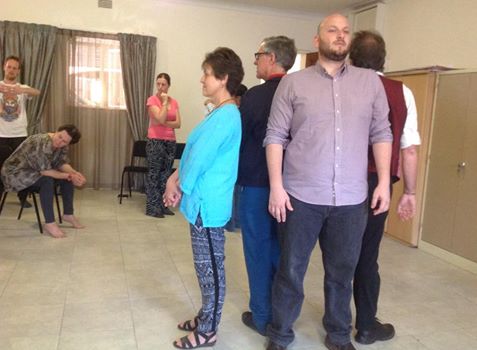
Image 1 - SilosWe are halfway through our workshop and we are exploring one of the typical ways in which organisations are described: the silo syndrome. We work in groups of 4 and begin to build group images. We do not go one person at a time. We simply step forward all at once and create the image. While we

maintain our image the facilitator (Hamish Neil from Drama for Life) asks us to look around and see all the images in the room.

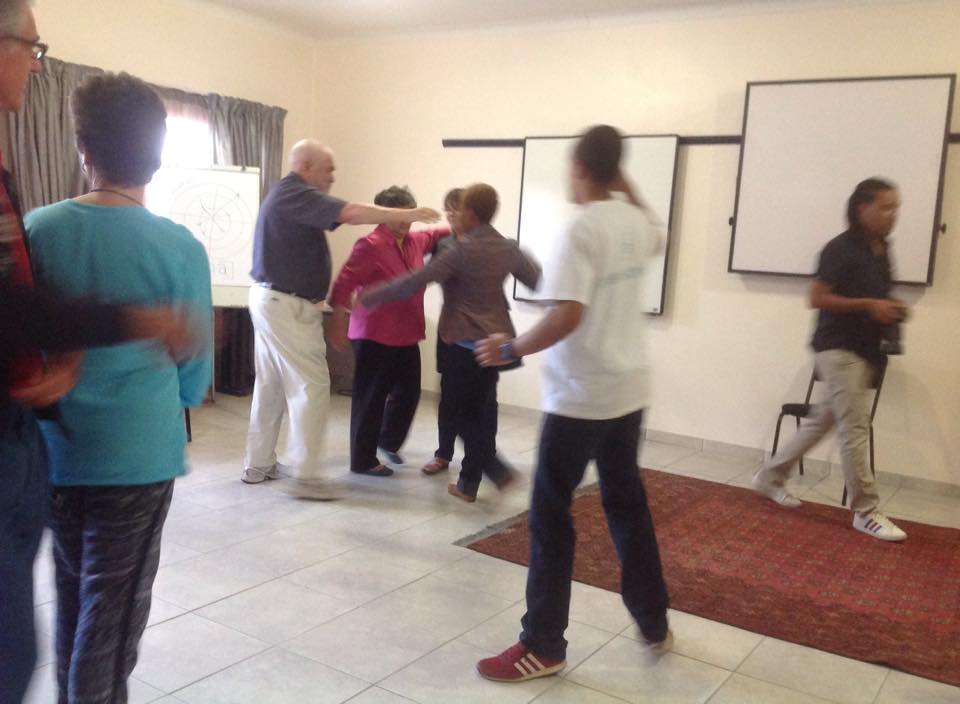
In most groups people are standing either with their backs to each other, but touching, or facing each other but standing separately, doing their work. Hamish instructs us to reverse everything we are doing and create the opposite image. He gives a countdown and everyone moves together. We find ourselves in an ideal opposite configuration. Most people are standing in circles hugging each other. In two of the groups three are turned towards one another hugging or reaching out while one person is turned out and doing something different from the group.

Everyone gasps or laughs. “Does this always happen?”

“Yes,” I say, “people always end up in circles holding hands or hugging. My instruction to Hamish was to make sure we do not end here.”

Hamish invites the two groups where all are turned in and hugging to explore this image. “Stay there for a while. How does it feel as time passes? Still comfortable? Without breaking the configuration, start moving across the floor. Now jump. Go get the photo copier and fetch the printing…

Everyone is laughing.Image 2 - Hugs

Moans and groans emit from the groups.

“Too much breathing into the centre.”

“I am worried about the garlic I had for supper.”

“Can i please just go back to being a silo.”

It is clear from the activity that no-one can get any work done in this configuration. They are increasingly uncomfortable and getting too hot.

We can understand why silo’s happen.

We acknowledge that there was no big stick beating people into silo’s. It happens because it works on some level.

This ideal image is often a respite from the original problem image, but not sustainable. By working with the image its unfeasibility as a long-term solution is recognised. As with the original silo image, is important that this image too is arrived at through spontaneous action and not planning.

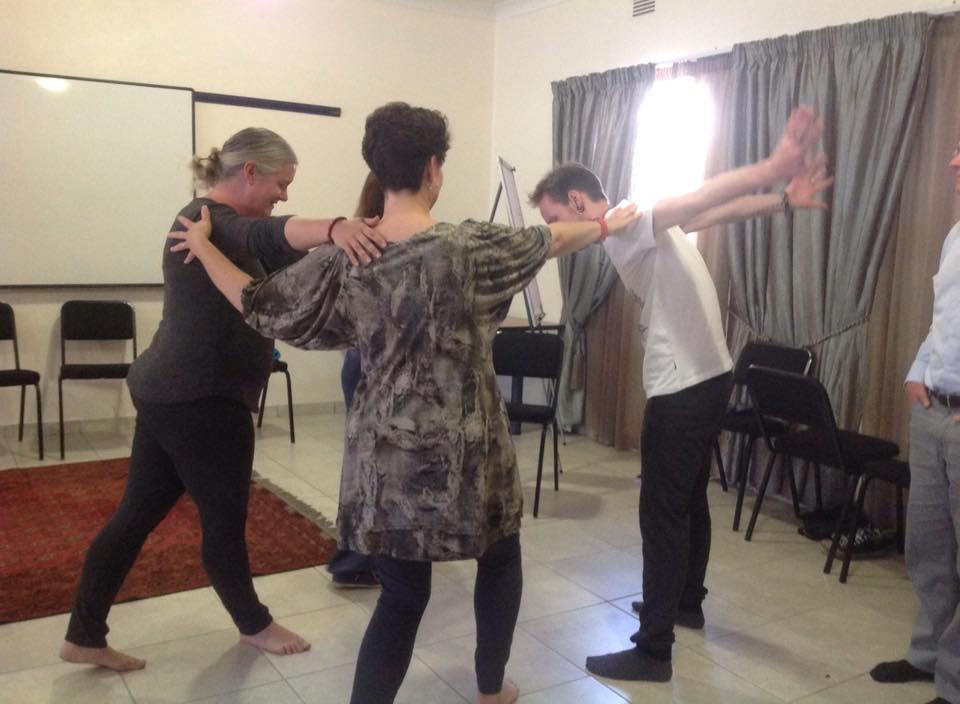
Now we are instructed to work together to discover what image goes in between the first two. What is the image of transition between, in this case silo’s and huggy-huggy. We are given some time to talk with each other and work this out. When we have our transitional image, each small group shows it to the large group one by one. Again on lookers say what they see before the group responds.

“Can we also explore what the next step could be after ‘huggy-huggy’, instead of exploring transitional images?” someone asks.

Hamish answers that this is not usually helpful because it does not take us into difficult places. It does not help us process. From the ideal embracing image, people might just go back to the silos because that is what they know. It is true that people want respite from the silo’s and the isolation, but they can’t sustain it, so they may just go back. It keeps us in dreamland where we can plan and desire and vision things that do not get real. We have to take them where it gets messy so that they can find something new, something that is not there, something that can bring shift.

“Is this about ‘thesis, antithesis and synthesis?” comes another question..

Hamish answers: “Be careful to try and neaten up the mess too quickly. It is not helpful to begin to judge and see some images as ‘better’ or ‘more synthesis” than others yet. Just stay in the direct response and action space without making sense of it yet. Stay in the bodies, don;t go into the head yet.

From the transitional images we learn that here there is the most aImage 3 - interconnectednessmount of eye contact, dybamic movement and interaction. There is more laughter, more frustration, more mess and more noise. There also seems to be a theme of disconnection and reconnection running through. Two of the images resemble dancing and the other two show lots of open arms but not so much touching.

We decide to pick up this exploration again next time we meet on 27 November. We want to go deeper into the transitional images and understand more about how they might inform our own transitional work.

Join us on 27 November for Moving people Part 2.

Time: 7 to 10 am

Venue: 305 Long Avenue, Ferndale, Johannesburg

Improving the quality and enjoument of work

Ahoy, business, not-for-profit, and organisational explorers, rebels and pirates! 

Welcome to the next Thrivable World Quest event!  On Wednesday, June 18 we explore the “Island” of Mastery.

We’ll be on a treasure hunt to discover:

  • What does mastery look like for you?
  • What enables people to do their work with mastery?
  • What does mastery look and feel like, and how does it evolve, in an organisation when that organisation is explicitly in service of life?

Berlin, Johannesburg, Manila, Milan, Montreal, and Tehran will lead the Quest.  Then, a few days later, Amsterdam and Cape Town will collaborate to verify our map and explore areas we missed.  Come play, explore, share and learn with us on our fourth Thrivable World Quest event.

Come play, explore, share and learn with us on our fourth Thrivable World Quest event.

What will you get from participating?

  • You’ll learn what thrivability is, what it takes, and how it can help your organisation to save the world.
  • You’ll gather and share stories about courageous pioneers who have made this shift in their organisations.
  • You’ll contribute to a world movement, a manifesto and a book.
  • You’ll experience practices, perspectives and ways of interacting that embody what we are exploring.
  • You’ll discover what all this means for you, your organisation/clients, and your world.
  • You’ll join a local and global tribe of smart, caring people interested in exploring these ideas.

The stories and insights we discover during the Quest are shared across the cities and around the world. Check out the treasure from our first three events blog. Then join us on June 18 to be part of this global initiative to transform organisations.

What is thrivability?
Thrivability is a growing global movement and an active leadership and organizational practice. The organizers of the Thrivable World Quest define ‘thrivability’ as the intention and practice of aligning organisations with what we know about how living systems thrive and people thrive.
For more about the Thrivable World Quest go to Thrivable World.

Session details:

Johannesburg

  • Date: Wednesday, 18 June 2014
  • Registration: 14h30
  • Time: 15h00-18h00
  • Venue: Worldsview Academy, Worldsview House, 150 Kelvin Drive, Woodmead, JHB

Cost: R250
RSVP: (Click) here to register online! For more information contact Petro.

Please forward this information on to your friends & colleagues who you feel may benefit from the SAODN activities! To join the SAODN mailing list, details need to please be sent to info@saodn.net.


Practical resistance: What’s the plan?

The tool, the path, the rules

Neo and his mentor

Every facilitator or speaker faces resistance. If you have done a good job of Painting a Picture of the Possibility , (Introduction), you can expect at least 5 types of resistance: personal, relational, practical, social and cosmic. Here we focus on the third kind: practical, also called contextual, resistance.

Apart from the personal and moral objections of that comes with the first kind of resistance and the doubts they may have about you as the mentor, the second kind, there is a very real practical resistance. How will I do what you ask? What are the steps \ the plan?  Can I see the path and see myself walking it?

Whatever your solution is: 3 steps to losing weight, 5 types of resistance and how to overcome them or , or 7 principles of effective leadership, your audience needs to know it will work for them.

Like Aslan in the Narnia series, Dumbledore for Harry Potter and Griet for Liewe Heksie, the guide in the hero’s story can cut to the chase and bring light to the befuddled mind of the main character. The magic weapon often comes in the form of three (wishes), five (stones) or seven (dwarfs).  Finally, the guide provides very specific instructions for its successful use: before the clock strikes 12, only when used by an innocent child or only if you use the right words like ‘Open Sesame’.

1. It cuts through darkness

The magic weapon is often a blade of some kind, like Arthur’s Excalibur, or a light, like Aladdin’s lamp. Sometimes it is even both like Skywalker’s light sabre.  The blade or light symbolises its power to break through darkness or cut through the woods of uncertainty

Your solution  must cut through what the audience experiences as darkness. Clean up the myths and misunderstandings around personal tax returns, what diet to follow, or how people deal with fear.  Give them a torch to guide them through the woods.

Your solution must therefore be  simple to understand and easy to remember and yet show that it really gets the audience’s context and obstacles.

2. The power of three, five and seven.

The numbers 3, 5 and 7 each have an internal logic helping your audience grasp and remember it. Stories have used these numbers over and over again.

Think of 3 little pigs, 3 bears, 3 wishes, 3 days in the belly of the whale, or in the grave, 3 time frames (past, present and future), 3 elements (substance, liquid and gas).  The number 3 has an internal logic because it sets up a pattern. Often the first two are the similar and the third is special, a punch line. The older pigs make mistakes, but the third gets it right. Because of the power of 3, 9 also gains  popularity: 3 main ideas with 3 sub ideas under each. The logic of 3 is so deeply ingrained in our consciousness that speakers, writers, trainers and facilitators use it often. An example is Daniel Pink’s book ‘To Sell is Human’ cleanly designed with three parts, three chapters in each.

Likewise 7 has made its mark: 7 dwarfs, 7 brides for 7 brothers, 7 days of creation and 7 days of the week and 7 holy sacraments. Speakers and writers  employ 7often:  Covey’s 7 Habits or Bruce  Wilkenson’s 7 Laws of a Learner. However, seven similar points can be difficult to remember while five is easier. So 7 items are often broken into 2 of one kind and 5 of another: 5 working days and 2 weekend days or 5 loaves and 2 fishes.

This is also how 5 gets its significance, although it hardly ever features by itself in stories and myths. . Remembering the 5 is made easier by the practicality of having 5 fingers on one hand. Many writers and speakers find acronyms with 5 letters to strengthen the internal logic of their ‘weapon’ or model:  David Rock’s SCARF model, or the SMART goal model or 5 types of resistance and to break through.

3. Rules for correct usage

To ensure that the hero is successful in the use of the secret weapon, the mentor provides specific rules for its correct application. But if practicality was the only reason for specific rules, why make it so difficult: Get out of the Ball by the stroke of midnight… Why not let the magic go on forever? By restricting the use of the weapon, you also restrict the number of people who are able to be successful, making your audience become part of a selected, special group. This makes your model so much more desirable and your audience feel so much more like chosen ones (see the post on Personal Resistance).

While your solution is simple, it is not necessarily easy to apply. It will take skill – but if your audience ‘buys’ it, they will then be open to further training in its use creating longer term clients for you.

Now, think of Neo in ‘The Matrix’.  Remember how you as audience member discover that there is a chosen one who has a special gift and a destiny. Together with Neo you discover that he is the One, but you know it before he does and so the tension builds as you watch him get closer and closer to the discovery.  Then there is that moment when it all dawns on him and his entire life up to that point finally begins to make sense…   He is the chosen one, the one who fulfils the conditions of the prophesy, the one who can manipulate the matrix in a way no-one else can.

Imagine you can recreate that moment for your audience, where, suddenly, in the light of your insights or your model their whole experience around a certain subject suddenly makes sense.  If your conditions for use are such that your audience turns out to be exactly the right kind of people in the right kind of context to use it, you will ensure that their resistance on this level crumbles.

There are only one more types of resistance to address: the one you need to face when you hae stacked up all your tricks, did everything you could and then something so left field hits that you stagger and fall flat on your face: cosmic resistance…

Dr. Petro Janse van Vuuren
Organisations as Thriving Living Systems

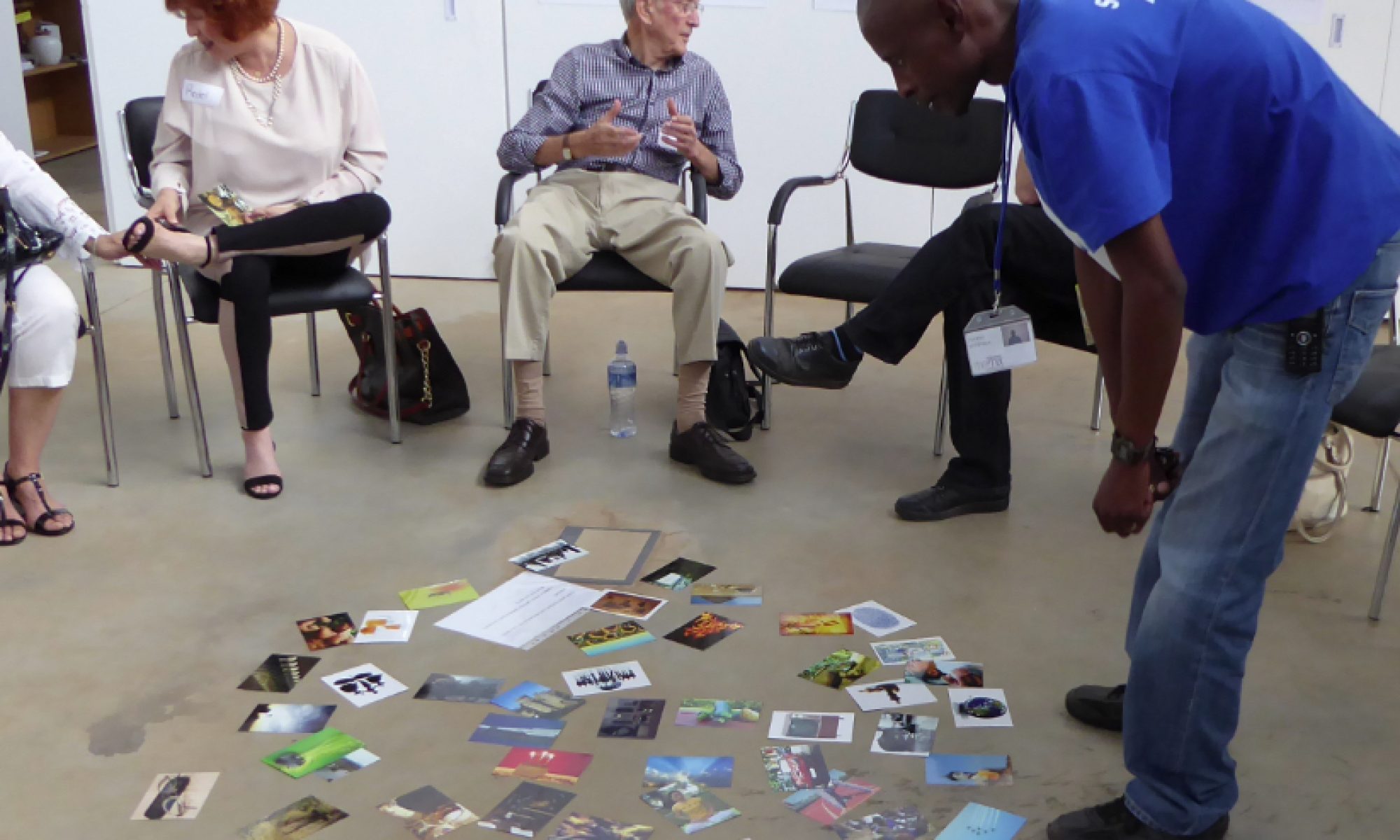
Thrivable world Quest image

Ahoy, business, not-for-profit, and organisational explorers, rebels and pirates! 

Welcome to the next Thrivable World Quest event!  On Wednesday, June 18 we explore the “Island” of Mastery.

We’ll be on a treasure hunt to discover:

  • What does mastery look like for you?
  • What enables people to do their work with mastery?
  • What does mastery look and feel like, and how does it evolve, in an organisation when that organisation is explicitly in service of life?

Berlin, Johannesburg, Manila, Milan, Montreal, and Tehran will lead the Quest.  Then, a few days later, Amsterdam and Cape Town will collaborate to verify our map and explore areas we missed.  Come play, explore, share and learn with us on our fourth Thrivable World Quest event.

Come play, explore, share and learn with us on our fourth Thrivable World Quest event.

What will you get from participating?

  • You’ll learn what thrivability is, what it takes, and how it can help your organisation to save the world.
  • You’ll gather and share stories about courageous pioneers who have made this shift in their organisations.
  • You’ll contribute to a world movement, a manifesto and a book.
  • You’ll experience practices, perspectives and ways of interacting that embody what we are exploring.
  • You’ll discover what all this means for you, your organisation/clients, and your world.
  • You’ll join a local and global tribe of smart, caring people interested in exploring these ideas.

The stories and insights we discover during the Quest are shared across the cities and around the world. Check out the treasure from our first three events blog. Then join us on June 18 to be part of this global initiative to transform organisations.

What is thrivability?
Thrivability is a growing global movement and an active leadership and organizational practice. The organizers of the Thrivable World Quest define ‘thrivability’ as the intention and practice of aligning organisations with what we know about how living systems thrive and people thrive.

For more about the Thrivable World Quest go to http://www.thrivableworld.org/

Session details:

Johannesburg

Date:    Wednesday,  18 June
Registration:
14h30
Time: 15:00 – 18:00
Venue: Worldsview Academy, Worldsview House, 150 Kelvin Drive, Woodmead, JHB

Cost:  R250.00
CLICK HERE TO REGISTER

 For more information contact Petro on 0828282259 or, Petro@playingmantis.net .